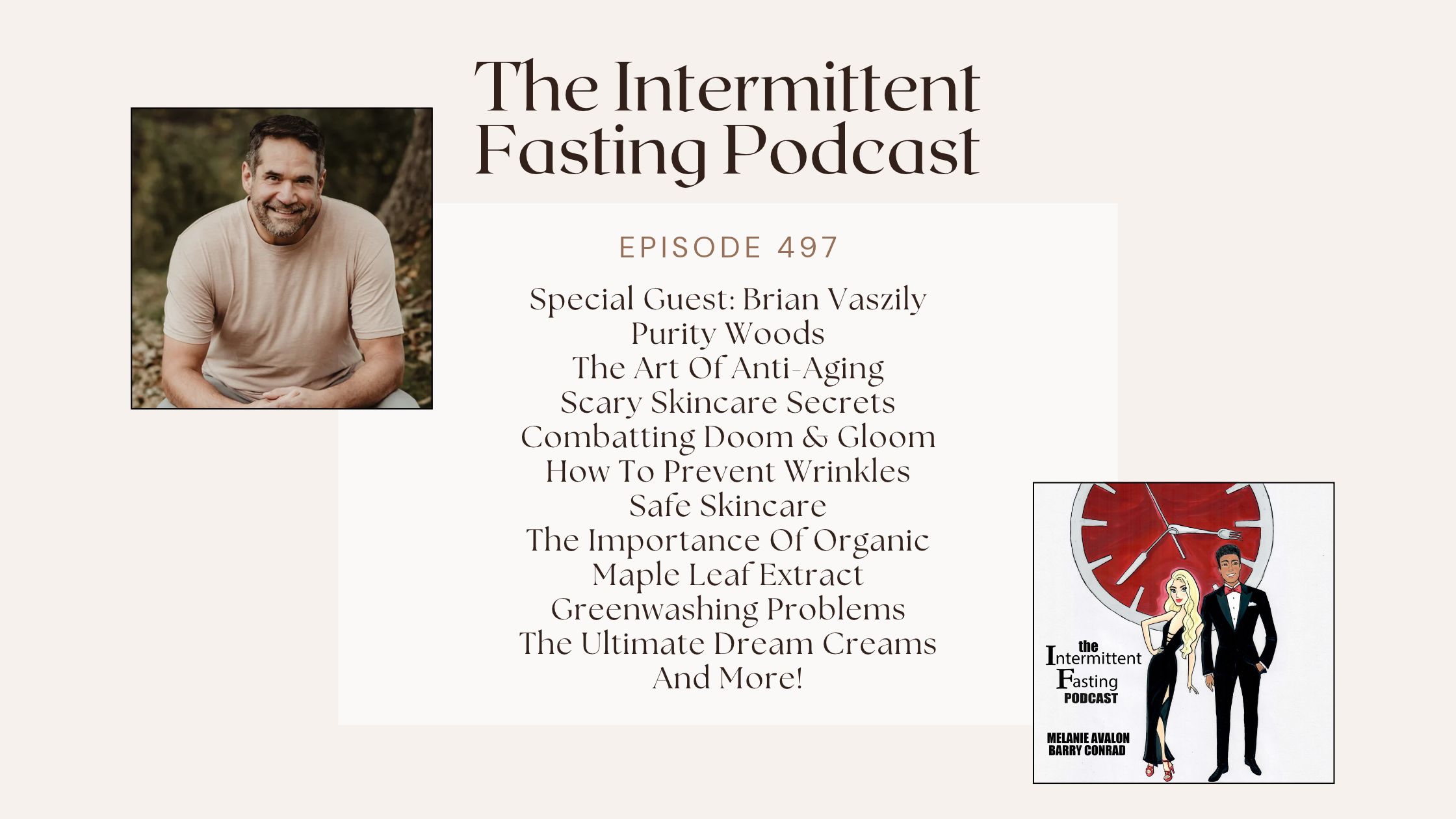
Welcome to Special Guest Episode 497 of The Intermittent Fasting Podcast, hosted by Melanie Avalon, biohacker, founder of AvalonX, and author of What When Wine Diet: Lose Weight And Feel Great With Paleo-Style Meals, Intermittent Fasting, And Wine, and Barry Conrad, actor, singer-songwriter, and creator and host of Banter with BC.
SHOW NOTES
Brian Vaszily [rhymes with PAISLEY] is one of today’s most renowned and respected natural health and longevity researchers, advocates, and leaders. For over 20 years, he’s helped guide millions of people to research-based healthy aging solutions, and he’s worked with and helped guide many of today’s other most prominent natural-health-oriented doctors and researchers. He’s the founder of the popular health destination, TheArtofAntiAging.com, with over 500,000+ members. The Art of Anti-Aging's mission is to empower those in middle-age and their “golden years” with the most effective evidence-based natural solutions to look and feel their best, avoid and overcome disease, and live long. Brian has created and hosted multiple highly acclaimed online health and longevity summits that feature today’s top natural-health-oriented MDs and researchers and that have been heard by over two million people. Brian is also founder of PurityWoods.com, a fast-growing provider of premier-quality USDA Certified Organic skincare products including their much-raved-about organic Age-Defying Dream Cream, which even world-renowned M.D. Dr. Joel Fuhrman said “restores the appearance of youth to your skin like nothing else out there.”
Socials:
SPONSORS & DISCOUNTS
PELUVA:
Peluva is a five-toe, zero-drop minimalist shoe designed to help your feet move naturally while providing enough cushioning for everyday wear, fitness, and athletic activities. Unlike traditional wide-toe-box shoes, Peluva gives each toe its own space for a more authentic barefoot experience.
Get 10% off with code IFPODCAST at peluva.com!
If you enjoyed this episode, please consider leaving us a review in Apple Podcasts!
Original theme composed by Leland Cox, and recomposed by Steve Saunders.
Our content does not constitute an attempt to practice medicine and does not establish a doctor-patient relationship. Please consult a qualified healthcare provider for medical advice and answers to personal health questions.
TRANSCRIPT
(Note: This is generated by AI with 98% accuracy. However, any errors may cause unintended changes in meaning.)
Melanie Avalon
Welcome to episode 497 of the Intermittent Fasting Podcast. If you want to burn fat, gain energy, and enhance your health by changing when you eat, not what you eat, with no calorie counting, then this show is for you. I'm Melanie Avalon, biohacker, founder of AvalonX, and author of What When Wine: Lose Weight and Feel Great with Paleo-Style Meals, Intermittent Fasting, and Wine. And I'm joined by my co-host, Barry Conrad, actor, singer-songwriter, and creator and host of Banter with BC. For more on us, check out melanieavalon.com and barryconradofficial.com. You can submit questions for the show by emailing questions@ifpodcast.com or by going to ifpodcast.com. We would love to hear from you.
Please remember, the thoughts and opinions on this show do not constitute medical advice or treatment. So, pour yourself a mug of black coffee, a cup of tea, or even a glass of wine, if it's that time, and get ready for the Intermittent Fasting Podcast. Hi, everybody, and welcome. This is episode number 497 of the Intermittent Fasting Podcast. I'm Melanie Avalon, and I am here today with a very, very special guest. Really excited about this interview. So this guest has actually been on my other show, the Melanie Avalon Biohacking Podcast, and I knew we definitely had to have him back on the Intermittent Fasting Podcast because it is about a topic that I have talked about historically a ton on this show and continue to talk about, which is primarily the role of safe skincare, effective skincare, and what skincare is actually doing to your body. Because, like we talk about on this show, with fasting, we focus a lot on cleaning up what we put in our bodies, especially with, with food, and yet what we put on our bodies can have massive effects as well. And you guys know I wax poetic about this all the time, but there's endocrine disruptors in many conventional skincare products that can even be obesogens. So could those be affecting your weight loss goals and efforts? I don't know. We can talk about that. And so when it comes to safe skincare, there are a few brands out there that I really, really love, and one of them is Purity Woods. And oh my goodness, friends, so I remember when I first ... I guess the way I met Brian was through Purity Woods, and when I first met them, I was actually hesitant to try a new skincare brand because I had found some that I really liked, and I was like, "Well, you know, I don't ..." I didn't wanna add anything new to my routine. Oh my goodness, I have not looked back ever since trying the products. So we'll talk about ... We'll talk about why they're so amazing. But I personally use the Day Cream, the Night Dream Cream, and they have a serum that is absolutely divine, their Hyper Lift Serum. So, um, I use those when I say literally every single day of my life and haven't stopped since being introduced a couple years ago. That is the truth.
Melanie Avalon
When I had Brian on the Melanie Avalon Biohacking Podcast, I was blown away by his knowledge when it comes to not only formulating these products, but the mission behind it, his understanding of what the effects of these products have on our bodies, on our aging, on our health, all the things. So I'm, I'm real excited for us to catch up and, and talk about what all is new and also introduce some of this to you guys. So Brian, thank you so much for all that you do, and thank you so much for being here.
Brian Vaszily
Melanie, I'm ... You can't see it, but I'm blushing after that wonderful, wonderful testimonial for our products. On the other hand, honestly, it, it ... I'm, I'm not surprised.
Again, I'm the one saying this, right? But, uh, we put a lot of, uh, research and also love into making sure these things work. And I'll tell you, you know, when I have seen you, you have amazing skin. Do we take all the credit for that? No, but I'm glad we have a, a piece of that, so appreciate the, uh, the love you shared for it.
Melanie Avalon
It's so funny, like, because it's, it is so true. I literally remember the first time I tried the products, and it really was what I just said.
I, I was very hesitant 'cause I was like, "I don't, I don't wanna try another skincare brand." It, it was just so, so amazing, like the way it made my skin feel, the way it smells. I know we talked last time about, um, you have this really powerful maple extract that I had never come across before and then, like, reading about the benefits of that. Either way, it was ... I haven't stopped. And, and, and not to get into the specifics, but I really don't like products that have, like, residue and stuff and, like, leave that on your face. And these products just leave your face, like, glowing and shining. And, and now I'm wondering how much of that has to do with unnecessary additives in other products. I haven't thought about that before. I don't know if you have thoughts about that.
Brian Vaszily
Sure. Quite a bit.
I mean, that's part of the process, residue. And the, and the thing about residue, I mean, you know, the residue of these potentially toxic and, uh, well-established toxic ingredients that are allowed in these products is that, um, they're, they're not really just residue. Many of them p- penetrate, and that's probably the key point to start off here, right? I don't know what direction you wanna take this in exactly, but I like to remind people that, you know, anything that's going on your skin in a, in a product, especially if it's a product meant to perform in some way, have some type of anti-aging effect, moisturize, anything like that, the whole point is it needs to penetrate. In other words, you're eating it. And so there's no such thing as on the skin. It's into your body. In other words, it's ... You know, people need to treat it the same way they treat food that they're putting into their mouth. They need to think about it that way.
Melanie Avalon
I really ... Like this is my first time thinking about the, the residue aspect of it. So going back a little bit, so your, your personal story, what led you to doing all of this?
When did you ... Like, especially because, I don't know if we talked about this on the other show, but I feel like with skincare ... Not to be, like, stereotypical, but I feel like women tend to be the ones that, that get into it more at an earlier age and everything. So I'm, I'm wondering with you, at what point did you become interested in your own skincare? Or, or did it come out of, like, a health journey? Like, just what, what led to, what led to having Purity Woods?
Brian Vaszily
Yeah, it's a great question, and if you asked me f- s- 17 years ago, uh, "Hey, are you gonna launch a, you know, certified organic skincare company?" I would be like, "What are you talking about?" Sort of. Now, what do I mean by that? Well, the first half of my life, and you can pretty much cut it in half at this point, was pretty rough. My dad, good man until around the age of, my age of nine, then he became severely alcoholic and rather abusive to us. And, you know, so I went through a lot with that. Uh, I grew up inner city, uh, simultaneous to this insi- in inner-city Chicago in a rather rough neighborhood, lost friends to gangs. So, so it was a rough earlier start to life. And what kept me going, and actually what literally in some cases saved my life, was powerful women. So I'm talking a wonderful angel of a mom who endured so much. Um, I'm talking a great sister, but I'm also talking certain teachers who were all female, um, certain friends who were female. They really held me up and, and, and I'm here, sitting here, not just alive, but thriving today, and they're a big part of the reason why.
So fast-forward, and I'm cutting a lot of the story out here. I could always go back and fill in a lot of blanks if you so choose. But part of the hardship was that I myself became, uh, you know, a father and a husband at a very young age, very poor. To our credit, my wife at the time and I, we did go to school, college full-time while working full-time as well. And then when I got out of school, I had to get a job. It was, like, mandatory. I went in for English, and communications was, was my area with some, you know, business behind it. First job I had was... Well, that's not true. The second job. The first job was brief. The second job I had in order to put food on the table, you know, for a young child and family, was, uh, inside the pharmaceutical industry. So I saw a lot, y- you know, in- inside of this industry, and, uh, so much, you know, of what, what people have issues with regarding the pharma industry is true. So I've seen it from the inside. I could tell stories, uh, you know, again, maybe for another time, unless I piqued your interest enough here. But, uh, I did manage to... I felt very yucky. Okay, I don't know. No other word comes to mind about working in that industry, honestly, you know, from what was going on inside. I found my way out. So because my own father, you know, he finally did, to his credit, quit the alcohol. I was already a older teenager when he finally did quit the alcohol, but then he spent years dying, basically, in and out of hospitals for, uh, a decade before he finally passed away. And so I saw the medical system from the side, uh, that a lot of people who have experienced it know what I'm talking about, how inept and, uh, unkind it can really be. So put all that together, and then I finally found my way into the world of more so integrative and natural health. And we're talking already over twenty-five years ago now. I became deeply immersed in this world and have been since that time.
Brian Vaszily
So flash forward, I've helped a lot of other organizations, a lot of other names and brands that people probably are well aware of, a lot of well-known MDs and researchers out there who are, you know, pretty famous behind the scenes for a long time, helped them. Then back in around 2018, I think, 2019, uh, well, actually it was 2017, I was at a crossroads, and I could have taken a lot of dif- different directions. But here's what I noticed, Melanie. These same very powerful women who had earlier in my life helped me and in some cases probably saved me, even they were, I can't avoid the word, prey to this pervasive message in our society. Because they were hitting, my mom in her case, her 70s, my sister in her case at that time, her 40s, my wife, her 40s, uh, other friends in their f- uh, were hitting their 50s. And I watched all of these even very powerful women become prey to this really strong message in our society which equates getting older with doom. And I'm like, "Wow, wait a minute." Um, you know, the 40s, the joke, right? The 40s are over the hill. Ha ha. But the point is that there, there's a lot of belief in that in society, and it's perpetuated through the media and so much more, and it really impacts... And it hits men too, don't get me wrong, but it really hits women hard. So I saw these powerful women negatively impacted by this messaging.
Forties, 50s, 60s, 70s, a time of decline, a time of... And I'm like, "That is not true at all." By then I'd already been in, inside working closely with health experts, world-renowned health experts, becoming a research geek, and all the research pointed the opposite way. If we just take some steps, these years, 40s, 50s, 60s, 70s, even beyond, ought to be the best years of life, even in a, in a physical regard, certainly in emotional and mental regard. So it's the reverse of what this myth was. And I said, "I know exactly, in honor of these women who helped me, who saved me, I know exactly what I'm going to do." And I launched The Art of Anti-Aging. It's an, uh, information company where we present evidence-based steps that help you live long and live well, basically, to really sum it up. And it's called The Art of Anti-Aging, not because, of course, we're against aging. We're against these negative messages of aging. So it really started there and started having these big event summits, you know, as you may know. You know, inviting a lot of well-known doctors and researchers in and putting good messages out to people. You know, putting great information out there, and we developed a fo- today there's, you know, we, uh, I send email every day to about half a million people. I'm just honored to be able to do that, and it's just because I've just stuck to this m- mission, which was like, I just wanna let people know there's a lot you can do, and these should be the best years of your life. So how Purity Woods? Well, I'm a research geek. Like I said, I go deep into the, the white papers and all the academic research that, you know, so many people would not enjoy, but I do. I like it.
Brian Vaszily
I-- it's, that, that one's a little more of a selfish thing. I, I looked in the mirror one day, and there were crow's feet around my, my eyes. I'm like, "Aha." And then my wife, who now she's a stay-at-home mom with our kids at home, but, uh, she was a cosmetologist who had a natural bent to her as well, and she also almost simultaneously noticed these crow's feet. So we're both in the same spot, and like, I know exactly what I'm looking for. I want something with XYZ ingredients. We can talk about what those ingredients are. And it must be organic because I already knew back then, now we're talking, you know, a decade ago or so, I knew back then how terrible These products were that have these typical ingredients in them.
So I went looking, and here's the short story. Couldn't find it. Could not find-- In United States, I could not find this at all. So really long story short, went to... Y- found some formulators in, in Canada, created the product. It worked like gangbusters for me and for my wife, and so I'm like, "Well, now I know exactly what I need to do. I need to put this out there to the world," and that's Purity Woods. That product became the Age Defying Dream Cream, and it's still the best seller in our lineup. It's still our flagship product. We have other great products, but yeah, it all started with that one. So that's, that's the story.
Melanie Avalon
Oh my goodness. Okay. So, so many thoughts here. So you are, you are speaking my language because the aging piece, the reason I am doing what I'm doing in part is because I have been haunted by this fear of aging for so long, and it goes back to what you were saying, like the, uh, the sense of doom and gloom that is ascribed to a- not only aging, but in particular women. It feels like there's this ticking time clock, and Bryan, I need help here 'cause I still, I still struggle with it.
It's so interesting because from like a lifespan perspective, like we have the grandmother hypothesis, and we, we know women tend to live longer than men. Evolutionarily, that's supported, and yet there seems to always be this idea, and I even harbor it all the time, which is like, well, men get better with age and women don't. Like, it's like, it's like the opposite. And I, I often like just think about like why that is. Is it just that we perceive beauty different in men versus women? Is it something actually physical? Do, do women actually age perceptually on the outside faster than men? Does it have to do with the skincare products maybe that women are using? What do you think is going on there, the aging differences?
Brian Vaszily
Yeah. There's a... Well, first of all, I'm gonna break that one down because there's, there's several different, uh... Just like you when, when I had my response, I wanna go in so many directions at one time. Skincare products, the products we put on our faces, the things that we're putting on our bodies in general, even beyond, uh, cosmetics into personal care products as well, are actually a significant reason people look significantly older than they should. So I'm gonna take a tangent, and then I'm gonna come back to your main question there. But there, there's, you know, there's still two-- there's basically these two camps out there, right? Three camps. There's one camp that doesn't care. The other two camps are age gracefully, let it go, don't touch it, you know, accept it and, and it's, and it's wrong to care, you know, uh, about excessive wrinkles and fine lines. And then, then there's the other camp at the other extreme who's trying really hard if they're, I don't know, 45, to try to look like they're 25. That's unhealthy.
But the reality is that a lot of people who are feeling, you know, upset about age, about fine lines and wrinkles and such, feel also a sense of guilt because they're told by some parties or some avenues, "You shouldn't care so much about that." But guess what? Yes, you should. Up to a point, you should because mo-- I, I'm gonna say this. I'm just gonna be blunt. Most people, especially women, because they use the most, you know, cosmetics and personal care, look older than they ought to look, and it is because of these things being loaded in large part with so many toxins. Point being is you shouldn't feel guilty about that because the truth is your body has multiple organs. They all, if you could see them, the rest of them, they all s- uh, show signs of advanced or premature aging if you are indeed premature aging. You only happen to see one of those organs, and it's showing you signs of premature aging today in many cases. If we all took even half the steps that we, we hear so often out there, um, including potentially if you hear about, you know, toxins in skincare, that's one of them, and if we ate a healthier diet, if we did do, you know, intermittent fasting to, to point to that one. If we did sleep better as we ought to, if we all exercise somewhat more, we would look better. We would look better. We would look as we ought to look g- at our age. So most people do look older than they ought to look because we didn't do so many of these, uh, you know, habits that we know we ought to be doing. We didn't do them earlier in life. The good news, okay, is that the skin is one of the most receptive organs to change, meaning it, it, it responds quickly. You know, you see differences when you start taking even some smaller or what seems like smaller steps to improve the situation. The skin responds quickly, and all of a sudden you start saying, "Yeah, I knew it. I knew I should glow more.
Brian Vaszily
I knew I shouldn't have that many wrinkles." And, and it's, it's a beautiful thing, and one of those things is feeding your skin the right things, and another one is feeding your body the right, you know, um, foods and not the wrong ones. That's the tangent I went on.
T- the other question's a big question. It's much of a social thing. We get into feminism. We get into so much if you're asking me about why women are hit harder with the messaging that age equals doom. But I will tell you it's untrue. I'll start there because again, I, uh, this is what I've devoted my, my life to addressing and, and demonstrating. Women in their 50s and 60s who are taking healthy care of themselves are absolutely beautiful, and that's not me personally stating that only. When they take proper care of themselves at that age, even older, right, they glow. You know, it's not like they o- they should not be trying to look like they're 21. That's a sickness, okay? But when we take even somewhat effective care of ourselves, we glow. It's beautiful. It attac- you know, if we're talking, you know, uh, traditional gender roles, right, it, it, it does attract men. So it's just a nonsense myth that's been thrown off where we've idolized the age of 21. I'm kind of, you know, give or take like five years in an either direction, right? And if an alien came down, I always put it this way, if an alien came down and just watched our media, they would assume that like 80 to 90% of the female population was in their age range of like 17 to 26 or something, right? Just because that's where the media's, you know, put its focus. And of course, we're, we're, we're creatures of the media, and so it's penetrated into our brains that that's the model and anything beyond that is, is, you know, outside of the realm of what's, uh, norm and, and beautiful, but that's just a bunch of nonsense, you know? So yeah, I can go on with this, but, uh, that's, that's the first part of the answer to your question.
Melanie Avalon
Oh my goodness. I, I love all of it so much.
Yeah, I, I think about it a lot, especially because like you mentioned, there's this weird guilt around it as well where we like feel like we, we don't wanna be aging, but then we feel guilty if we're trying to do things to address wrinkles or, you know, whatever it may be. So I, I, I could like, I could just talk forever about like like what is happening there. Like why do we judge one thing and, and not another? So okay, this is so interesting and, and it's actually really interesting about the, um, what you were saying about if you could see your organs on the inside aging. And I'm trying to remember h- I don't know if you've done the, um... I think, I think it's through TrueAge, but they have, um, one of their age tests, it might be the... It's either the one at like Duke or Harvard. It, it actually shows you the age of all of your different organs. Have you done that one before?
Brian Vaszily
I haven't done that one, but I do know what you're talking about, yeah.
Melanie Avalon
Yeah, it's interesting. I'm trying to remember if it... I don't think it has your skin though.
As... I wish it did. It's like everything else is internal, but I think people completely forget that your skin is an organ as well.
Brian Vaszily
Right. That's why I started this whole conversation because yeah, I mean, there's, there's two images I wanna put in people's heads if they retain nothing else from this conversation. That is one of them. Imagine, you know, when we, when we dive into talking about, you know, applying with, with abandon just because we're told it's gonna, you know, these products are gonna do something for us, they're gonna make our wrinkles disappear. Imagine... And then you take this, this product sitting on a shelf, it just says that. We squeeze it, rub it on. You are putting it on an organ. So I always like to say that's an organ, and imagine if you had access to your brain, another organ, or your heart, or your lungs or any other organ in your body, would you just do that? "Hey, here's a, here, squeeze this, put it on your hand and rub it all over your heart. I promise you it's gonna make your heart, you know, uh, healthier." I mean, you'd be like, "Whoa, whoa, whoa, wait a minute." You know? Put it on your brain. It's strange how we have forgotten that our, our skin is an organ, and it's a clearly an essential organ. It holds us together, first of all. Second of all, it's like the front line to our immune system, and without it, you know... And when w- well, without it, we don't exist, but if we compromise that, if we make it struggle, which is what we're doing when we put all these chemicals on, we're, we're like making it, uh, w- work twice as hard, and it doesn't have the capacity to necessarily do that because we are feeding it so many things that it has to defend against.
So it's less able to defend against things it was supposed to defend against, the pathogens all around us and, you know, so on and so forth. The other image I want people to remember is that when you're pushing your grocery cart down that cosmetic aisle, down those personal care products aisle, that's food aisle. Just never forget that. If you remember nothing else, remember that. Treat it the same way you treat the rest of the aisles in that store that have food in them because it is food. And again, we could dive deeper there, and I kind of already have. But, uh, yeah, those are two things I really want people to remember. Your skin is an organ. Treat it as such, and when you're pushing that cart down the cosmetics aisle, it's food.
Melanie Avalon
And speaking of, so like all of the conventional products that people are buying, and, and I get flashbacks all the time, like whenever... and it's rare that I go into like those aisles, but when, but like when I go into like, or like a CVS or something and then I see all the m- like all of the skincare I used to buy when I was younger, I'm like, "What was I thinking?" And yet to that point, those brands are doing r- real well.
So do they work in the short term? Like how are they even... How, how are we thinking that they're working?
Brian Vaszily
Yeah, McDonald's is doing really well. Uh, Taco Bell is doing really well, and it's the same thing. What I mean by that is that if, you know, the, they've cr- well, they've cr- they've mastered, in this case of the fast food I just mentioned, they've mastered your taste buds. So when you go, if you have a craving and you're a person who does go to McDonald's or does go to Taco Bell, you put the Big Mac in your mouth or you, you know, put the whatever the thing is, that Taco Bell burrito, in your mouth, it tastes, it could taste good to many people in the moment. It's got the right mouth feel. It's got the right consistency. It's got the salt and in many cases the sugar balance and all those things. It's been mastered that way.
So it works in the moment to satisfy that craving and create more of that craving, by the way. But what does it do for you even a few hours later? You can feel it. It's not good for you. What does it do for you, you know, um, when it starts to become a cumulative habit? It destroys your health and wellbeing, right? It's no different with these products. These cosmetics and personal care products are fast food, the ones, typical ones that you see on many of these, uh, these shelves. Now, I do go in those sections because the good guys, you know, and some of them are Purity Woods competition. That's okay as long as, uh, you know, there's, there's good guys out there doing good stuff, trying to make the conscious true, not greenwash, but genuine products that will help you. So those are starting to find their way on those shelves too, thank goodness. But just throwing this out there. This, this one's not scientific, but 95% of the products on those shelves you don't want. They're fast food.
They have ingredients that are synthetic and many of them, again, potential toxins. That's me being careful, but I'll just say toxins. A lot of them are well-known toxins. A lot of them are considered toxins, proven toxins in other countries throughout the world and are banned, but they're used here. So why are they in there? Well, they're Cheap for the company. They're highly profitable. They're not putting that stuff in there for you. They're putting it in there for them. It's very, very cheap and inexpensive. Do they have an effect on you? Let's talk anti-aging creams, for example. Sure they do. Yes, short term, just like the Big Mac, right? So you put it on your skin, and yeah, it'll... It may seem smoother a few hours or overnight or two days later, but you're paying a hefty price in the same way you pay a hefty price for that Big Mac because of what these things can do to your endocrine system, as you started this conversation noting, meaning your hormones, basically. Talk about inter- intermittent fasting, the, the, the benefits, the reason that we do intermittent fasting, right? Well, everyone, you know, many people wanted the weight loss and the fat loss and s- insulin sensitivity, um, your heart health, uh, your brain function. So many, so many of these ingredients work directly against those things.
Brian Vaszily
They are, you know, potential or known harmful to the brain, harmful to the heart, harmful, as I mentioned, the endocrine system, which essentially is, you know, your hormone system. They are obesogens, meaning they can contribute to, uh, to retaining or, uh, weight and/or preventing weight loss a- and on and on and on I can go.
So again, they're in there for their benefit, absolutely not your benefit, those ingredients.
Melanie Avalon
It's really mind-blowing, especially the fact, like you mentioned, that they've banned, you know, over a thousand of these compounds in Europe, and here last I checked, it was like 11 have been banned here.
Brian Vaszily
Yeah. Well, it's 1,600 now. About 1,600 banned in the European Union, and elsewhere, I must note. But still, 11, just 11 ingredients, you know, that are, that are banned here. That's insane, and that, that alone should speak volumes to people.
You know, what's going on here? When we talk about the size of the beauty care industry, you know, it... People cite the billions, but you know what it is? It's actually in the trillions because nobody's counting these chemical companies. They're the real power behind it, and, and they make an immense amount of money because to... There's about 10,000 different chemicals now that in, in very, you know, small amounts to, to high frequencies are used in cosmetics and personal care products. That alone, again, it's immense. They h- hold immense power. Honestly, I'm just trying to be realistic. I don't see that changing anytime soon, except for the fact that the market is, is maybe to messaging that you're putting out there and I'm putting out there to some extent, starting to shift and make their decisions with their dollars, meaning forcing these companies, uh, slowly, and they're stubborn, and they play games, and they greenwash, and they trick people, but they're pushing the market. Other than that, they're not gonna change on their own. I mean, obviously, you know, it's extremely profitable, including for the chemical companies.
Melanie Avalon
I was gonna say, 'cause you mentioned the word greenwash, I was like that... I ha- 'cause when you were saying the, you know, the change and, like, s- working with our dollars, and I just got hit with this image where it's like, yes, and it goes... There's, like, this greenwash moment that seems to happen on the way where, like, the brands start making it seem like everything is all hunky-dory, when really it's, like, not. They just f-
Brian Vaszily
That's the worst, actually.
Melanie Avalon
I know. I was like, I was like, I don't know if that's ba- like worse. I... Maybe.
Brian Vaszily
It is worse because people think they're making the right choice. You know? So when it... So everyone's aware of what we're talking about here, so Purity Woods is certified, USDA-certified organic. Now, you know, I, I head this organization, and I can tell you that ain't easy, folks. It's a, it's a pain, uh, because we have to d- demonstrate to this independent body that truly there are no synthetic chemicals in it. Not only that, but that the natural ingredients used were raised organically, grown organically, so no pesticides, herbicides, you know, chemical fertilizers. It's, it's, it's work. It's work. So we do it the right way, and again, we... There... Thank goodness we have a little bit of competition out there directly in the, you know, in this anti-aging skincare space. Thank goodness that there's others trying to do the right thing who are in related areas, you know, other kind of personal care like deodorants and stuff like that. Thank goodness for that, and please consider giving them, if not us, your business on this front because it makes a massive difference.
But the greenwashers, instead of just being honest and saying, "Yeah, you know, we got a ton of chemicals. Leave it at that. You know, make your choice," they're tricking people. That's all they're doing, and they're saying things on their label because they can like, "Organic." They screen that on a label, and everyone's like, "Yeah, I'm told that that's a good thing. You know, Brian said..." You know? I'm like, "No, no, no, no, no. It's not certified. It's not independently verified." They can say... They can scream organic in big letters because if they have a single organic ingredient in that formula, they're not technically lying. But then if you turn it around and look, you're like, "Well, yeah, you know, it has one organic. The cocoa butter's organic, but what in the world's all these other chemicals?" They can do that, and they just tricked many people by doing that. They can say things, you know, that, that still catch a lot of... All, you know, all natural, but it still could be, like, all natural that was grown with an immense amount of pesticides. I mean, so you've got to, you've got to watch. Nothing's perfect, and I'll say that. But, you know, certified organic, uh, in the United States is one of the strict-est that you wanna look for. If you're elsewhere in the world, uh, Ecocert, uh, in Europe and elsewhere. So you wanna look for these independent certifications so you're sure you're not getting tricked, basically.
Melanie Avalon
Yeah. To that point, I, I feel like it's, it's even... 'Cause there's some other brands I, like, use and have used that are not certified organic, and so when that happens, you really have to take the due diligence to trust the company basically with, with what they're saying. To that point, I actually wanted to ask you about the, the organic certification because we were talking before this about my Glow Coffee, and that's an example where... So those beans, like the farm they come from is completely organic and regenerative, and we've also third-party tested for toxins, and we're trying to get the certification right now, and it, it's coming down to, like, just the... You were mentioning how hard it is to get the certification. So, like, for us, I think the main hiccup is getting it with the roaster, who is also practicing organic practices, but it's just, like, a very lengthy process. So, like, right now it's like we can just say made with organic beans, not certified organic.
Yeah. For you to get that certification, what did it require, and do you have to recertify yearly or, or what is it like?
Brian Vaszily
Yes. Yeah, and it's through our, you know, it's through our manufacturer, and so it's at the source, and in the case of, you know, we... There- Our manufacturer's up in Canada. Why? Because they're close to the source of some of, you know, again, we use all these awesome plant ingredients. You brought up one earlier, like, uh, maple leaf extract is phenomenal for blocking elastase, which breaks the elastin down in the skin. In other words, you know, it really is about eliminating the appearance of wrinkles, and it really does do it. Science showed it. 2018 University of Rhode Island study showed that these red maple leaves do this. Well, this, uh, our manufacturer in Canada is really, uh, right behind them is where they get these. They, they, they literally go out there and they pick all these leaves, and they've got to show, they've got to show here that, you know, the USDA certifying body, the, uh, s- uh, certifying organic body, they have to show them where these are picked and demonstrate these are not sprayed with chemicals. You know, it's just one example of many.
Things like that. So it's, it's, you know, you know because, uh, you have this, by the way, awesome, awesome coffee, Glow Coffee. I love it. I know I was telling you this beforehand, and it's, it's outstanding. And, uh, yeah, you've gone through the ringer. I know. You were kinda telling me. It's, it's excruciating, but, you know, in my estimation, I'm worth it. I don't want anything less than that, and I think everyone else deserves the same thing. You know, your health and wellbeing is worth it, so it should be like that, right?
I mean, it's just honestly, today, people can literally bottle anything that they want, anything, and put anything in it, and they can stick it on a shelf, or they can stick it online, and they can make claims for it, and they can sell it. That's it. That's how Wild West, you know, uh, at least when it comes to cosmetics and personal care products, the industry is. Is that a good thing, a bad thing? It, it, it's not a good thing if you believe what you're told. That's why it is important to take a look. And in your case with the coffee, you don't, you know, you don't necessarily have, like, you know, 12, 15, 20, you know, different ingredients going in there, so it does become at least a little easier to see that you're u- you know, being responsible and using clean ingredients. It becomes more of a task when you are, like in the case of some of our products, you know, there's, uh, we, we do utilize a number of different things like our Age Defying Dream Cream, and there's three different kinds of maple leaves in there. There's German chamomile. There's astaxanthin, which is derived from red algae. There's sunflower seed oil that's organic. Aloe vera leaf juice, uh, that's organic, and, uh, I can go on. But the point is that when you start looking at these labels, it could be dizzying to say, "Well, is that one, is that one, is that..." In that case, it's probably pretty easy 'cause those all sound from nature because they are, right?
Brian Vaszily
But when you see these labels where you can't pronounce words and you're like, "Well, what does this even mean?" It becomes a whole lot easier to try to go by certifications.
And here's, here's my little cheat for everybody, uh, when it comes to my secondary level cheat. I'll put it this way, Melanie. When it comes to cosmetics and personal care, if it doesn't have certified organic on it, that doesn't mean it's bad, first of all. Now, certified organic is a great cheat, and it means you could feel pretty confident. I don't know of anything else that inspires more confidence, and I've been in this forever in the United States, that inspires more confidence. But if you don't see that, it doesn't mean I can't use it. There's, there's still other steps, right? So there are some chemicals that are c- way less harmful than others, but you're not gonna know that 'cause I don't even know that, and I've been studying this stuff forever because, again, there's 10,000 chemicals used. There's 1,600 banned elsewhere. But the cheat is I always look for the word fragrance, and if I see that on a label, I put it back. Because the rest of them I can glance at, and, you know, I have a pretty decent knowledge, and most of the time if it's got fragrance, it's pretty bad. If it doesn't have fragrance, again, loose rule, don't hold me to this. I don't wanna hear from somebody 'cause there's exceptions, but if it doesn't have fragrance, it's likely not... It's likely they're being responsible enough. Well, what am I talking about? Why? Isn't fra- fragrance sounds even nice, right? And then sometimes they make it sound even nicer. Sometimes you'll see the word parfum, which really sounds nice, or sometimes you'll see the generic scent, which doesn't sound so nice, but they're all the same thing. Whether you see fragrance, scent, per- parfum, please be really cautious because what that actually means, and there's been studies done on this, you know, by the EWG and, uh, others, it showed it could, uh, it's basically hiding anywhere from often dozens to some cases hundreds of ingredients behind that one word, and when they have done studies, they are not good things that they're hiding behind that word. How do they get away with that? Well, fragrance is the, is the special mix of chemicals that they're, uh, you know, pouring together that create these artificial smelling, in my estimation, but again, I've trained myself to this, but they create the scents that these products are associated with. Now, you know, we could talk a lot about psychology here too, by the way, and people equate smells of products with working, and, "Oh, my God, it smells like whatever, berries," or, "It smells like lemon," or, "It smells like musk. It must be good," you know? But these are all fake chemicals creating that scent. But the reason they can bury these chemicals behind that word is because it's basically their special patented secret formula, and so they don't have to divulge it, but they're hiding often a lot of junk you don't want in your body s- behind these things. So when I see fragrance, I, I'm like, "Nope." I put it back.
Melanie Avalon
I'm the exact same way. It's like I'm, I'm not even really, like, looking at new products anymore, but when I did, fragrance was like, "Nope." Yeah, 'cause, 'cause basically it doesn't even have to be in it to be a fragrance. It's like you said, it's a legal loophole from, like, the 1960s so that they can... And then they can just put in whatever they want. It could literally be anything, and you would have no idea. Like, no idea. It's very frustrating.
Brian Vaszily
Yeah. So again, that's the, the second level cheat. If you don't see, you know, certified organic, you know, look for that. That's, that's one of my go-tos.
Now, uh, y- the in- inevitable question I always get, Melanie, is like, "What are the worst ingredients?" You know, and again, there's 10 10,000 of them. There's 1,600 banned elsewhere that are used, you know, many of which are used here in the United States. Only 11 banned here. So that's tough. But there are very common ingredients that are not good that you wanna, you know, be aware of, like phthalates comes to mind. I mean, these things are used to make plastics flexible, and they're in these formulas to plasticize, so to speak, the, the formulas, right? To make the, the, the creams, you know, not, not chunky, uh, uh, basically, so they don't stick to you and all gloopy or whatever. But they're really not good for you at all. They're terrible for y- uh, reproductive systems, first of all, and they are definitely terrible endocrine disruptors. So phthalates, P-H-T-H-A-L-A-T-E-S, is something you wanna look for. But again, I, I can go on all day with, with some very common ones, and I'll do that if you want me to. But again, you'll never know, 'cause I don't know nearly all, all of them. But there are some terrible ones that... Parabens, uh, not all forms are terrible. I don't want any in my body, but some are particularly bad, like methylparaben, so M-E-T-H-Y-L paraben, or pro- uh, propylparaben. These are-- these prevent, uh, the d- the job sounds good on their part. They're supposed to prevent, uh, growth of bacteria and mold in, in formulas that have water in them. But they can mimic estrogen in your body and completely disrupt your, your wh- uh, you know, your endocrine system. I mean, a- nobody should be taking these, but if you're like, uh, perimenopausal, menopause, I mean, you really don't want, you know, things with parabens in them. And, uh, you know, there's so many more. Triclosan is, is an interesting one. It was... Uh, and this just kinda speaks to the state of the industry, because back in 2016, triclosan was banned, but it was only banned because there was a huge outcry from hand soap, because it's a known basically toxin. But guess what? They didn't ban it from anti-aging creams and moisturizing creams. So it's still in those products, and people are putting it all over their face. I'm like, "What the heck?" I mean, it's just, you know, that's insane really, when you think about it. So yeah, again, I, you know, if you want me to go on and on with, with specific ones to look for, those are a couple of the common ones. There, there's still more of them. But again, the cheat sheet way is organic, certified organic, or at least look for those, you know, that contain the, um, the smelly s- stuff, the the fragrance, the scent parfum.
Melanie Avalon
Speaking to the endocrine disruption, and like I mentioned in the intro, the obesogen potential is so fascinating to me because I think especially when it comes to like diet and weight loss, we really focus on the food side of the equation, and yet we could be putting on these products which are literally, why they m- while they may not have calories per se, they can literally signal to our fat cells to either, you know, not release their fat stores, so like make it harder to burn fat. They can actually perpetuate fat cells and encourage new fat cells. They create an inflammatory, you know, condition where it's just more difficult to, um, have a healthy metabolic response there.
And so that's why f- we had a tagline for a while, it was like, "Are you fasting clean inside and out?" And then we would like talk about safe skincare. Yeah, it's, it's just absolutely, absolutely fascinating to me.
Brian Vaszily
100%. I mean, and yeah, gut inflammation, which, uh, you know, t- triclosan for example, I mean, it, it alters your gut inflammation, what I was just talking about. So it really does impact, uh, y- you know, the organs throughout your body. And, and again, I just gave a few examples there. I, I can go on and on. So many of them do disrupt the, uh, proper w- metabolism, the, uh, you know, of, of your food and they all are one way or the... You know, we're, we're, we're, we're l- our whole, you know, we d- talking, even I'm talking right now about our bodies as if it were separate pieces. But when you impact any part of your body, we're holistic beings, right? You're impacting the whole being. So they're really all messing with you period, your health and your well-being period.
Because it's not just about, oh, if it's gut inflammation, I think many people know by now, well, your gut health is so, you know, uh, important to the rest of the health of your brain and your body. So these things are just messing with our health at a far higher level than most people even realize. I kinda put this where it's like when I got into this, uh, I don't know, 20, like I said, 20, 25 years ago, uh, there was, uh, a, a lot of people were... And I was more so behind the scenes supporting other, um, you know, doctors and researchers, and they were getting called quacks. They were getting called quacks because they dared to state things like, "You know, processed foods are actually quite bad for you." And people's reaction, even just 20, 25 years ago, certainly earlier in history than that, was, "Come on, if it was that bad, why would they allow, you know, why would they allow it on the shelves?" You know? And I still get this reaction today, and people are kinda hear what I'm saying right now, and even perhaps, you know, some listening even now, although I think your audience is super intelligent from my previous experiences, I'm so impressed. But the people elsewhere hear this, and they're still kinda have that, you know, like, "Yeah, no, what if it was that bad? Why would it allow?" Well, I think we've already covered why, because it's a mighty powerful industry. We go back to the statistic we talked about earlier. 1,600 chemicals were banned elsewhere and only 11 here. There's something wrong with the picture, and the pic- uh, what's wrong is on this side of the pond, not over there, right? So just it's, it's, it's more important than most people y- you know, can fathom, this, this issue.
Melanie Avalon
To that point, like people saying, you know, "If it's that bad, how can it actually be existing?" And we were talking before this about the, uh, advent of AI and everything that it's doing.
Do you think with all of AI it'll make it harder for like the secrets of the hidden toxicities to be hidden because AI can just analyze the effects system-wide with like studies and things like that? Like do you think it'll be a flashlight, or do you think on the flip side it might just help companies continue to create toxic products and sell them?
Brian Vaszily
Wow, you ask some really big awesome questions. I mean, honestly, that one's like intriguing. Depends on who, uh, who gets, uh, ownership of AI really, because is AI-- is everything that AI put out, you know, puts out now, is it true or do... Is it influenced, you know, by something? So, well, how, how does AI... How did, at least, uh, you know, at the start, AI get its, its knowledge, right? It went out and it just consumed in a very rapid, you know, fire way the existing knowledge out there, and it duh, right? Well, the problem is that there's a lot of screwed up knowledge out there that was, h-has been driven by, you know, powers that be, like certain corporations and stuff like that. So it's, it's an intriguing question and, uh, you know, challenge everybody to go on their ChatGPT or whatever and, and, you know, ask the right questions to see what kind of answers it gives you.
But that said, the potential drawbacks to AI are also some of its pluses, right? So it then starts learning on its own. I'm tempted to use, you know, like a swear word here because this is so important but, you know, it might be able to... I think it will be able to see through the BS and, uh, and give people the truth. So I think on that one I'm gonna give AI the edge and say, yeah, you know, it'll probably be able to say to people, "You don't want this crap in your body." You know, uh, w-we'll pick, you know, pick any of these ingredients, toluene, uh, Teflon, I think people have heard of that one, polyethylene glycols, pegs, you know, ask, and it, it knows the composition of that given ingredient and it knows far more than any of us already the composition of the human body and it, you know, all it has to do is in a moment, it might take us years, it takes it, you know, two seconds to say, "These things don't match up." So I would give it the edge and say, yeah, it'll probably be, uh, advantageous for teaching people in a lot more accelerated way that these things don't belong in their bodies.
Melanie Avalon
I'm just fascinated by it, and the conversations I have with it on the regular, oh my goodness. It's fascinating to think that it, it doesn't age, I guess.
And if it were to become conscious, then it would be the immortal. It, it would, it would have mastered the art of anti-aging.
Brian Vaszily
Oh, I'm sure. Yeah. Thanks for... Uh, that was clever. I love what you did there.
And I'm sure it, uh, it has and it will, yeah. Yeah, you know, it's an interesting thing. AI is really like forces us to be a, a, a reflection of what human beings mean is really what the biggest thing there is. And I put a, a different idea out to people. I'm not saying that there should not be some great concern, um, but you know, lately we hear, "Oh my God, AI can kill us all." All right? But think about this, right? If AI really does accelerate to the point of being far more intelligent than human beings, why do we think that the ultimate intelligence is about killing, right? Think about that. Isn't the ultimate intelligence is usually we look up to figures like Jesus and Buddha and these spiritual figures, and we say that is the ultimate intelligence. Well, they're not about killing. They're about the opposite of killing, right? And, and w- if AI is accelerating that w- in, in, in such a way, aren't they gonna exceed our intelligences? And would it pr- possibly be more so like that? Could it be a really cool thing like that? A really good thing like that? Because that is the ultimate intelligence. So that's what I mean. It's like we're patterning ourselves. "Oh, it's gonna get so smart and kill us all." I don't think that's very smart.
Melanie Avalon
It could become the good intelligence of humanity or... And it doesn't have to necessarily be binary. I guess there's a lot of options.
Another option could be it becomes the ultimate, like, power-driven side of humanity. So the shadow self, like the ultimate version of that, and then that would not be good.
Brian Vaszily
No, but I would like to believe it exceeds the intelligence of humanity and that would be a good thing.
Melanie Avalon
It's like the Force. It's like Star Wars. I guess, guess we'll see how it all goes down.
Brian Vaszily
Or live in it.
Melanie Avalon
I know. Actually, so c- back to your products, how many, how many products do you have? Are you formulating new products? And if so, are you-- would you use AI for, like, formulations now?
Brian Vaszily
Oh, don't get me wrong. I mean, AI is great for source research, for example. I mean, it's outstanding for that. You still must qualify every single thing it finds because it is, despite what some may believe, quite flawed, but it, it makes the work of discovery, of research discovery a whole lot faster and easier. So yes, of course I am. But then, you know, I trust but verify definitely is the case with, uh, with AI today, you know, for me.
So back to... So how many products? So we, we... I'm proud of the fact that in our lineup, you know, we have seven, soon we'll have eight, and that's it. And I say I'm proud because, you know, a lot of times companies put out like 40 and 50 and 60, you know, different skincare products, for example, and they're all very slight variations on, on each other. Even I who live in this world, I'm like, "I don't understand what the point of that product is. What is that thing supposed to do?" You know? They're doing that just because it's a smart way to make, you know, more business and more money, so I get it from that side of things. But we've got the bases covered, the, you know, the largest bases covered. And I'm not saying there's more products to be, to come, because there are, but I have to take my sweet old time with them, working with our formulators, because again, we go back to the part of the conversation where it's excruciatingly challenging. Because what we have to do is we have to find truly effective ingredients from nature, and here's, here's my little spiel on that. Nature still knows what it's doing way more than any human being, way more than any technology created by a human being. Nature's still way smarter. So there are answers in nature. I've seen this in 25 years of studying, you know, the natural world for, uh, you know, health medicinal purposes. There are answers out there. We've only tapped a few of them compared to what's out there waiting for us, and so it is with skincare. So there's these ingredients, I talked about maple leaf as one example, they're out there in nature waiting. So you've got to find ingredients that really truly have demonstrated their worth through research, through studies like this one I talked about from the University of Rhode Island for red maple leaf, right? Then you have to not only put good stuff in there that actually works and helps you eliminate or fade the appearance of age spots or fade the appearance of wrinkles if it's an anti-aging oriented product or moisturize your skin at a fundamentally deep level, whatever the thing may be, right? You've gotta find that, but then you've gotta find ingredients that are natural, that can be certified organic, that are clean, that hold it all together. Unlike the plasticizer that I talked about earlier, phthalates, we can't use junk like that because that goes against everything, right? So there are ingredients that do that, but it's work. So these things take time is where I'm going with this, to come out with these new products. And when they do, they're, they're, you know, they're m- amazing.
Brian Vaszily
But they, they're, they're a lot of work to put these things out there. You brought up the, you know, the Age Defying Dream Cream, I believe. You brought up the wonderful serum, which is like the product if you have excessive wrinkles, you, you'll wanna visit our serum, uh, like you talked about. But they are a lot of work to pull together. So I can't, you know, I can't just create like 40 products in a g- in a given year or anything like that.
But I'm glad because again, we've got the bases covered. If you want, you know, if you've got excessive wrinkles, do use that serum. If you, uh, you know, we've got a... You brought up the night cream, which is like one of my favorite products in there, and that's exceptional also for if you want plumpness in your skin and so on and so forth. So, you know, we've got a lineup that I'm proud of and it's y- you know, it's, it's a full lineup that anybody checks out, they'll be pleased with.
Melanie Avalon
For the serum, for example, which I am obsessed with, and it smells so good. Obviously not with a synthetic fragrance. It, I'm assuming it's from the maple. Smells like, smells like everything that you would if to me, if like, I don't know, like a, a really nice breakfast cereal was actually good for you. Like it smells so ha- Like pancake syrup in a good way. I, I'm obsessed with it. Like it makes me so, so happy and I love the way it feels. I don't have a ton of wrinkles right now, so like using it, I guess more preventatively, is that still... Like does it work well preventatively?
Brian Vaszily
Oh my gosh, yeah. So in the, uh, Elastin Boost Hyperlift Serum is what you're talking about. Why, why are ingredients in the order they're in on an ingredient label? I think most people can intuit that it's by volume, okay?
That doesn't necessarily mean that if an ingredient is like six down, it's not that m- much, it's not gonna be, uh, count. Some ingredients all you need is a little. But in this Hyperlift Serum, the first three ingredients you see are the three different maple leaf extracts. And these maple leaf extracts contain, as I mentioned earlier, compounds that literally block the ela- uh, the action of elastase. Elastase is an enzyme that breaks down your elastin. There are really three, you know, key reasons that skin caves in basically and starts to look wrinkled and starts to look fine lines and wrinkles and crepey looking skin, you know, thin looking skin. The three reasons are elastin, collagen, which are two, you know, two proteins, and then, um, moisture basically. Okay?
So when you have, um, a lack of moisture, you, you wanna moisturize your skin. You want ingredients that won't harm you, that, that naturally moisturize your skin. And then you want things that help the other two. So collagen and elastin can both break down. Now they bo- both do decline to some extent as, you know, as we age, right? You don't have to accept that by the way. But bad habits, using a lot, ironically using a lot of other skincare products that contain all these chemicals really can accelerate the breakdown of these two collagen and elastin, as can other bad habits that so many of us, um, have or have had in our past. Bad diets. I'm older than you and there was a time I think some listeners might remember where it was cool to put, uh, cocoa butter or whatever on your skin and suntan outside. You know, like-
Melanie Avalon
Oh, yes. I did that. I did that growing up. I shudder. I'm like, "What was I thinking?"
Brian Vaszily
You and a lot of other people, believe me. Well, you, you could still be paying the price for that many, many, many years later, right?
So all of these types of things contribute to the breakdown of these things that, uh, otherwise would keep our skin looking a lot younger than it does. Again, the great news is nature provides, and there really are ingredients that, like I just said with the maple leaf, can reduce and in some cases, you know, block the action of the things that break these down. So yes, it's a tremendous preventive because you're stopping the elastase that might otherwise by now, Melanie, be breaking down your elastin and, uh, yeah, it's a great preventive. Now it, but it's also, you know, exceptional for, uh, for helping those who do have already, you know, wrinkles. In fact, you know, if that's your problem, if that's your number one issue, I would use this product, uh, above any other product in our lineup, the Elastin Boost Hyperlift, uh, Serum. Now, if you've got things like glow issues, you know, or more even skin, you want, you know, the other products as well, but purely for wrinkles, Elastin Boost Hyperlift Serum is it. Yeah.
Melanie Avalon
What I'm hearing, especially with the lineup, is that you're, you know, very intentional with these products and it's not like creating 100 products so that you just oversell people. It's everything is very intentional.
So having a, a day cream and a night cream, and I, and I think about this a lot, like what is the difference, the different needs of our skin or how is it more receptive to different benefits in the day versus the night? And I normally think about this the most 'cause like I said, I, ever since, you know, a few years ago when I was introduced to Purity Woods, I started using the products and I have not stopped. So every now and then I'll, like with the day cream, night cream, I'm not on the same cycle of like... I didn't open them both at the same time at the beginning. So I, I might like run out of one before I run out of the other. And whenever that happens, I'm like, "Hmm, I wonder if I can use the night cream during the day or the day during the night while I'm waiting."
Brian Vaszily
Yeah. Yeah. You'll get... You'll, you'll gain benefit. But there are reasons, right? So one reason for the Age Defying Dream Cream, which most people use more so in the day. It's not a bad... It's a great thing to put it on at night, but it's an even better thing to put on the Age Defying Night Cream at night, and I'll tell you why in a moment. For, you know, there's a lot of reasons, but I'm just gonna give a key example. So the Age Defying Dream Cream, for example, contains one of the most amazing ingredients in nature for your skin, and it's called astaxanthin All right? Astaxanthin comes from red algae. It comes from the same red algae that makes flamingos pink and it makes salmon pink. They eat that stuff. And this promotes skin elasticity, fine line reduction. But the most amazing thing it does is it combats the appearance of photo-aged skin because it has powerful UV-blocking properties. All right? Daytime, sunshine, light, UV in other words. This is why this is one you want on during the day. Now, I have to be careful, and you may know this, this, uh, this game too, right? I have to be careful about claims that, that, that I make, especially in writing. So I will ... I have to use words like the following: It combats the appearance of photo-aged skin. But I will tell you personally, I use it because it's exceptional if I'm out in the sun. I know it's protecting me, so I'm gonna put it that way to everybody. All right? It ... Astaxanthin is an exceptional ingredient for the biggest or ... Yeah, it probably is the biggest problem these days that, that we kind of alluded to with the cocoa butter or whatever on the skin. The biggest problem today is, you know how, you know, we've exposed skin excessively, including in our past, to UV light. And it's not so simple as that because if you did that but you had exceptional habits otherwise, your, your skin would, you know, do a better job of protecting you. But we also break down our skin's ability, you know, to protect because we have a bunch of other ... or have had, like bad diets and other everything in our past or for some people still in their present. So the point is that's one example of why this is outstanding in the day.
And then well, what about the night cream, right? So with the night cream, it also similarly has some ingredients that are particularly exceptional that you want working at night. Now, night is ... If I was gonna put a product on just one time a day, I would put it on in the evening because the skin is in the ultimate, you know, rejuvenation repair mode. It's, it's just like the rest of your body and the rest of your organs are working, uh, you know, in their ultimate repair mode at night too, so it is with your skin. So you wanna be, you know, feeding it some really healthy, clean stuff that actually can provide you benefit. One of those, for example, is called tremella. Tremella fuciformis extract. It's a mushroom, just call it tremella. You don't need to h- know the whole word. It's actually a mushroom, and it contains polysaccharides, other nutrients that help pull moisture really deep into the skin.
Brian Vaszily
It improves skin quality, in other words, down to the cellular level, and this action takes place at night. So this is why you want ... one of the reasons you want the night cream on at night.
It contains ... They have some similar ingredients, by the way, that work day or night, but then it's got some of these specialized ingredients that really do their work at those specific times of day.
Melanie Avalon
Can I tell you my astaxanthin story?
Brian Vaszily
Please do.
Melanie Avalon
So, like, I really love scallops. I don't know if you're ... Are you vegetarian or what, what's your diet?
Brian Vaszily
I am ... I'm plant-based, but yeah, I do eat some, uh, yeah, some fish, especially a f- smaller fish, occasionally a seafood. So yeah, I'm there.
Melanie Avalon
So I love ... I ate a lot of scallops. And when I first started eating a ton of scallops, one night I was, like, cooking them and I noticed there was, like, a scallop that was, like, bright orange. And I, I was like, "Oh, it must be bad." So I, I threw it into the trash.
And then I, um and then I sat there and I was like, "Wait a minute." I was like, "I feel like that might have to do with ath- astaxanthin or something." So then I looked it up and, yep, turns out that orange scallops are female scallops that are spawning, and they're very high in astaxanthin. So then I went and got it out the trash and I ate it still. Uh, but it was just sitting on the top of the trash. It wasn't, like, dirty. But I was like, "Oh, this is actually a super healthy scallop, high in astaxanthin." So.
Brian Vaszily
You taught me something. I had no idea until right now. I've never heard that.
Melanie Avalon
If you ever see, like, a bright orange scallop, go for it.
Brian Vaszily
You would think that they would mark it, like, intentionally. You know?
Melanie Avalon
I know, right? I was like, "Why is this not a thing?" They could, like, really upsell it too because now, now that I'm aware, I probably ... And I eat a lot of scallops. It's very, it's very rare that I see one. But when I see one, I grab it.
Brian Vaszily
Why aren't there more female scallops if they're so rare? Maybe they keep them out on purpose for some other reason.
Melanie Avalon
Actually, I should, I should figure that out. And it, and it's just when they're, like, in their s- their spawning moment.
Brian Vaszily
I'll walk away from this conversation not only thinking about that, but researching that, I promise you. That's me, you know? So that's, that's kinda interesting. Cool.
Melanie Avalon
And I wanna make sure I called it the right thing 'cause I, we did get some ... When I, I told that story once on the podcast and we got some feedback about calling it the wrong ... Oh, it w- oh, yeah, it is female. I think either the gender or the sex of the scallop. Regardless, I hope I used the correct terminology there.
Um, but so th- that's a little, little takeaway for you.
Brian Vaszily
I'm sure you'll always get feedback about something. I mean, it- it's inevitable. And it's cool too. Other people care. That's, that's actually kinda neat.
Melanie Avalon
You just can't win. Oh, I'm ... Something I'm really curious about timely-wise, with the advent of the or the explosion of the whole world of GLP-1s, you know, I know that's affected a lot of industries, so it's obviously af- it's affected, I think, the supplement industry 'cause people are turning to that for, like, weight loss and stuff.
It's affected, I think, the processed food industry because people are just not hungry. When it comes to skin, have you seen at all an uptake in, like, sales related to GLP-1s because a lot of people are losing weight and then they're getting, like, excess skin and they're feeling their s- like their skin is not looking the best?
Brian Vaszily
I've thought about that, but I haven't seen it yet. But I thought about it. In fact, I'm like, you know what? I anticipated that there ... that there would be an increase, um, you know, in interest, you know, from that, from sagginess and stuff like that People, it's, it's not a tidal wave yet, and I'm waiting.
I, it's odd that you brought that up. I was just thinking about this the other day. But I do hear more so, you know, some people complaining about negative side effects. Like, well, that is a negative side effect I guess, but that's an after effect. Side effects like dryness, dehydration and dryness and things like that. I've heard, you know, it's an expression I think even, like, you know, volume loss in the face and Ozempic face. But that's, uh... Have you heard that?
Melanie Avalon
Mm-hmm. Yeah.
Brian Vaszily
Yeah, okay. You're right. You know, so that is sort of, you know, partly like sagginess with sagging jowls and things like that. But I've heard about thinning hair and brittle nails.
But... And I thought, man, I thought there was gonna be a s- surge, and I'm like, I should be right place, right time with some type of good product to address that. But I did look into that, as a matter of fact. Not su- too deeply, but no, I haven't... There hasn't been loud knocks on the door. Like, we get knocks on the door all the time for other things that are really hard to do, by the way. Like, we get knocks, uh, and have been for years on a truly certified organic sunblock, but that's impossible. And, and you know, so I'm still gonna, I'm probably, you know, like maybe next year or the year after gonna put one out that's, that's the cleanest you can find.
But when I say impossible, I think it'll just make simple sense to people. You cannot grow minerals, right? I mean, so they can't certify organ- uh, you know, certify minerals because minerals take billions of years to grow. They're rocks, you know, when you, when you think about it. So it's like not in line exactly with the rest of the products in the lineup. Still, I think, you know, there's a lot of garbage you, you know, you wanna keep out of your body that are common in many sunscreens, which is different, by the way, than a sunblock, right? You know, there... But we get knocks on, uh, all the... And I haven't seen many knocks on the door yet for that, to answer your GLP-1 question. I could talk about GLP-1s all day in, in other regards. You know, it's just like AI to me. It's just like so many pros and cons it's not even funny.
Melanie Avalon
It's so interesting. I've, I've recently have been, have fallen down the peptide rabbit hole as far as just like trying different ones and like... Yeah, it's a whole thing, so fascinating.
I've also been thinking about how... And I thought about that question with the skincare, which I had not thought about before, but I've been thinking about it with my supplements and I was like, oh, I should probably send out some like educational material around like if you're on GLP-1s like h- here are some good supplements for you to like support your nutrition because it can be hard to, you know, eat enough.
Brian Vaszily
Yeah. Man, I'll tell you this. If you are taking a GLP-1 you, you do want hydration and it's super important. Not just drinking plenty of water, but certainly that definitely using clean, healthy products to hydrate your skin too because that, that one I have heard. You know, a lot of people feel dry from it, so yeah.
Melanie Avalon
Okay, and speaking of, so I... 'Cause I actually, I told you before that I needed you to tell me how to actually use this, and it's actually because we're gonna have a special offer for listeners for this episode. So, so like I said, I'm obsessed with these products.
Have not looked back ever since I started using them a few years ago, and did not think I was going to. I was like, this is just gonna be another, another brand, but it has stuck with me. So we have a, a limited time offer if you go to puritywoods.com/melanie. So that's puritywoods.com/M-E-L-A-N-I-E. You can use the code MEL10 and that will get you an additional 10% off plus a free gift of your choice, and this is where it comes into my question for you. So the free gift is either a jade roller or a gua sha, yes?
Brian Vaszily
Yeah.
Melanie Avalon
And I feel... Okay, how do you use... Or, okay, how do you use these? I need, I need help 'cause I have one from you guys and I haven't used it.
Brian Vaszily
The skin roller is a little more self-explanatory to some extent, right? You don't push down hard, you just gently roll it across, you know, skin on, on your face.
I'll get v- uh, first I'll stay very high, higher level with this, then we'll go a bit deeper. The gua sha is, is a more delicate touch, uh, with it, and I'll go there too. So what are the benefit... Let, let, let me start on that side of the things. You know, they have s- similar benefits, these two tools. They're both ancient tools by the way, right? Are you using either one?
Melanie Avalon
Tell me what to do and how I can like h- I don't even know when to do it.
Brian Vaszily
Benefits. Benefits, let's start there, okay? Some of the benefits. They improve your circulation, and your circulation, um, you know, when it's improved it, it gives a glow. You know, that's, that's part of the whole glow that everyone wants is s- uh, circulation underneath, you know, the skin that's, that's working well. So they help in that regard. They reduce morning puffiness, so m- morning's a great time to use either. They, uh, relax tension in the face, which a lot of people have and have no idea that they have because so many people are so stressed today. And so we carry it in our face a lot, and these, uh, both of these really, especially the gua sha, help with relaxing facial tension. They help with the, uh, the lymph, uh, you know, fluids throughout the body. It's an immense, uh, benefit.
Uh, you know, you can use them beyond the face. Many people do like, you know, certainly the neck and any area where you want skin to look good, but you can literally use them anywhere on your skin. They even improve like muscle tone, especially gua sha. It can alter muscle tone and like contour the appearance of the face. This is not just a, you know, ancient belief. This is actually... Uh, there's been various studies demonstrating this is the case. You can look it up yourself. How do you spell gua sha by the way if somebody wants to do that? Just so everybody knows it's G-U-A space S-H-A. Jade roller is a lot easier to spell. Jade roller. Uh, but, uh, how do you use them? Well, with the gua sha it's like light, with the curved part light downward or outward strokes that inc- uh, really like encourage the drainage, uh, the lymphatic drainage I was talking about. You know, so it's like outward from the inside of your nose. Like if you're on your neck, you know, from the top down. And what you can do by the way instead of me trying to, uh, explain this in a auditory place, it's a very visual thing, right? I'm sure if you put in, you know, how to use gua sha you'll see, uh, you know, some, some good demos out there on this. You don't wanna use it on dry skin. You wanna- It's so important people push too hard. You wanna keep the pressure gentle. Should feel relaxing. Actually, a lot of people do it just because it feels good and get benefits anyway. You know, if you're getting bruising, you're doing it wrong. You wanna wash them, by the way, just keep them clean. They're easy to clean, and both ... The one ... You know, you get your choice, you know, with the special that you just announced, and with either one of them, it's super easy to keep them clean. So under the eyes, you kind of, uh, you know, you wanna use the smaller rounded curve of the gua sha tool and just kinda gently sweep, you know, away from the inner corner of your eyes outward. You can use them on your cheeks. You place it flat there, like by the corner of your mouth. And again, you can see I'm kinda struggling 'cause it's, it's, it's a very visual thing, but, you know, I hope that gives you a general sense. It's, it's, uh, you know, how to use it.
Brian Vaszily
Just gently gliding along. There's some great demos out there. Um, I know we ... I had a, a, you know, a true expert in gua sha do a video demo. I'm not sure if you could find that, you know, like, easily on puritywoods.com. You could try, you know, go to the homepage. But if you don't find ours, you'll find some other good ones that just give you these quick demos on YouTube or anywhere, like, they're ... But they are ... Not only do they feel good, but like I said at the start with the benefits, they are known benefits with these tools. In fact, I've thought about, like, literally putting 'em up for sale on the site because they're so good. I'm like, you know what? Instead we'll just give them away, you know, with, uh, occasional specials for awesome people like you and, and everyone that follows you, Melanie. So yeah. Uh, did that help at all? 'Cause I feel like I stumbled through that one a bit.
Melanie Avalon
No, no, no, no, no. This is so helpful. And what is yours made of?
Brian Vaszily
Well, jade. And it really is. Mm-hmm. Yeah. I mean, that's truly what it is.
Melanie Avalon
Think I need to habit stack it. 'Cause I, I don't know why I haven't, like, started ... I've been meaning to do this for years.
So I think I need to start, maybe when I'm podcasting I'll, like, be doing it on my face or, like, in the sauna every day.
Brian Vaszily
You know, I mean, a lot of people do habit stack it when they're, you know, putting a, like, post-putting on their ... For example, do it with the serum. After the Hyperlift Serum, you know, it creates kind of a glide situation for it and just y- it's really easy. You don't ... You know, you can do it for 10 minutes, 15 minutes, but you can even do it for two and get benefits, you know? So e- e- e- that's a good way to start at least.
Like, even if you do it right after you apply, you know, whether it's that morning or night that you do your, uh, your, your routine or both, w- even a couple minutes right after, that's a good time to habit stack it.
Melanie Avalon
Amazing. Okay. I am ... I'm gonna start. So this is what, this is what it took for me to, to start. So I will report back on that.
And so I actually found the different organ aging thing I was talking about earlier. And yeah, so it's Symphony Age from Yale, and they look at 11 organ systems and they give you your age of each one. And it's so interesting to me that they don't have the skin. They have blood, brain, inflammation, hormone, heart, immune, metabolic, liver, kidney, lung, and musculoskeletal, but no skin. I would, I would really wonder, like, how much would people's skin age, like, correlate to the different, the different organs. You know? Like, I wonder where it would first show up, those, those effects.
Brian Vaszily
You have now given me, like, two homework assignments that I promise you I'll, I'll go look up, uh, female scallops, and now I'm gonna look up Symphony Age and why it doesn't apply to skin.
Melanie Avalon
I know. Oh, it's so, so interesting. Okay. Well, this has been absolutely, absolutely amazing.
So, so incredible to have you on the show, and I think now listeners can see why I am so obsessed with Purity Woods and everything that you're doing and the products. So friends, again, go to puritywoods.com/melanie. Oh, and I left out the main part. Okay, so puritywoods.com/melanie will give you up to 21% off, like, by itself. And then for a limited time through November 6th, and I need to double-check when this airs, but through November 6th, the code MEL10, that will get you an additional 10% off plus a free gift, and it's the choice of the gua sha or the jade roller. So go there now, get these products. I promise you will become obsessed just like me. Oh, and they make incredible gifts because I know people ... I don't, I don't know, know about you, Brian, if you are ... when it comes to, like, gifts, how you approach gift giving. For me, I like to, like, when I see things that I know are good gifts, I like to get them so then I'm, like, stocked up on the gifts. So this makes an incredible gift for people as well.
Yeah, but, but thank you so much. Was there anything else you wanted to touch on and leave with listeners before we go?
Brian Vaszily
Yeah. Like I said, I'm, I'm gonna plug you back. I'm a coffee fanatic, everybody, and, uh, you know, perhaps you've all already tried Melanie's Coffee, but truly, she didn't ask me to say this. I'm telling you, that is the best-tasting coffee I've ever had, and I am a real coffee fanatic.
So I just really wanted to plug you back and, and, uh, you know, because it's coming from the heart, and tell you if you drink coffee and you want clean and you also, you know, w- want, uh, for ... I can geek out and I really wanna start talking about the benefits, by the way, of, of drinking coffee, especially black. But, uh, I'll just tell you this. That is the best-tasting coffee of all time, so also go check that out if you haven't already. I, I, I, like, bow down to you 'cause you made my favorite coffee, and that's not easy to do, Melanie, so thanks.
Melanie Avalon
Oh my goodness. Thank you so much. I'm, I'm just smiling so much.
We'll have to send you, like, a whole case. Actually, you know what? That's a really good analogy because with the coffee ... So I like coffee. I'm not a coffee ... I'm, I'm a wine lover myself more than coffee. Um, but I do like coffee. That said, my business partner, he's like more like you, the coffee aficionado and, like, all into the taste and everything. When I wanted to create Glow, and I'm gonna bring this back into the skincare side of things. When I wanted to create Glow, for me it was all about the health benefits, so I was, I was like, "We have to find the beans that are highest in antioxidants. We have to, like, make sure they're coming from, you know, regenerative farms, organic farms. We have to roast them to preserve the antioxidants." So I wasn't even thinking about flavor. I was like, "I, I want it to, like, meet these criteria." And then when I found those beans, they taste amazing, and I think it's because of the criteria. And it's kind of like with the, like, the skincare, the analogy would be if you go and you put in the, you know, the, the most pure, like, organic best ingredients, that's gonna create the best skincare. That's gonna be a good user experience, I would assume. So it's kinda cool how those two things go hand-in-hand in my perspective, like the health side of things versus, like, the user ex- experience side of things.
Brian Vaszily
You assume correct. I mean, on the skincare side, that's exactly it. Yeah, you, you put the high quality in as long as you know, you know, it's, uh, like, back to the maple leaf as my example in this conversation. If you know it's good and you, you want a clean one and the best form of any of these given things, it's gonna have the maximum effect, including in the case of your coffee, in taste, right.
You, you nailed it. So, um, yep, just again, kudos to you because I, I am a, you know, I'm a big fan of coffee and, uh, it's, it's my new favorite. And it's fun that 'cause I, I gave you a new favorite, you know, that you put on your face and you give me a new favorite that I put in my mouth every morning. So-
Melanie Avalon
Oh my goodness, you're right. We, um, I actually do, I put the coffee on my face as like a toner and it like wakes me up. I've actually been doing that though for... And I put it on the bag because I've been doing that for like a decade, like splashing coffee on my face. And it was because I was like getting these... And this is before I became like a clean skincare, you know, obsessed. But I would like look at these products that had all, all these ingredients and it would have coffee and I was like, "Why don't I just put coffee on my face instead?" And so like it became a habit and it kinda just like wakes me up in the morning.
So awesome. Okay. Well, again, Brian, thank you so much for your time. And listeners, I'm sure if you enjoyed today's episode, we're gonna have Brian back on the Biohacking Podcast next year for his new book, so that'll be super exciting, so stay tuned for that. And then again, go to puritywoods.com/melanie, that will give you 21% off, and then use the special discount limited time code MEL10 for an additional 10% off plus a free gift, either the gua sha or the jade roller, which I'm about to start using in my daily life, so I can report back on that. Brian, thank you so much. This was so incredible and, yeah, I can't wait to talk again next time. Thank you.
Brian Vaszily
Same. Thank you so much. Appreciate it. Love what you do. Thank you.
Melanie Avalon
Bye. Thank you so much for listening to the Intermittent Fasting Podcast. Please remember, everything we discussed on this show does not constitute medical advice, and no patient-doctor relationship is formed. If you enjoyed the show, please consider writing a review on iTunes.
We couldn't do this without our amazing team. Editing by Podcast Doctors, show notes and artwork by Brianna Joiner, and original theme composed by Leland Cox and recomposed by Steve Saunders. See you next week.