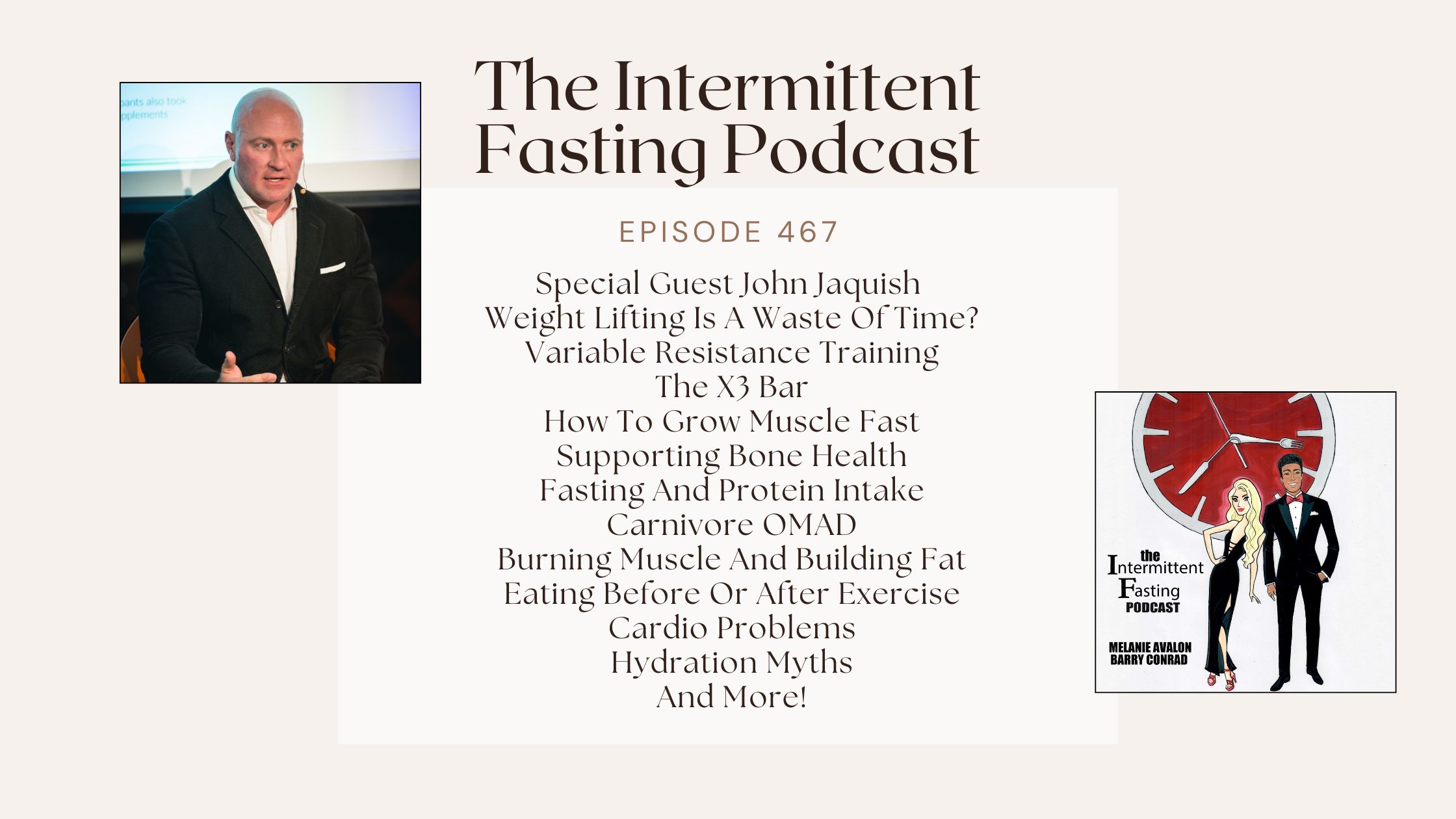
Welcome to Episode 467 of The Intermittent Fasting Podcast, hosted by Melanie Avalon, biohacker, founder of AvalonX, and author of What When Wine Diet: Lose Weight And Feel Great With Paleo-Style Meals, Intermittent Fasting, And Wine, and Barry Conrad, actor, singer-songwriter, and creator and host of Banter with BC.
SHOW NOTES
John Jaquish, PhD.
Inventor of the most effective bone density building medical device, which has reversed osteoporosis for thousands and created more powerful/fracture resistant athletes, John is now, partnered with Tony Robbins and OsteoStrong for rapid clinic deployment. In the process of his medical research, he also quantified the variance between power capacities from weak to strong ranges in weight lifting, which brought him to his second invention, X3. The research indicates that this product builds muscle much faster than conventional lifting, and does so in less training time, all with the lowest risk of joint injury. Dr. Jaquish is a research professor at Rushmore University, speaks at scientific conferences all over the world, has been featured on many to the top health podcasts, is an editor of multiple medical journals, and is a nominee of the National Medal of Science.
Book: https://amzn.to/4jOk1an
The Melanie Avalon Biohacking Podcast Episode #104 - Sally Norton (Oxalates)
Get $50 off the X3 home gym system, Fortagen protein, and everything else at ifpodcast.com/x3
GLOW
Melanie Avalon created Glow to be her ideal coffee. Made from 100% specialty grade Arabica beans, Glow is organically grown, rigorously tested to be mold free and free of contaminants, and thoughtfully sourced from sustainable, women led farms. Glow is thoughtfully sourced and roasted to preserve high levels of coffee’s primary antioxidant, chlorogenic acid (CGA), to support metabolic health and helps you glow inside and out! Get it at glowcofeeco.com
If you enjoyed this episode, please consider leaving us a review in Apple Podcasts!
Original theme composed by Leland Cox, and recomposed by Steve Saunders.
Our content does not constitute an attempt to practice medicine and does not establish a doctor-patient relationship. Please consult a qualified healthcare provider for medical advice and answers to personal health questions.
TRANSCRIPT
(Note: This is generated by AI with 98% accuracy. However, any errors may cause unintended changes in meaning.)
Melanie Avalon
Welcome to Episode 467 of the Intermittent Fasting Podcast. If you want to burn fat, gain energy, and enhance your health by changing when you eat, not what you eat, with no calorie counting, then this show is for you. I'm Melanie Avalon, biohacker, founder of AvalonX, and author of What, When, Wine. Lose weight and feel great with paleo-style meals, intermittent fasting, and wine. And I'm joined by my co-host, Barry Conrad, actor, singer-songwriter, and creator and host of Banter with B.C. For more on us, check out MelanieAvalon.com and BarryConradOfficial.com. You can submit questions for the show by emailing questions at iapodcast.com or by going to iapodcast.com. We would love to hear from you. Please remember, the thoughts and opinions on this show do not constitute medical advice or treatment. So, pour yourself a mug of black coffee, a cup of tea, or even a glass of wine if it's that time, and get ready for the intermittent fasting podcast.
Hi, friends, welcome back to the show. We have a extremely exciting special episode today for you guys. I'm just really, really excited for this. So, the backstory on today's conversation, I first came across the work of this fabulous human being half a decade ago, I was just checking when I first met this person. And what happened was, I don't know if it was his PR team or whoever it was, but I got a pitch for a book and the title was, or is, weightlifting is a waste of time, so is cardio, and there's a better way to have the body you want. And I, every now and then, because I interview a lot of people on the podcast and I get a lot of pitches about books, and every now and then I like insanely remember my first time seeing the work. And I just remember seeing the title, seeing the cover, and thinking, okay, that looks really intense and a little inflammatory. So, I was skeptical is my point. And then even funnier, if you go to Amazon for this book. So, I always like to read all the Amazon reviews for all my guests that come on the show just to get a sense of how people collectively are feeling about the work. So, this book has almost 4,000 reviews on Amazon today, which is wild. And unlike the majority of the guests I have in the show where typically the reviews are all positive, this one, half of the reviews are pretty much like five star, completely positive, talking about how this is changing their life. It's a major paradigm shift. And then the other half, I don't even think they've read the book. It's basically haters who have a very defensive response to the concepts like.
John Jaquish
It's people who reacted to the title.
Melanie Avalon
this to the title. I'm like, you haven't even read the book.
How are you? And what's interesting is I have shown like the other day I told my like one of my guy friends who's, you know, really into lifting and all this stuff. I was like, I'm doing this interview this week. And he's like, Oh, that's not true. I'm like, you haven't, you haven't read the book. You don't know what it says. So the point and then on top of that, so that's just like the vibe surrounding all of this for how shocking and paradigm shifting it is. And I will say though, I was blown away reading this book, the, the science in there, the myths that it deconstructs the complete paradigm shift you will have when it comes to your body, your body composition, the best way to create and support that and the amount of time it actually takes. And then also, like I mentioned the subtitle, you know, the role of cardio. And then what I also love, I haven't even mentioned the author, I'm here with john j quish, who is the author of this. He's also the founder of osteo strong that people might be familiar with to help support bone health. He works with Tony Robbins. He is a legend in the world of body composition. This book I cannot I cannot recommend it enough because it will change your paradigm, like I said, and on top of that, it dives into so many things, all of the myths surrounding this the muscle confusion theory, which is funny, because I've actually had Tony Horton on the show who kind of developed that and he told me he just made that up. But it talks about diet, fasting, keto, all the things We'll be right back.
John Jaquish
Tony said he was the one that came up with muscle confusion.
Melanie Avalon
He said like around, I mean, I'll fact check that.
John Jaquish
It's not only is muscle confusion theory wrong popularized it no I mean it was that muscle confusion has been around since before Tony was born
Melanie Avalon
Well, I'm going to check the transcript so I don't misquote him, but I'm fairly certain. He was saying that at least with P90X, it was like a whole thing. That's when people were all like muscle confusion theory. At the very least, he said it's not real.
Oh, and John is the founder of the X3 system, which is a way that you can, we'll talk about this, but potentially get your ideal body and minimal time investment per week. So John, thank you so much for coming on the show like five years ago. Thank you so much for coming back now and thank you for being here.
John Jaquish
Hey, thanks for having me. I'm excited.
Melanie Avalon
So like I said, so many questions for you and questions from listeners as well. To start things off, can you just briefly talk about your personal story?
Because what I love, I love how your background, you had something happen with your mom and you also had an interest and developed exercise equipment for bone health, which is so important. So what led you going from that to what you're doing now?
John Jaquish
My first invention was osteosterone, and the purpose of that is treating bone loss, typically in the postmenopausal population. So women who have gone through menopause, and there's an acceleration of bone density loss during that period, what we do is place axial force through the bone in a self-controlled manner, which dramatically reduces injury risk.
So when the bone is aligned on its axis, so loading from end to end is where the stimulus happens. So the machine gets you in a very specific position, the positions you naturally absorb, high impact forces. In science, this is called impact emulation. So place the body in the perfect position, and then self-impose loading, and there's a computer screen in front of you that shows you how much force you're creating. It shows you how much force you created the first time you ever did it, your best performance, and then the current real-time what you're doing. And therefore, you have the biofeedback right there. So you're creating force to attempt to best your all-time record of placing force through the bone mass. And when you do this, you only need to do it once a week, and it only takes a few minutes, you grow bone. You grow bone faster than anything that's ever been measured, far outperforms any pharmaceutical, and there's no side effect.
Melanie Avalon
That is completely wild and I'm really annoyed at myself that I haven't actually started doing this. Like would this benefit everybody or just people at risk for osteoporosis or osteopenia?
John Jaquish
Well, the benefits are different. So if you were to do it, you're not post-menopausal, you don't have a loss of bone density, but what you can do is increase the level of bone density you have right now so that when it starts falling, it doesn't fall as low as it would have.
Basically, when you build bone through this process, you keep that bone for 30 years. Bone metabolism is very slow. It takes a long time to build, and you notice because you do it once a week, the metabolic rate of bone tissue is just a lot longer than muscle, for example. You can work a muscle every 36 hours and get optimal growth. But with bone, primary mineralization completes within five to 10 days, which is why we tell people wait a week and come back every week to do the therapy. But it's easy, it takes minutes, it's not painful. The risk of injury is very, very low. There's still a risk of injury. I mean, you still are loading the body with hundreds or even thousands of pounds, but you're doing it with the guidance of your own central nervous system. So we let comfort be the guide. Every human has the ability, well, I shouldn't say every, some people are very weak. Most humans have the ability, if you squeeze a fist, you could break all your own fingers, but you can't because of a process called neural inhibition. You can squeeze a fist and your body will allow you to squeeze that fist just tight enough to where the bones are all loaded, but not enough so where you could self-create an injury. So when we use this neurological process to load the body, well, now the body is the, the central nervous system is the throttle to how much force can be placed through the bone mass. So you just try your hardest, whatever that is. And as long as bone is being built, pretty much every week you'll see the functional bone performance numbers going up.
Melanie Avalon
So, I was actually reading a book yesterday. It was focused on perimenopausal and postmenopausal women. It was saying that women reach, like, 95% of their peak bone mass by 17, and then 100% between 25 and 35. Does that mean, well, A, it sounds like if you were doing this, like, as a teenager, that would be great, right? Because then you could actually increase your potential ceiling of bone.
That's right. But then after 35, is it like, sorry, you can only go up to the ceiling?
John Jaquish
No, you can build like far above normal levels of bone density. You can be very fracture resistant.
A normal T-score is zero, which means you are at the level of bone density that a 30-year-old of your race should be. The different genetic backgrounds are a little different. Like for example, you'll notice that people have African descent and people who are like Pacific Islander descent, Hawaiians, Tongans, Samoans, people from French Polynesia, they have very little fragility fractures, but it's not because they preserve their bone density better than everybody else. They just have a thicker gauge of bone.
Melanie Avalon
thicker gauge bone.
John Jaquish
Yeah. So like if you, if you look at your wrist and the, you know, like, let's say you, you're using your thumb to point at yourself, the bone in your form that is closest to you is the radius. So if you pinch your radius and just feel that bone right there, you know, it might be depending on who you are. It might be a centimeter thick or two centimeters thick or three centimeters thick.
I'm a 220 pound, six foot athletic male. I played on a rugby team where I was the only guy that wasn't tonguing. And there were people of my same height on my same build. And if you'd grab ahold of their wrist and feel their radius bone, it's almost 30, 40% thicker around than mine. That's part of the reason that they don't really have this problem. So they can lose bone density, but it's sort of like, it's easy to break a pencil. But if you bunch five pencils together, is it easy to break them? No, it's much more difficult. So certain groups of people, it doesn't matter necessarily as much. The people that matters the most are typically Caucasian and Asian and Hispanic.
Melanie Avalon
Basically, they have bigger bounds.
John Jaquish
Yeah, people of African, Tongan, Samoan, French, Polynesians, and Hawaiians. They are built for collision, and coincidentally, who's good at rugby? Some people are just built to crash into other people, and it doesn't hurt them as much.
And it was funny because I was doing my PhD while I was playing rugby on this team, where I was the only non-Tongan guy. And it was like I would tell these guys about my research, and at first they were like, nah, you're pulling our leg. Come on, that's not true. And I'd show them. I'd be like, look at my wrist. Look at your wrist. All right, find a guy smaller than me. Look at his wrist. Look at my wrist. And yeah, it was just obvious. And this is how forensic scientists, when they find a skeleton, they can tell you all sorts of things about the person, what race they were, and whether they were male or female. So the idea that the only difference between different races is skin color is just naive.
Melanie Avalon
So, does the size of the bones at all correlate to fat and muscle deposition on a person or is that separate?
John Jaquish
I mean, definitely not anything that we've identified, and I doubt it just because there's the things that determine someone's likelihood of holding more versus less adipose tissue are their hormonal, their behavioral, their activity base, that a lot of it is the climate you live in. Is it advantageous to hold a lot of body fat?
Well, it is if you live in Denmark.
Melanie Avalon
Yeah, I remember, I just remember like in high school, like there were some people who were overweight and they multiple times had this memory of people being like, Oh, they're just big bones. And I remember thinking like, I don't think that's the cause. I don't think that's what
John Jaquish
Yeah, the genetics of obesity. Well, here's a great example. I came up, we're really going down the race hole today, which is fine. Somebody will be offended, but I don't care.
The, if you look at Africans from Africa, it's hard to find an overweight person. But if you look at people who are from Africa, they're here, we're talking two generations, right? Two, three generations. And, you know, there's some people here that are morbidly obese. It's not genetics. It's not at all genetics.
Melanie Avalon
Yes, environment.
John Jaquish
Yeah, it's environment, and any environment that we have placed ourselves in, in Western countries is horrible. Like the food that is available to us, most of it's not food. Like basically I look at a grocery store, it's like there's the place where you can get the plants, which I could argue we don't need that either, but then there's the meat counter. And everything else should just be pushed into a landfill. Like we don't need any of that, it is what is hurting us.
Melanie Avalon
When I go into center aisles, I'm like, this is like a foreign country.
John Jaquish
It's not food. That is right.
It is not food. You know, take some industrial peanut butter and put it in front of an ant hill and you'll watch the ants walk right around it. I'm not being facetious, that's a fact. Like they don't, they look at that and they're like, I don't know what it is. And they just walk right by it, it's not food. Like the bugs are smarter than we are. They can tell it's not food. So, you know, unless it's animal protein or fruit is a lot better than vegetables, vegetables have just a lot of defensive chemicals that hurt us. And I don't have enough data to back this up completely, but there's a lot of evidence that deoxylates and lectins from vegetables and grains are really, that's the cause of cancers. It's got nothing to do with, certainly nothing to do with meat. The biggest, like there's a lot of carcinogens. There's other things that can trigger cancer growth. And we can do that in a Petri dish. Like you can take certain chemicals and put it in a Petri dish with human cells and you can watch them become cancerous. But I believe the overly abundant prevalence of seed oils and oxalates and lectins in our diet is really why this is happening. And as we have switched to a more plant-based diet as a population, the higher the cancer rate gets. Not the lower, we were told, we were told, oh, get away from meat, meat causes cancer. The more we get away from meat, the more cancer we get.
Melanie Avalon
I'll put a link in the show notes too. I did an interview with Sally Norton all on oxalates and yeah, it's kind of really shocking.
John Jaquish
She's such a wonderful person.
Melanie Avalon
She's amazing. Yeah. And it's mind blowing that it's I know it's well pretty. I know it is well known, but it's especially when you listen to that and read her work and learn about it. It's surprising to me that it's not even more well known.
I do like having on really intense vegans on this show, like, you know, figures in the vegan world, because I like all different perspectives. But I like using myself as a case study, because I eat, you know, an insanely high protein diet, I do one meal a day, it's almost like all protein. And I like to say, like, here are my health markers. And I have all these like, you know, biological age tests on me. And like, I'm aging, I'm like, not aging fast. So clearly, this high protein thing is not as much of a problem as you're saying it is.
Wait really quick tangent rabbit hole, and then we can come back to the all the other things. What do you think about the new food pyramid?
John Jaquish
Oh, the fact that they basically just did what the South Park episode did is just poetic.
Melanie Avalon
It's like, no, I'm like, are we in a simulation right now?
John Jaquish
You know what? I don't think we are because of how awesome that is. Because it's basically like South Park made a joke 10 years ago. No, it was less than that. It was maybe five years ago. Do you know what I'm talking about? Where they're like, turn the pyramid upside down. Have they inverted in South Park? Yeah, they just turned it up. They said turn the pyramid upside down. And it was a joke. Oh, that's so funny.
No, and then everyone who was eating that way is like, oh my God, everyone's getting healthier. Yeah, yeah. I mean, South Park made a joke about it. And basically, that's exactly what RFK did. He just turned it upside down. Well, you got to look at a lot of what we call corruption and dishonesty is not nearly as evil as we think as it is lazy problem solving. So why do governments want us to eat grains? And why is there this demonization of meat or has been for the last 50 years? And the promotion of foods that we know are just terrible for us? Why would health institutions support this when they can obviously tell it's wrong?
Well, in the United States, as an example, 76% of people are either on social security on SNAP or welfare. Now, I know those things are very different. And people in social security hate it when they're mentioned in the same sentence with somebody on welfare. It's not the same thing. I'm not saying it's the same thing. Don't make stupid comments. That's not where I'm going. What I'm saying is that 76% of the population has their monthly food budget determined by the federal government. So does the federal government want to give you $2 a day and tell you Oreo cookies are really good for you? Or do they want to have to give you $25 a day so you can eat ground beef for three meals? Now ground beef will actually not cost $25. It probably costs more like six or seven. But the point is, what world governments will tell you is healthy is always cheap. It's just cheap. And they only want to participate in helping feed people when it comes to giving them something cheap. Wheat grain is cheaper than topsoil.
It's literally cheaper than dirt. So that's why grains have been promoted because in the 1950s, like, oh, we got cereal. We made breakfast out of grains. We'll figure out how to make lunch out of grains, dinner out of grains, everything will be grains. It'll be wonderful. And it was wonderful because it was cheap. And of course, as people start eating this way, it's like, oh, gosh, the health outcomes are not better. That's when the fraud started. Because I think they went about this with the best of intentions. But then they're like, oh, shit, now we got a lot of people telling them that this is healthy. That's really how this went down.
And coincidentally, this didn't start in the United States. Like, in the dark ages, there were farmers that were told by Kings and noblemen, hey, if you can find like a meaty seed pot or something that we can feed people, it would be a lot less expensive.
John Jaquish
And then also at that time, cities were starting. So Kings realized if you keep everything behind a city wall, you can protect your kingdom and you can have some of your clothing production, weapons production, keep that behind the wall, you're better protected community.
Well, they didn't have refrigeration. So by the time they'd get the meat into those cities, it would be spoiling. So no one can have fresh meat. So that's when Kings and noblemen went to asking farmers to selectively breed for larger seed pods. So like, there is no such thing as a natural vegetable. They're all created by cross pollen. Like you're walking through a forest of broccoli, or the wild flames of corn. No, there is no vegetable. I never thought about that. Oh, yeah. And vegans, they love saying, oh, there's food everywhere in nature. I'd love to take a vegan out to Yosemite and be like, yeah, cook me dinner. Make it happen. Go ahead. Turn some pine needles into food. Yeah, it's a stupid argument. And it's made via emotion, not logic.
Melanie Avalon
Well, speaking of, so, and like I said, you talk about this in your book. Do you do mostly all meat, basically? And do you do fasting every day? Or what does your diet look like now and does it change?
John Jaquish
It fluctuates a little bit depending on what I'm trying to do, but there's two modes I have, either dropping body fat or gaining muscle. I'm at a place now where I started doing some experiments with protein sparing modified fasting. I take an essential amino acid complex, three doses of it in the morning, three in the afternoon, and then I have a large dinner, which is predominantly meat. I do try and get at least 20 grams of carbohydrates a day. There is not a good health reason for that, but it helps you look better.
To say more. When muscles are more full and also your skin is a little more full, sometimes when people are dieting down and you look at them and it's just like, wow, I know you're trying to get healthy, but you kind of look like you're starving. That's not a good look. Just 20 grams, we'll make sure that doesn't happen. I'll even go all the way up to 50. I do six days a week, I do very, very heavy strength training with the X3, so that has me using that amount of glycogen that those carbohydrates create. As long as I'm using it now, if I do an off day, which is usually Sundays, no carbs that is a day.
Melanie Avalon
Well, definitely want to dive into the x3, but just really quickly because you mentioned just now that, you know, what you're eating depends on your goals, either building muscle or losing fat. And we actually got a really good question from Kendra.
She said, how do I know how much to eat to be able to build muscle but still lose fat? So can you do both at the same time or is it one or the other?
John Jaquish
Absolutely. That's a great question. I probably should have led with that. Thank you, Kendra.
There are fitness people who will tell you, and I don't know why they have a religious commitment to this belief, that you need to be at a calorie surplus to build muscle, and that is not true. Not even close. You need to be at a protein surplus. For example, I can build muscle doing six doses of FortiGen, that's my amino acid complex, and nothing else. That's 24 calories in a day, and my scale weight is going up. Now, I have to rehydrate to realize that. I do that for a couple days, and then I have some carbohydrates and just drink some water, which is the water retention is really what carbohydrates do. There's a reason that the second part of that word is hydrate, because it really determines how much water you're holding. That's another reason why you want to cycle the carbs up. Not a lot, just a little, and then you can realize those muscular gains, but yeah, you can gain muscle on very few calories if you just have the highest quality protein, which is essential amino acid.
Melanie Avalon
Yeah, and also a similar concept that I know you talk about in the book is you point out that people often think that just overeating in general will build muscle, but that's not the case. It's protein, like it's got to be the protein that's overdone, is that correct?
John Jaquish
Yep. So you want at least one gram per pound of body weight and protein. You need somewhere between 50 and 100 grams of fats. Now, you don't need that every day, but you need that on most days.
People like the idea, like when I tell them about foraging and they're like, oh, can I just live on that and not eat anything else? And boy, I wish that were true, but no, you still need to eat real food. But you need to eat if you have the proper amount of essential amino acids, the amount of food you need is really small. I used to, before I would only do two doses of foraging a day. At the end of the day, I was one meal a day. I'd eat a 48-ounce ribeye. And man, the last 10 ounces of that 48-ounce ribeye, you're like, ugh, this is like a job, even if it's delicious. You're not in love with it. Now that I've switched to a more protein-sparing-modified-fast approach, then I don't need to eat those giant meals to get the right amount of protein.
Melanie Avalon
I wonder if I would, because like I said, I eat an extraordinarily large amount of protein and meat every night, and I always do feel like I could just keep eating meat forever. I don't, but I just love it.
I wonder if I integrated fordogen, if I would not have that feeling. I don't know where it's coming from, but I just love meat. I could just eat it for like ever.
John Jaquish
Well, you should. That's that's that's exactly well, and that's that's the way our biochemistry works. That's what we're supposed to be eating.
Anyone who is like, actually taken a real approach to prioritizing protein will notice that whatever problem they thought they had seems to disappear when they do this.
Melanie Avalon
Well, what's really interesting, too, is because my co-host on this show often call me like the unicorn because of how much protein I eat. But we get questions all the time, especially from women, about how do I get enough protein, like they really struggle.
And it's, I have to like come out of my own bias and like mindset because for me, it's like so easy. I'm like, I look at, I look like the recommended amount of protein, you know, like if it was like a hundred grams, like I would be starving. Like I eat so much more than that. What do you say to people who struggle to get enough protein? Would it be adding in like the essential amino acids, like the portagena?
John Jaquish
That makes it so easy. I mean, when you mix forage in water, you can see through it. It's not a thick, nasty thing, and it doesn't give you indigestion.
It's not like whey protein. It's pretty straightforward. One scoop is 50 grams of protein, and it's all usable, unlike whey protein, which is only 18% usable because of its ratio of amino acids, which is very inappropriate for human use.
Melanie Avalon
Well, I'll go ahead and give a link. I'll give it later as well. But if listeners go to ifpodcast.com slash X3, that's where the X3 system is that we're gonna talk about before to Jen is there as well. And the code save50 gets you $50 off that website. So thank you for that.
Actually one more eating question just because we have another eating question. It was from Yvonne and she said, do you recommend, and you kind of touched on this a little bit earlier, but do you recommend eating before exercise? And if so, what do you recommend eating?
John Jaquish
So when it comes to exercise stimulus and response, it's better if you work out on an empty stomach because that way all your blood flow goes to the musculature. And timing of meals is not that big of a deal. Like you can get your nutrition at the end of the day and do all your exercise at the beginning of the day. You're not gonna miss out on anything.
The idea that there's an anabolic window that you have to eat in, not true. Like it's been completely disproven. So as long as you get it in the same day, you're good.
Melanie Avalon
Yeah. We talked about a study on the show. I think it came out, well, it was when Vanessa Spino was the co-host.
So it would have been like two years ago or so I think, but it basically debunked the idea of this limited anabolic window because they realized, I don't know if they realized, but I guess they hadn't really done studies looking at muscle protein synthesis past a certain amount of time historically. So we didn't really know if it was like still happening and they did a longer study and realized that it still happens. Like the signaling is still there later.
John Jaquish
I think the title of that study was the amount of protein that can be absorbed in one sitting is apparently unlimited. Yes, yes, that was it. Oh, I practically have that study memorized.
I had a different argument for the same thing, but I had to cite, I think, three different studies and infer my conclusion based on what was seen in those three studies, and that's ugly. You don't want to make a point doing that because people are like, oh, well, you don't know those things relate. What do the authors of the study say? These are professors. You can't harass them. I just roll my eyes and be like, all right, dude, don't believe me. That's cool. Just go fail somewhere else.
Melanie Avalon
So you're making like the same argument based on three other papers or slightly
John Jaquish
No, I was making the same argument. There is no limitation. I knew I'd known for years that there was no limitation on the amount of protein you can absorb because otherwise, as a species, we would be extinct.
Oh, yeah. You can only absorb 30 grams of protein at once. That's why all the Native Americans were always carrying around their hydroflasks with a whey protein. We would not have lived. It's so amazing how many just blistering, stupid arguments are made, and people will seemingly want to fight you to the death over it. I don't even need to show. When somebody's like, calories in, calories out, it's just about counting calories. Yeah, we've been saying that for 70 years, and people are fatter and sicker than ever.
I think you're wrong. I don't even need to study. Does counting calories help? I suppose it can, but with what I'm doing, most days, I probably get 1200 calories a day. Veins are my abs. I'm very lean, and I'm very strong, and I'm gaining muscle. What do I need all these calories for? I think that's just nonsense.
Melanie Avalon
Yeah, it's it's really wild like and like I do believe like at the end of the day if you gained weight then you did absorb and taken and assimilate more calories than you put out. But the amount of calories you eat says nothing about the amount of calories you actually turn into fat or muscle like it says nothing to that.
John Jaquish
No, no, absolutely nothing. And, and it's also like, just look in nature, like there are animals that will defy the laws of thermodynamics, like, they will only you know, they'll eat two or three pounds of meat, and then they'll gain six or seven pounds of muscle. I'm talking about when they're growing up. And you're like, huh?
Like, how did this, you know, when you when you watch, I was just with my wife, we were playing with baby tigers in Mexico.
Melanie Avalon
Baby Tigers!
John Jaquish
Oh, they were the cutest. But these guys were saying these things grow like a pound a day. Well, how much do you feed them?
Melanie Avalon
Eh, like half a pound. That's interesting.
John Jaquish
Well, it's and it's also like the real the real issue with counting calories, why it's so stupid, you cannot store protein as body fat. There is no mechanism in the body to convert it. So when you overeat protein, your body temperature goes up to speed up your metabolism. Like, why on earth would we ever count protein as calories? If we're looking to lose body fat, I just defeated the entire like calorie concept.
Why are we even looking at that one? We should only be looking at fats and carbohydrates and we need fats. Do we need carbohydrates? Like I said, I can create a vanity argument for a small amount. I also feel like when women go to zero carbohydrates, and there's there's a few papers about this. And at first, I thought it was just, you know, people who like cake, just making excuses. But I do feel like the women that have a little bit of carbohydrates in the diet are just happier.
Melanie Avalon
I noticed, so I'm embarrassed to say this because it's not healthy, I'm not like advocating for this, but the way I kind of found, one of the ways I found myself becoming obsessed with like the science of diet and things like that was like in college and I was like thinking about the, what you just mentioned, like the biochemical pathway conversion potential of different macronutrients and I was like, okay, so basically like lean protein, not going to become fat, I'm just going to like drink wine and eat lean meat and see what happens and that's what I did for literally like a year, so I'm not recommending that, but it just goes to speak to what you're saying, like there's not really like a conversion pathway there.
John Jaquish
I'm going to actually congratulate you for doing that because when you say things like that, people can relate to it. Because yeah, yeah, it would be great. We all hike to a mountaintop and meditate at 5 a.m. every day and did all the principal things and we all live like monks. I mean, that sounds cool. And would we be super healthy? Yeah, but that's not life.
My mountaintop that I go to in the morning is the AMPM at the gas station. Because I'm on my way to work. So they don't have organic anything there. So it's like, that's why I don't eat anything there. And the idea that you had some wine, that was your carbohydrates and you ate meat and a lot of your health problems were solved. Well, would you be even better if you cut the wine out? Yeah, maybe. But it's one of those things where preaching the most principled thing is just not something that people are going to follow. And I also find it to be the case where you can ask somebody to cut certain things out of their diet, like permanently. You know, like if you smoke cigarettes, like, yeah, just don't do that. Okay, but you know, when you ask them, you know, no tobacco, no alcohol, no, like, you know, they basically, they can just, it's just, it's too much. It's like, why am I even getting out of bed in the morning to some people? So, you know, we get serotonin from a lot of different places, taking them all away is not a recipe for long-term success, which is why the people that go like the most hardcore usually fall off the wagon.
Melanie Avalon
One of the reasons I did that, because I was like, what can I do and what can I not do? And I was like, what I don't want to do is I don't want to count calories.
So what can I eat, unlimited. And I was like, lean meat. I was drinking cheap wine back then, which now I only drink organic, you know, dry from wine situation.
John Jaquish
Yes, expensive wine is much better.
Melanie Avalon
Yes. Well, organic, low alcohol, I'm like low sugar.
Well, but I did notice you're mentioning, you're mentioning especially with women that they're like happy with carbs. When I finally brought back carbs, I started eating fruit again and I felt so happy and I was like, I'm keeping fruit. So now I basically eat like lean meat and fruit.
John Jaquish
But how many grams of carbs do you get a day?
Melanie Avalon
So, it's a good question. Well, a lot of days I will do like, I won't add fruit, but on the days I do eat fruit, oh gosh, I eat a lot. So, probably like an entire, oh gosh. I don't know what it comes to. It's probably, I'm trying to think how many pounds of fruit I eat. I eat a lot of blueberries. Probably like 200, it might be like 200 carbs of fruit. A day.
I'm trying to, okay, how big is like a Costco size thing of blueberries? Like a bag. I'm seeing how many ounces that is. Three, okay. Okay, so their bags are like three pounds. So, I'll probably do like two pounds of fruit. How many carbs is in that of blueberries?
John Jaquish
I would say probably 50.
Melanie Avalon
Okay, this this tracks two pounds around 130 to 135 total 110 120 net.
John Jaquish
Wow, okay, more than I thought.
Melanie Avalon
You eat one of those a day? I eat a lot of fruit, yeah. It probably does come out to about that many grams, if I'm doing a fruit day. So some days I just do like meat. It's kind of like whatever I'm feeling, but yeah, it really works for me.
The thing that works for me is just not combining fat and carbs. So like if I'm having lots of fruit, it's lean meat only. But if I'm doing only meat, I might have like fattier meat. That's just works for me. And like a one meal a day situation. I'm not saying to like do this listeners. People always ask me what I do. I'm like, I'm crazy. So I don't necessarily do what I do, but fine, what works for you? But getting to the, okay, so that's a lot of like diet stuff. So getting to X3 system. So like we started at the beginning of this, your background was with the bone science of building bone. What did you learn from that that translated to muscle building?
John Jaquish
When I was doing the first clinical trial of the Osteo-Strong machines in East London, so I had the National Health Services, NHS, that's sort of, it's like NIH, but in England. They were funding part of the study and they were offsetting the costs of the DEXA scans for the test subjects. By the way, the British NHS, like actually, even though it's a government bureaucracy, they were super easy to work with, like A+. I tell people, I tell English people this, and they're like, they want to fight me.
They're like, I hate the NHS. And I'm like, well, you know, I mean, maybe you're just, maybe you just, you got to go in to be nicer. I don't know. I don't know what it is. But it was funny because of bureaucracy and I was like, oh, we have to deal with these people. Man, after bureaucrats are going to screw everything up. And it was like walking into the Starship Enterprise. They were like, how can we help you? And I said, what I need? And I figured they'd come up with 100 reasons why we can't do that. And they're like, we have policies against that, but because this is for research, we will override all of those. And I'm like, well, when do I receive approval? And the woman just signs the paper, enhance it to me. And she goes, you just did. Have a great day. It was all, it was like, it was like a hidden camera show. It was like, there's no way this just happened.
Melanie Avalon
And how long ago was this?
John Jaquish
2012, it was big. I mean, I don't know. If anybody from NHS listening, good job, guys. I was doing that in the physicians at the hospital. They weren't test subjects in the study, but all of them had low bone mass, including the men. For whatever reason, it was like just a crew of low bone density people, and they were beginning to rebuild their bone mass, so they were super excited about it.
It was an idea that had been in the back of my mind, but I never said it out loud. One of the days where the study was coming towards conclusion, I walk into the meeting room, the doctors, I didn't know what they wanted to talk to me about, I hope there wasn't any problems, and they were so excited, big smiles on everybody's face, and they were like, we just want to ask you a bunch of questions about this, because this is one of the most fascinating things we've ever seen. Now, I can understand why they said that, because it's a perfect example of a physical medicine intervention, physical medicine meaning we're just triggering the body to heal itself. It's like, you're triggering the body to heal itself, but it's working better than a multi-billion dollar industry of pharmaceuticals, and there's no side effects, and I was like, yeah, they're telling me everything I already knew, they're telling me everything I already told them, and then they're like, why doesn't this just replace fitness?
And I was thinking, okay, there's a lot more to fitness than bone, there's muscle, there's cardiac abilities, flexibility, there's skill building, there's movement patterns, and I said, okay, look, we can probably learn a lot about muscle by approaching it from the perspective that we have a variable capacity for creating force, and that is not realized when lifting weights. And so, that was sort of vague, and I said, don't worry, I'm gonna keep you guys informed, I'm gonna work on this. And that's, basically, I flew home, and I started with a clean sheet of paper, and I thought, I need to develop a variable resistance device so I can get peak loading where you are strongest, and sort of the normal loading that you lift in a gym, kind of in the middle of the range of motion, and at the bottom, you actually want something lighter. That way, as you can fatigue with diminishing range, this is the most important principle.
People that get X3 and don't read the instructions, and they don't use diminishing range, they're not gonna be successful. So, what you do is, first, you're doing repetitions that go very high in weight, and you're going full range, because at the extended part of that range of motion, or contracted, depending on how you wanna discuss it, you have incredible power in those positions, so you go to fatigue there first, as you're firing the most tissue there. That makes natural sense. Then, you just shorten the repetition, so you go as far as you can go with each repetition. So, you go to momentary muscular failure, sometimes 10 times, in one set with a fresh muscle that is full of glycogen, which, by the way, is really your only growth opportunity in a workout.
John Jaquish
Because once you start getting tired, you're just repeating an activity where you are stopping short of really pushing the muscle to a limit where growth will be triggered. And that is called junk volume. You don't wanna do junk volume.
So, ultimately, the faster we can exhaust a muscle that is full of glycogen, especially if we can exhaust it multiple times in that same experience, the growth stimulus is far more powerful, and the recovery time will be short because recovery gets extended with more exercise volume. So, very small amount of sets, very high intensity, very small time commitment, incredible growth, and because by the time you're going to fatigue in the weaker range of motion, you're not dealing with a huge amount of weight. I did my chest press this morning. At full extension, I was dealing with 500 pounds. When I went to fatigue with my last two or three repetitions, I was only pushing like 120 pounds. So, I can lift 500, but I'm so exhausted, I can't even move 120. You think that's gonna be a powerful stimulus? Of course it is. Like that's exhaustion, like no one's ever seen. I mean, you can't exhaust like that with a regular weight, which is why I wrote the book, Weightlifting is a Waste of Time. Now, I didn't say resistance training is a waste of time because with variable resistance, basically the book is about variable resistance. Like if you train in this manner and people should read the book or Google variable resistance, there's some amazing stuff out there that you can read, but training with variable resistance dramatically reduces injury risk. And for anybody who's basically over 25, you should really pay attention to that. It dramatically increases the amount of force you're dealing with, but the force is given to you where you can handle it. It doesn't feel dangerous. It's just difficult. Like it is, you will go 100% with a set doing X3 and you'll say, wow, that was way harder than going 100% lifting weights because you just recruit so much more muscle and you exhaust to such a profound degree, but it's over in one set.
Melanie Avalon
Can you clarify it just a little bit because I'm understanding that you go to failure and so that is giving you the stimulus for growth. But when you're in that junk volume zone, do you feel like you're going to failure but you're just not?
John Jaquish
Yeah, you can continue going to failure with set after set after set, but the muscle, it's like getting a tan. You can go outside on the 4th of July for 10 minutes, and you come inside and your skin's a little tender, and you're like, okay, I'm going to throw a hat and a shirt on right now, and you get a tan. But you could go outside in December and be out there all day long, and you won't have any effect. So it's low-intensity stimulus versus high-intensity stimulus.
Your body's only going to respond to something that makes the central nervous system feel like there is not enough tissue here to do what we need to do. But if you exhaust first with your first one or two sets, and then you keep on doing sets after that, do you really think that's going to do anything? Gotcha. Yeah, and there's plenty of science that says, if it does anything, the thing that it does is very small. So you run into diminishing returns very quickly. Like when they did some of these volume studies, the growth from the first set, big. No, this is regular weightlifting, not variable resistance. Variable resistance is different than this. First set, big gains. Second set, maybe a third of the same that was seen in the first. The third set, maybe a third again. So that's almost nominal by the time you get to the third set. So why do it? Why not just have a higher frequency? So I work every muscle three times per week.
Melanie Avalon
And actually to that point, so because you mentioned that this doesn't take much time at all, so April said, because she's a good example of a major demographic on this on the show. So she said for a healthy active woman and perimenopause, how often and how long should I strength train per week?
And she wants to also know about creatine supplementation, but so like time wise for like a perimenopausal woman doing this weekly, like literally, how much time is it?
John Jaquish
If you goof off and check your email between sets, it's gonna take more time. So I'm going to, and that's what I do. Because I'm, you know, it's like, I work at a home, my X3 is at home, so sometimes I go to read an email while I'm resting between sets. Basically, you could get it done at 15 minutes. The most amount of exercise I would want you to do following the principles that I'm talking about in the book, 15 minutes a day, six days a week. That's the maximum. And if you wanted to cut that in half and go 15 minutes a day, three days a week, you will still do amazing.
Melanie Avalon
And this cannot be achieved with traditional weights. Not even close.
When you develop the system, the x3 bar system to do this, like how many iterations did you create? Like was it hard? Like how'd you even have the idea? Was it hard to create the system?
John Jaquish
That's a great question. I'm glad you asked it because I don't want to give myself credit where I don't deserve it.
So my research in bone came to loading just in that optimal range of motion where we absorb high impact. There was a whole, well, way back in the day, we're talking 1960s, 1970s, there was a guy named Arthur Jones who developed the Nautilus strength training equipment. And that was variable resistance. In fact, the reason they called Nautilus Nautilus was because of the pulley was in the shape of a Nautilus shell, which they call a cam because it's lopsided. So as you extend, so you might at the bottom of an exercise, let's say a squat, you're holding X amount of weight and at the top, you might be holding 1.2X, so the weight goes up. Now, Arthur was on the right track, but he didn't have the same amount of data that I had because after Arthur in the 1990s, this is probably the most important person in strength training ever, and his name is Louis Simmons. So Louis Simmons looked at what Arthur did and said, yeah, great. He didn't find what the optimal ratio was from top to bottom. And so what he did is he had a gym in Columbus, Ohio, and decided that he was going to run some experiments with variable resistance. This was at the same time the Russians were doing the same thing and they were breaking all sorts of world records. So Louis decided, okay, I'm going to start using variable resistance. I'm going to find the strongest guys on the west side of Columbus, Ohio. It's where he lived. And we're going to break world records. And it only took him about 10 years. West Side Barbell has more world records than any country on earth, including the United States. And he did it using variable resistance.
Now, this is a very aggressive place. He would throw you out if you didn't follow his principles or if you didn't train to complete fatigue. Like he was very notorious for just like, hey, you know, you get out. You're never coming back here again, just for not training hard. So that's part of how we did it. But think about it, it ultimately ended up being over 140 world records that his athletes broke out of that one gym on the west side of Columbus, Ohio. And it was when I read the research that was really inspired by Louis Simmons. And then when I would look at some of the material that West Side Barbell was putting out, I was like, okay, this is like the product I create is basically going to be like West Side Barbell in a box. It's funny because I thought I'm creating a home product. Home products are by their very nature compromised in some way compared to a full blown gym.
And or at least that's the assumption people will make. And then as I got started, I noticed there were all kinds of professional athletes messaging the company asking for accessories or help doing one thing or another, some advice or hey, could Dr. J do a video on this and this and this. And I would ask these guys when I talked to him, hey, yeah, thanks for reaching out. Where did you hear about X3? And they would always give me the same answer. They're like, oh, dude, everybody loves X3.
John Jaquish
This was like a few months after I launched the product and I'm scratching my head like, really? Everybody? Who's everybody? You know, I mean, I was sales were great, but I wasn't like the next Google. So I'm wondering who this everybody is.
Well, I found out a few years later when I got contacted by West Side Barbell because it was West Side Barbell because basically professional athletes, West Side Barbell kind of graduated from powerlifting and they were their coaches were now helping NFL players. Their NFL programming was all built around X3 because you can travel with it. And most NFL players don't even live in the team where they're, they don't live in the city where the team's at work. You know, they're not going to, they're not going to train at the stadium every day. Not every day. They're going to be on the road. They're going to be back home. They're going to have to visit family. There's going to be an off season. Like how are the, how do we get these guys to be consistent with their workouts? Well, they use the electronic version of the, of the X3 to capture the amount of force that they're creating and the coaches just have a login to look at it.
Melanie Avalon
Wow. Is the electronic version one that consumers purchase as well? Or what's the difference there?
John Jaquish
Yes, but I want people to save money. So here's my advice. If you really want to get on board with this, start with the non-digital version. Start with the regular one. It's half the price, it's only $550 because the digital one's $950.
Start with the regular one, decide that you like the workout and you understand how it works. And in the beginning, counting repetitions, you basically, we tell people, count your full repetitions and count your partials. So ultimately, if I'm doing a chest press, I did 15 repetitions, 15 full repetitions and maybe 10 partials after that. So I just keep track of those numbers and I try and beat that. The digital one captures the amount of force you've created to the pound. So my chest press workout, I'm going 500 pounds, 20 reps, full reps, and then I might have partial repetitions that are of a different level of force and it totals all that force together. So that way, you really know, oh, I might be one half rep away from beating my record.
And it's really beating your record. That's the principle of progressive overload is probably one of the only, it's probably the smartest thing ever written in sports performance. I might even say it's one of the only smart things written in sports performance because there's a lot of things in sports performance that are like, oh, you need to train in the stretch range of motion, it's really important. Yeah, okay. Thanks, captain. Obvious, that's where everybody goes to fatigue. So is it important or is it just where people go to fatigue? Yeah, so I mean, I didn't, like that finding was supposed to be profound and I'm just like looking around like, seriously? You wrote a paper about this? Bringing everything together for something actionable for a listener here. The variable resistance is, it's more exhausting. It'll be the hardest workout you've ever done.
It'll also be the fastest workout you've ever done. And it's not designed to be fast. It's effective. It just happens to turn out that your body doesn't want you to do a long workout. All you have to do is take the target muscles to absolute fatigue, a fatigue that you cannot even get to with a weight. You do that and it only takes a couple of minutes. You make sure you get your amount of protein that day. You don't need to worry about anything else. You will grow.
Melanie Avalon
Yeah, this seems like a complete no brainer. And I will say anybody I've ever spoke about X3 with like fellow people in my biohacking sphere, it's always the response I get is like, yeah, it works.
Like, I remember what you just said is almost exactly what Brad Kern said to me, he co authors all the books with Mark Sisson and Oh, I know Brad. Yeah, he's so great. He's so funny.
John Jaquish
He's actually come to my office like a whole bunch of times, got way out of his way to just come to my office and hang out with me. And I was just like, wow, like, yeah, such a nice guy.
Melanie Avalon
I'm so sad that I haven't met him in real life. We talk all the time.
Yeah, when we were talking about it, and he said like, basically, he's like, it really works. He's like, it's so fast. It's like the hardest workout you'll ever do, but the fastest and most effective workout. So, okay, I'll tell you my, the hurdle for me, who I'm not like a historically a gym goer, I just kind of make my life active. And I'm so scared that I'm gonna do it wrong or incorrectly since I don't speak like gym language. So are there videos that are easy to follow?
John Jaquish
The videos... So there's three sets of videos. The two of the sets of videos are free and they come with the product. So you get the product and you get a link that brings you to sort of a password protected part of the website. And you can see the standard program. Then we have the hypertrophy program, which is... It's a lot more of the same. But for the people who don't want to swallow that you only have to do one set. And the funny thing is if you know you're going to do two sets, what do you think you do on your first set? Do you go all out? You don't. It's like if I invite you to a dinner party and you know you have another dinner party later on in the evening, are you going to stuff yourself with the first one? No. It's just like humans aren't stupid. Like don't imagine you're dumb enough to be able to do two sets with any sort of seriousness. You're either going to half-ass it on the first one or the second one is just going to be a waste of time and inroads into your recovery ability. But aside from that, they're just like a lot of people who really wanted a more exhaustive programming. So there's those two levels.
And if you're serious, if you want to go all the way, there's a program that Westside Barbell offers that is the X3 Training Academy and that's what the NFL does. So you can actually do the same workouts with the same equipment as the NFL. So this is...
Melanie Avalon
what they use. Okay. That is telling. Mindset wise, so I wasn't expecting this question, but I like it.
And then some other listeners chimed in. So Karen said, and she says weightlifting, but I'm going to apply this to x3. So how to make this enjoyable, I hate it. And then Damon said, I used to work out with others and that helps. I do it by myself now and I dreaded every day. Do you just have to, do you have any mindset hacks for how to enjoy this or do you just suck it up and do it?
John Jaquish
No, there's a lot of different things you can do, and I totally get that. In fact, being scared of your workout is probably the largest problem.
Since I started working with West Side Barbell, I work out with the strongest people on earth. In fact, my regular training partner, his name is Craig Bongelli, he was ranked the ninth strongest person in the world by ESPN. It's like you're trying to break your own records every day, and they are terrifying amounts of weight. Now, you have to constantly remind yourself that the records were set by you. You're only competing with yourself. Now, if you get to a record where, let's say you're using one band and you're going 25 repetitions, and you basically get to the same output multiple times, what you can do is alternate between going heavier and lighter. Then it's like, okay, I'm going to go with a heavier band, or I'm going to add a lightweight band to the existing band I'm doing, which may add 25 to 50 pounds depending on the movement and whatever range of motion you're in, but that'll break the plateau. As far as loving it, nobody likes brushing their teeth, but we still do it because we know it's the right thing to do.
Doing things so that you're accountable. Let's say you wake up at 6am and you turn on a FaceTime call with your friend, and then you do the workout together, you hold yourself accountable. Or you use the X3 Tracker app, which is not the digital one. The force bar is the digital product. You use the Tracker app, and then you promise your friend at the end of your workout, you're going to send them the screenshot of your conclusion of your saying. Accountability partners are big. I don't think the group thing is as good because if you just don't show up to the group Zoom call where everybody's working out, it's like there's a lot of people there. No one's going to be like, where's John? You need somebody to go, where's John? So one person. It's like buddy system. That's big. And for me, that's the guy, Craig, that I just mentioned. He's the one that keeps me accountable. I hold him accountable. I mean, yeah, he's the ninth strongest guy in the world, but it's still the same workout.
Melanie Avalon
Well, what's really alluring to me, because I think one of the good ways to get dopamine and make it more enjoyable is just literally turning it into a habit, because then you're getting that dopamine hit from fulfilling your habit. I do cryotherapy every time, every day, and I still don't like it. I still dread it every day.
I get that dopamine from doing it and the way I feel after, and it's really short. So, this translates well, I think, to that, because this is something very doable, very habit building, very short or time-wise, yeah, really no excuse. And there's just benefits to doing hard things that you don't want to do.
John Jaquish
Right. Yeah. The dopamine is a great, great example. Especially like doing it first thing in the morning.
When I do a heavy workout, whether I break my records or not, and usually I break at least one every day. The rest of the day, the things that I come upon, I run a big company and it's chaos every day. Somebody's always on fire. There's always a crisis. And it's just like the scale of problems just gets so small. Somebody will come into my office, oh, it's the end of the world. This is like, okay, not a problem. We'll take care of it. It makes it so that your attitude is just, you're so level headed all day long when you do your strength training in the morning.
Melanie Avalon
You pretty much break a record every day for yourself.
John Jaquish
at least one of all the lifts I do. So it's about five movements each workout and at least one of them will break a record.
Some of them are in flux, like if I get to a point where I hit a plateau and I either do one or two things, I either go lighter and try and shoot for more repetitions or go heavier and shoot for a lower amount of repetitions, but you know being competitive about that with myself. So each time and I just went through that change with my deadlift. Like now peak force of my deadlift is over 600 pounds. You know that's that's a much I was I was right around 550 before and so that that level it's different and I have to be much slower and more controlled and that means that the total number of force went down but it's also the case to where I'm not running into any complications with cardiovascular fatigue or breathing because breathing while you're deadlifting is very difficult because you're you know holding with about 50 percent of the muscles in your body that 550 or 600 pounds. So there's not a lot of like active recovery going on when you're in like the down position because you're still holding the weight. I upped the weight now I'm beating my record every time.
Melanie Avalon
And I'm super curious. So people who start x3 now who have not done it before, depending on where you're coming from, I'm really curious how fast and what type of results people will see.
So say people who have not been doing resistance training at all, compared to people who did in the past, but then stopped, compared to people who are actively doing it. How fast will they see changes and what can they expect to see?
John Jaquish
It's the same result from everybody, even like there have been people who have been working out for 20 years, and they start using x3. And they'll say, I feel like for 20 years, I've been doing nonsense. Because, yeah, within a month or two, they're like, I've gained more muscle in the last 30 days than I have in the last 20 years. And really, the answer is people spend 20 years doing nothing. I mean, how many people do you know that year after year, they're going to the gym and they talk about going to the gym, they're all about their workout and, you know, when CrossFit was popular, they were doing that and they bought all the CrossFit t shirts and they never shut up about CrossFit. And then and then you it's like, you're looking at them and you're like, if you didn't have all those CrossFit t shirts, nobody would know you work out. And that is that what I'm saying right now probably describes 99% of the exercise and population. Like, nobody knows, because you're not doing anything.
Like, you might feel like you're doing something, you might sweat a lot, it might be difficult, but you're not stimulating any growth. So, what do you I mean, just ultimately, like, like, let's, let's get there. And coincidentally, this is why the discussion about variable resistance with a like a biohacking or intermittent fasting group goes so much better. Because anybody who wants to talk about biohacking or intermittent fasting has already come to the conclusion that what we've been told is wrong. And the people who are following standard weight training advice are proceeding with the preconceived idea that everything they've been told is correct. And so they're very difficult to talk to, because you know, you can tell them about intermittent fasting, oh, you'll lose all your muscle if you do that. You know, it's like, and then I go back to what I said at the beginning, when we started this conversation, like, if that were true, humans would be extinct. If you go through a period where you can't eat, you just wither away and die, huh? Like, you ever read anything about like indigenous populations to any continent? Like, they ate every couple of days, different populations, they go to hunt a moose, it takes two days to take down a moose with spears. Never mind the fact that probably some of your tribesmen were killed trying to take it down. And you take it down, you have a feast, gorge yourself, eat the organs, eat the fat, whatever, sleep it off, and then you go find another moose and chase that most for two days. It would take something like a week to take down a mammoth. Like, they would have to throw 200 spears into the ribcage of a mammoth before it would go down. You got to get pretty close to a mammoth to be able to throw a spear into its ribcage. Like, they didn't do that from a great distance. I know it's kind of a grim conversation, I'm giving everybody a visual.
Melanie Avalon
What like to persistence hunting stuff. It's like
John Jaquish
Right. But the idea, the idea that everybody was like consistently like well hydrated and now I'm not saying that we shouldn't care about hydration, but I'm just saying like a lot of these things, like we get wrapped up in this idea that we need to do whatever. And it's like most of our hydration ideas are because of Gatorade, eat eight glasses of water a day, absolute bullshit. That's from Gatorade. And then Avion hijacked that marketing message and made bottled water popular. Like when I was a little kid, nobody had a bottle of water. You walked around with a bottle of water, you were just like insane. Like what's wrong with you? Do you need water? Are you going to put a nipple on that? Like why are you carrying it around? Like you drink water at a meal. You know, like we had water fountains at school, which usually came from, you know, you use a water fountain and you're just like out of breath after recess. You splice some water in your mouth.
Melanie Avalon
flashbacks. Oh my goodness. Yeah, right.
John Jaquish
the water fountain. Yeah. Nobody uses, they don't even put water fountains there anymore because everyone's carrying around their little bottle.
Melanie Avalon
Well, and there's also definitely like in the cardio, like all the cardio myths, like your subtitle. And I think there's always, okay, so I'll just read this question really quick from Maris. She said, at 47, I have switched to exclusively lifting with short bursts of cardio. I also do yoga and Pilates. However, am I only doing damage by not being more aggressive with cardio?
Is the pendulum going to swing back the other way in a couple of years, stating that we all need to do more cardio for heart health? Like I feel like there's this ever present, omnipresent vibe out there that, you know, like you were saying, like it's so saturated, these ideas in society, even people who might not agree, like, I think we're still worried, like maybe I need to do more cardio.
John Jaquish
I'm going to give I'm going to give an answer that will set everybody in the right direction for eternity. But but I am part of the problem. And this is this is the challenge.
So like most of what we all hear about, and what becomes the trend is because of a marketing message because somebody has a business model. And that is true of what I am saying right now also, right? I'm to do is do critical thinking when it comes to these these trends. Instead of just believing it, let's let's get to the bottom. Let's take a look at the evidence. Why is so and so saying this? Is there a counter argument? If so, what's the counter argument? And what's the evidence there? So for I noticed when she said cardio, but she I think she also said interval, right?
Melanie Avalon
Yeah, so she switched to lifting and short bursts of cardio, but she's worried that she actually should be doing more cardio.
John Jaquish
So strength training gives you a healthier heart than any type of endurance exercise. There are more than 100 studies that have proven this. And that is demonstrated in multiple places in the book Weight Lifting is a Waste of Time. Endurance type exercise does not give you the same cardiac health benefits. The reason people don't understand this and will continue to not understand this is because the more muscle mass you have, the quicker it looks like you're exhausting because you just have a larger engine. So like for example, I was in the Munich airport a couple of years ago with an employee of mine and he's a skinny guy and I'm a bigger guy. Like the Munich airport for whatever reason seems to be like the airport of stairs. I was connecting there to go to Moscow. And so just to make our flight, we had to like, you go down the stairs and you gotta go through immigration and then you go up the stairs, you pick up your bags and then you go down the stairs again with your bags, which you have to carry. And I'm like, is there an elevator around here? But we were in a hurry so we're just carrying everything. So running up and down the stairs to make our next flight and there's like sweat all over my face while I'm doing this and I'm kind of out of breath. And he's fine. And he's like, wow, looks like you gotta work on your cardio. Now this guy knows better. And I was like, hey, are you really gonna be that stupid right now? Like look at the width of your legs and look at the width of mine. If I am calling upon my heart to pump blood to my quadriceps, they're maybe five times bigger than your quadriceps are. So just because I'm engaging them, the blood demand is gonna be bigger and I'm gonna seem like I'm out of breath. That does not mean I have poor cardiac health. I have incredible cardiac health. What that means is because of the type of training I do, I'm more of a sprint or power type athlete as opposed to an endurance type athlete.
But endurance versus strength, the strong athletes will live longer. And there is no argument there. The two greatest markers for long life are high levels of muscularity, low levels of body fat. Like endurance exercise is not the panacea. It is not the way to be healthy. You're grinding up your joints. Cardio is almost like strength training that doesn't work. Like the idea that your body has two modes is just not true. Like your body doesn't know if you're trying to do endurance exercise or trying to do strength exercise. It knows if you're pumping blood and it's gonna help you do so. It knows if muscles are going to fatigue and it will facilitate the attenuating growth if needed. There's not another thing it does. That's it. Oh, I should say that's it from the positives. Let's look at the negatives. If you're doing cardio, now I'm not talking about interval cardio. Interval cardio is brilliant and that's the way we should do it because it looks more like strength training to the central nervous system.
John Jaquish
And I'm gonna explain why this is important. When you stimulate the body to go great distances on a small amount of fuel. So let's say, so not interval cardio, I mean like endurance type cardio. You get on a treadmill and you're gonna be there for like 45 minutes in target heart rate. So this is a significant stress on the body. You're showing the body that you're trying to go great distances with a relatively small amount of fuel. So your body's gonna do you a favor. It's going to upregulate cortisol for a really long period of time.
And when it does that, you are sacrificing muscle because your body's saying, okay, we don't wanna drag all this muscle around. Remember what I said about the Munich airport, right? So if I was running up and down the stairs in Munich airport every day, my body would be like, wow, we gotta get rid of this muscle. Too heavy. Right, which is too heavy. So it's trying to make you more efficient for the activity that you're doing. I think everybody will remember in bio class, the said principle. What is it? Specific adaptation for imposed demand. You remember that? I know that was in your science class when you were like probably in like the, maybe seventh grade, eighth grade.
Melanie Avalon
Yeah, sad principle. It's been a while, but it rings bell.
John Jaquish
Right, right, right, right. But I think everybody's like, yeah, I vaguely remember that. Yeah, it's like if you wanna be a runner, if you wanna look like a runner, like a distance runner, go run distance. Your body will help you, but I don't think that's what you want because runners typically have a significant amount of body fat, which is why you wanna see some cellulite, go to an amateur running event.
Go to like a five or 10K. Get a cottage cheese on everybody's legs. How come you never see that on sprinters, ever? I mean, it's not a hundred percent. I'm sure there's some pudgy sprinter out there somewhere. But it's like, this is just not, cardio is just not the answer. It gives the opposite of what you want. So when cortisol goes up, and also when you're doing endurance activity, you're doing it every couple of days. So you're chronically upregulating cortisol. And cortisol is not a bad hormone, by the way. There are no bad hormones, but you're putting your body in a situation where it thinks it's doing you a favor because what you're doing is trying to become a machine that goes great distances on small amounts of fuel. So you lose muscle, and here's the worst part. You preserve body fat. So it doesn't make you gain body fat, but it keeps you from losing it. So when people lose weight from doing cardio, they're losing muscle and preserving all their body fat. So cardio's just never gonna be the answer.
So if there's a resurgence of cardio, I'll tell you why. It's because somebody's selling some cardio shit. I mean, the last bump that cardio had was during the pandemic when Peloton pissed away, I think, $2 billion, and then either almost went bankrupt or had to restructure. Like, they're a completely failed company. There's a reason you don't see ads for them anymore. They were telling everybody, oh, cardio's it. This is the best product. And it was shiny, and it had a TV on it. And everybody on the TV and the ad who's also peddling is having a great time. And so you're like, hey, I'll have a great time while I'm doing my cardio also. Yeah, guess what? Joke's on you. That's not fun. So people go, they get their Peloton. And at first they put it in their living room because it's gorgeous. And then they realize, oh, these workouts are hard. So they don't do them. And then they start throwing clothes over the Peloton, and they move it into the bedroom that they don't use.
Melanie Avalon
That's so true. I totally forgot. Peloton was like the thing. Buff.
John Jaquish
There were so many people that came up to me and they're like, man, you need to start doing what Pelotone is doing, like, oh, that's the, everybody in Venice wants to be a company like that one. And it was just like, and what's your evidence that everybody should be like this?
Just because they're spending a lot of money doesn't mean they're making a lot of money. And I was right. They didn't make the money back that they were spending.
Melanie Avalon
Yeah, no, that that was absolutely amazing. And it hurts me.
I mean, I not I don't know people who if you want to do marathons like for your personal satisfaction and like a goal. I think that's great. But there's so many people doing marathons because they think that's like the healthy thing to do. And I'm like, I don't know that that's that healthy for you.
John Jaquish
Yeah, you'll you'll do better with strength, everyone. Like I said, there's more than 100 studies that demonstrate this.
Greater cardiovascular health from strength training. You do not need to do any endurance.
Melanie Avalon
Pamela wanted to know about blood flow restriction, and I know you talk about that in the book. Do you ever integrate that with X3?
John Jaquish
What I do with X3 is blood flow restriction, but you don't need the tourniquets. Like your muscle actually does this automatically. It just doesn't do it well with weights. But with variable resistance, it automatically creates it, right? So what you need to make sure you do is you don't rest at the bottom of any of the movements. So you keep constant tension on the muscle, which keeps blood from inflowing or outflowing.
And when the cardiovascular system realizes that it's pumping blood out and not getting blood in return, there's a whole bunch of anabolic signals that happen because it basically feels like some muscle has disappeared. And so now it wants you to increase your muscle mass. That's the whole point of blood flow restriction, but that happens automatically if you're using X3 correctly. And the problem is training the tourniquets, your body knows there's a tourniquet there. So it won't actually let you recruit muscle. So that's why people who do the tourniquets, they train with super lightweight. Well, is super lightweight ever done anything positive to anybody? No, not at all. So it's like a chicken and an egg thing. Yes, there is a mechanism there, but the way people go about doing it will never work. The way it works with variable resistance is the only way it will ever work.
Melanie Avalon
Awesome, okay, so automatic blood flow restriction draining done the right way, perfect. This has been absolutely amazing and I think listeners can now understand why, I literally think this is probably one of the most helpful and enlightening episodes we've done on the show.
Friends, I cannot recommend enough, all the things. So reading the book, we only barely scratched the surface of everything in there. So it's weightlifting is a waste of time, so is cardio. And there's a better way to have the body you want. So grab that now and you can get the X3 system, you can get that forage in powder, the essential amino acid powder we were talking about earlier and all the things at ifpodcast.com slash X3 and use the coupon code SAVE50 to get $50 off. So John, thank you so much for that. Was there anything else you wanted to share or touch on with listeners before we go?
John Jaquish
I have a new approach with getting this education out there. I relaunched my YouTube channel, which previously was just used to dump stored videos. I'd upload like 25 videos in one day and then I wouldn't upload anything for six months. But it was weird because my marketing guys were like, yeah, did you know YouTube is like our third biggest sales? And I'm like, that's like our junkyard, like what are you talking about? So I started actually taking it seriously and I do somewhere between five and 12 minute videos on different subjects that are popular and it's always helpful, actionable information. Also, I'm really conscious to try and save people money. It's not just commercials for my product.
In fact, I tell a lot of people like I did here, don't buy the expensive version of my product. Get the people one first. If you love it, then upgrade it. We have an upgrade program. I'm not just trying to hustle stuff. I'm really answering questions. I'm really helping people do their best. My products are very inexpensive. The regular X3 is $550. I'd rather train with that than train at the Olympic training center, which is $50 million of equipment. It's superior. So it's like you're really getting something special for a super low price. And like I said, I just want people to get so much value out of the small things that I'm working on because I don't want it to just be for affluent people. I want it to be for absolutely everybody.
Melanie Avalon
Awesome and yeah, and I'm just thinking about it like compared to like a gym membership, you know That's like a one-time investment in x3 and then you're set
John Jaquish
Yeah. I mean, I got my prototype on my 40th birthday. It was the day after my 40th birthday. I've been training exclusively with X3 since then. I've put on 60 pounds of muscle. Oh, I look like my fraternity brothers. They see me and they're like, hey, are you related to John Jaquish? And I'm like, hey, dude, I live down the hall from you in the fraternity house. I'm John Jaquish. And they're like, I can't even believe it's you. I'm a totally different person. And it's all because of that product.
And you don't need anything else. One of my goals is to change the gym industry to the point where most people won't need a gym anymore. And if you do, you'll bring your X3 and just need to overcomplicate it. Specialization movements were designed to sell equipment. They weren't designed to make you better. I think once people switch over, and especially when you see, oh, here's another thing, the X3 forum. There's a forum on Facebook for X3 users. There's 40,000 people in it. All of them have had great results. And the before and after pictures there are mind-blowing. And they're posted by regular people who you can talk to and ask questions to. These aren't actors. These aren't people who are paid to give me their before and after pictures. And they use them for 20 different products. It's really the real deal.
And you can see it, talk to these people. And so if you're skeptical, skeptical people are smart people. So I like you more already. Even if you want to challenge me, it just means you're smart. So go for it. Join the forum. Ask questions if you have any. And then my YouTube channel is jakewishbiomedical. I didn't mention that.
Melanie Avalon
We will put links to all this in the show notes and it's funny, I'm just thinking about forums and I'm thinking about how like kind of, I feel like the early biohacking movement really was in like the bodybuilding forums. Like when I was like in college researching all of this, I would be in the, I wasn't doing any bodybuilding, but I would be in those forums because that was actually the people who understood the science of what was happening in the body. That's where like all the, all the knowledge was I felt.
John Jaquish
Yeah, yeah. You're 100% correct. Bodybuilders, they're kind of the original biohackers because it's like, they're looking at what we're told to do and they're like, that shit doesn't work.
Melanie Avalon
have to do it actually works. So
John Jaquish
No, I mean, they have definitely leaned on pharmaceuticals much harder than they have leaned on better methods of training. And I think it was just sort of bad luck that that's the road they went down because I know if I had been the age I'm at now in the early 1970s, we wouldn't even have weights and gyms.
Melanie Avalon
Yeah, which is wild to think about. So, well, thank you so much, John. This has been absolutely amazing. I cannot thank you enough for everything that you're doing. I'm really glad you went the route of the sensational cover with the book because I think it really, I mean, it draws people in for sure. And then I'm glad you made, I mean, I'm so grateful you made this incredible system, which I have now decided I'm going to implement into my life. I'm gonna do it. I'm gonna face my fears that I'm doing it wrong and I'm gonna watch the videos and I'm gonna do it.
John Jaquish
Well, you know, there's a forum, so if you have any questions, you just make a video, drop it in the forum, and you'll probably have 20 comments in 10 minutes.
Melanie Avalon
Perfect. Okay. Okay.
So again, listeners, go to ifepodcast.com slash x3, use the code say 50 to get $50 off. Thank you so much for what you do, John. Hopefully we can meet in real life someday at a conference and love to have you back in the future.
John Jaquish
If there's a lot of questions, we can do this over and over again.
Melanie Avalon
Oh my gosh, I would love to do a Q&A later. That would be amazing, like based on this episode.
John Jaquish
Yeah, that's I mean, like your community, like every question you read off was a great question.
Melanie Avalon
That's awesome. We didn't even get to like half of them. So perfect. Yay.
Well, thank you so much. Enjoy the rest of your day and we will talk soon. Thanks, Melanie. Bye. Thank you so much for listening to the Intermittent Fasting Podcast. Please remember, everything we discussed on this show does not constitute medical advice and no patient-doctor relationship is formed.
If you enjoyed the show, please consider writing a review on iTunes. We couldn't do this without our amazing team. Editing by podcast doctors, show notes and artwork by Brianna Joyner and original theme composed by Leland Cox and recomposed by Steve Saunders. See you next week.