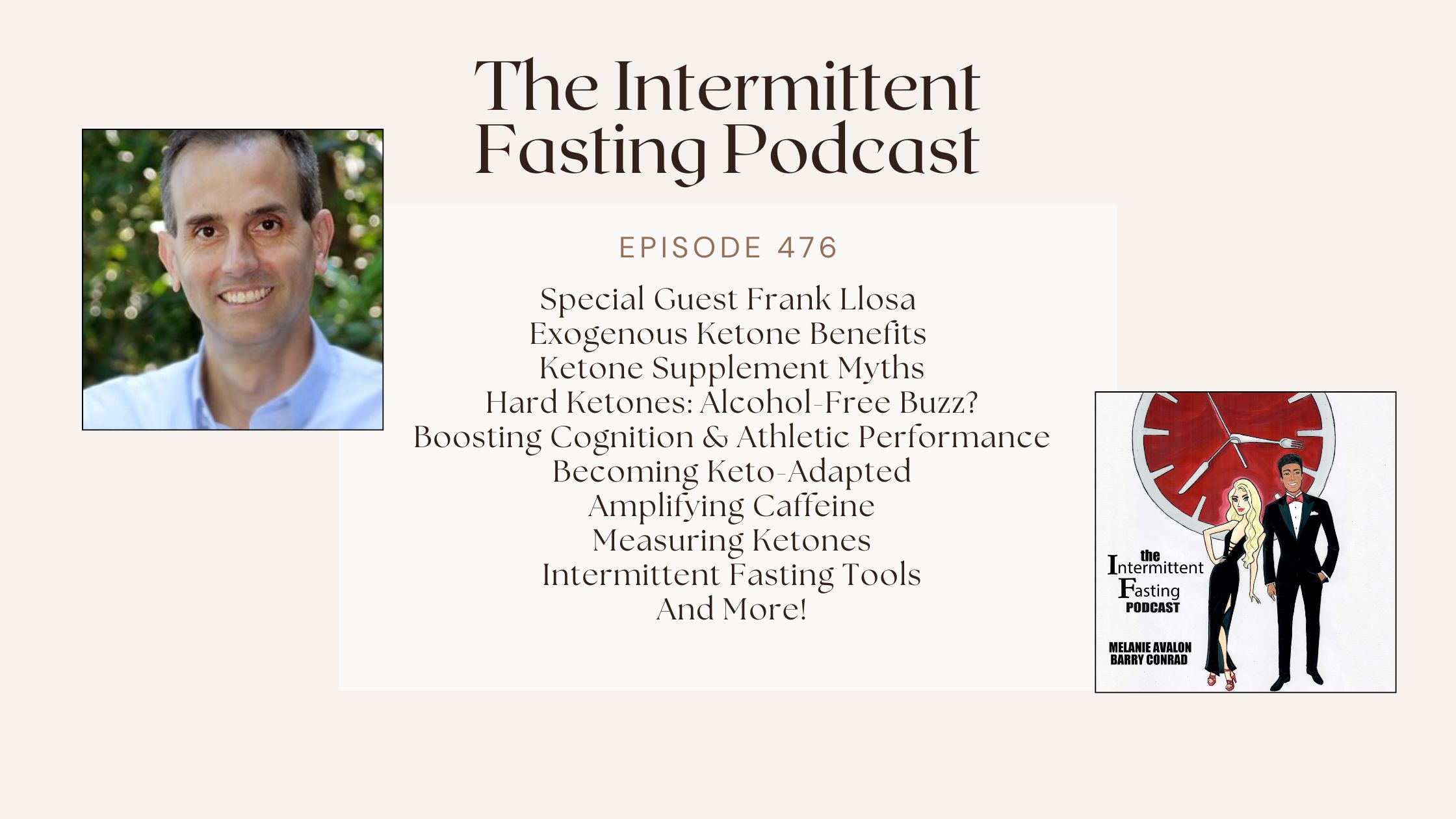
Welcome to Episode 476 of The Intermittent Fasting Podcast, hosted by Melanie Avalon, biohacker, founder of AvalonX, and author of What When Wine Diet: Lose Weight And Feel Great With Paleo-Style Meals, Intermittent Fasting, And Wine, and Barry Conrad, actor, singer-songwriter, and creator and host of Banter with BC.
SHOW NOTES
Use code melanieavalon at melanieavalon.com/hardketones for free shipping on Hard Ketones and KetoneAid.
Frank Llosa is the CEO of KetoneAid and Hard Ketones, positions he has held since 2017. His products are used by several Tour de France teams, and his company sponsors the Quick-Step and Astana WorldTour teams. His products are also being utilized in more than a dozen clinical trials around the world.
Socials:
@ketoneaid
@hardketones
SPONSORS & DISCOUNTS
PELUVA:
Peluva is a five-toe, zero-drop minimalist shoe designed to help your feet move naturally while providing enough cushioning for everyday wear, fitness, and athletic activities. Unlike traditional wide-toe-box shoes, Peluva gives each toe its own space for a more authentic barefoot experience. Get 10% off with code IFPODCAST at Peluva.com!
TANASI:
Tanasi creates a next-level, THC-free CBD with a patented CBD + CBDA blend found to be 3x more effective than CBD alone, naturally supporting sleep, stress, pain, recovery, and overall health and wellness. Their formulas are clean, tested, and come in easy-to-use options like tinctures, softgels, and soothing topicals. Get 25% off with code IFPodcast at tanasi.com
BIOPTIMIZERS
Get a MASSIVE 26% Off Bioptimizers' Probiotic Breakthrough, featuring the patented P3OM strain! Probiotic Breakthrough is a single-strain, stress-hardened probiotic designed to survive stomach acid and support gut health. It’s proteolytic, helping break down protein and improve overall nutrient absorption, while promoting a balanced gut microbiota. This plant-based, vegan-friendly, and travel-ready supplement multiplies in the gut for powerful effects without refrigeration. Get 26% off with code IFPODCAST15 at bioptimizers.com/ifpodcast.
If you enjoyed this episode, please consider leaving us a review in Apple Podcasts!
Original theme composed by Leland Cox, and recomposed by Steve Saunders.
Our content does not constitute an attempt to practice medicine and does not establish a doctor-patient relationship. Please consult a qualified healthcare provider for medical advice and answers to personal health questions.
TRANSCRIPT
(Note: This is generated by AI with 98% accuracy. However, any errors may cause unintended changes in meaning.)
Melanie Avalon
Welcome to Episode 476 of the Intermittent Fasting Podcast. If you want to burn fat, gain energy, and enhance your health by changing when you eat, not what you eat, with no calorie counting, then this show is for you. I'm Melanie Avalon, biohacker, founder of AvalonX, and author of What, When, Wine. Lose weight and feel great with paleo-style meals, intermittent fasting, and wine. And I'm joined by my co-hosts, Barry Conrad, actor, singer-songwriter, and creator and host of Banter with B.C. For more on us, check out MelanieAvalon.com and BarryConradOfficial.com. You can submit questions for the show by emailing questions at iapodcast.com or by going to iapodcast.com. We would love to hear from you. Please remember, the thoughts and opinions on this show do not constitute medical advice or treatment. So pour yourself a mug of black coffee, a cup of tea, or even a glass of wine if it's that time. And get ready for the Intermittent Fasting Podcast.
Hi friends, we have a very special episode today for you guys. It is with Frank Yosa, he is the founder of ketone aid and hard ketones. And this is the conversation I truly have been needing for years and years and years to learn about everything ketones and specifically exogenous ketones, as well as ketones that can give you a alcoholic buzz without the alcohol. True story. To be honest, prior to this conversation with Frank, I wasn't actually a fan of exogenous ketones. I was like, why take exogenous ketones when you can just make your own ketones? After this conversation, I'm having different thoughts. In this conversation, you will learn about the benefits of exogenous ketones, including for cognitive performance and athletic performance, how they can affect your metabolism, why you should not use them for weight loss, how to use them while fasting, tips to become keto adapted, how to amplify the effect of your caffeine without more caffeine. And of course, these incredible hard ketones, which literally provide the buzz like alcohol without actually having alcohol, mind blowing stuff. If you'd like to stock up on your own ketone aid, which is the exogenous ketones or the hard ketones, which are those non-alcoholic alcoholic ketones, which by the way, they come in pre-made drinks as well as shots, I'm going to stock up on the minty frostbite ones. You can get free shipping with the coupon code MelanieAvalon at MelanieAvalon.com slash hard ketones. That's MelanieAvalon.com slash hard ketones to stock up on exogenous ketones and or hard ketones and get free shipping with the coupon code MelanieAvalon. And now without further ado, please enjoy this special episode of the intermission fasting podcast with Frank Yosa. Hi friends, welcome back to the show. I am so incredibly excited about the conversation I'm about to have today. It is a long time coming. So the backstory on today's conversation, the way I first came across this individual, I actually don't remember the initial introduction. I just remembered the concept and the content, which was surrounding this product called hard ketones.
Melanie Avalon
And friends, I had never heard of this concept before, looked into it a little bit. And apparently it is a alcohol alternative featuring a compound called, I guess pronounced keto hall. Well, we'll talk about it on the show, promising or proposing to provide a buzz like state without the effects of alcohol and actually with potential health benefits because of the conversion to ketones that occurs in this drink. So I will.
I was overwhelmingly excited and obsessed with this idea, especially because at the time, one of my good friends was not drinking, and I'm a big wine drinker, I have my wine every night, so she was not drinking, so she ended up really loving hard ketones. Like I would have my wine, she would have her hard ketones, we were all like in a vibe. But in any case, that's when I connected with the founder, Frankie Yosa, who I'm here with today, and not only is he the founder of hard ketones, I feel like that, not that that's secondary, but he is also the founder of something listeners have probably possibly heard of before, which is ketone aid, and that is a form of ketone esters, so exogenous ketone supplementation. So when it comes to ketones, we talk occasionally about taking exogenous ketones and ketone esters, especially on the Intermittent Fasting podcast. I know there's a lot of conflicting information out there, there's a lot of controversy, there are questions about, you know, does it support your fast? Does it break a fast? How does it help your metabolism? How does it help your appetite? How does it help sports performance? Do you even need it? It's come up a lot when I've interviewed like, Luis Villanor of KetoGains, he'll talk about it. I've also had Dom D'Agostino on the show, so we talked a lot about ketones and all the things. And I am here with Frank today, and I really truly think he is the perfect person to talk to about this, because we were just chatting offline, and yeah, he definitely knows this stuff, and he has a lot of thoughts to share, and I'm really, really excited, and he has a very nuanced perspective as well. So I have so many questions. Frank has so much to share with you guys. Frank, thank you so much for all that you do, and thank you for being here.
Speaker 1
Thanks for having me on. I'm excited to...
Melanie Avalon
get into it. I've I'm really I don't know I like I can literally remember when I first came across the hard ketones thing and I was I was fascinated that I had never heard
Speaker 1
this concept before. That means I'm not doing a very good job.
Melanie Avalon
it's good. It's like it means you've got market. What's the word? Like you've owned that market. Like I haven't seen anybody else doing this is my point.
But before we like jump into all of that, I'm really curious, how did you get into the sphere? When did you first come across the concept of exhaustion as ketones? And I realized that we're talking about two different things here with the
Frank Llosa
Yeah, they're related, so I can get into that. So it started with my wife, we went to her relative's dinner party, and there was these rumblings about her godfather and how he should be given a commemorative gold medal, Olympic gold medal, because of his contribution to science and to sport. I'm like, what the hell are they talking about?
And then that's when I learned about Dr. Richard Veach. He worked at the NIH for about 40 years, trying to, he worked under Hans Krebs, so people might have heard of the Krebs cycle. So he wrote the longest paper that had Krebs name on it, but that was written by Dr. Veach. So he was the understudy, and Hans Krebs won a Nobel Prize in science. So then I went down the rabbit hole to better understand what he was doing, because he doesn't like explaining stuff from scratch, because it's kind of like, you know, 40 years. Oh, so what do you do? He just doesn't want to talk about it. So I did my own multi-hour, multi-day deep dive to understand the ketogenic diet, exogenous ketones and what he was working on so that I could hold a conversation with him.
And once I went to the next dinner party and he was there, I was able to talk and get along with him and understand what he was working on and the troubles that he had actually bringing this to market. And initially, I was helping him try to raise money because he just wanted someone to give him $20 million and then just have a tanker car of this stuff and people just line up and have a spout behind the tanker car and just make it and the world isn't that easy. So I helped him try to raise money, but the pitch didn't go too well because at that time, he wanted people to take $75 worth a day and it tasted like vomit.
So the pitch to VCs is like, okay, it tastes disgusting and it'll be $75 worth. What do you say? And meanwhile, CBD and all that stuff was taken off. So it's like, no, we'll just stick over here with the CBD route. And ultimately, he was just like, why don't you just go do it? And I was full-time in real estate, so nothing even remotely related to this. But I said, sure. And I then took the deep dive into doing it and took one to two years to actually manufacture it. When Dave Asprey bought this molecule a year before I got into this, he had it synthesized and it was like $25,000 just to make one shot of this stuff. So bringing the cost down. And just being able to scale it up is a huge task in and of itself. So we had multiple R&D labs that would sometimes compete with each other on the same task and then one would say, Oh, it's not possible. Well, thank God I hired this other one over here because they found a way to do it. And then we had a Kickstarter a year into it and I hadn't even drank it more than once because if I got a small vial of it, I'd rather send it to Ben Greenfield or Joe Rogan and like have them experience it.
Speaker 1
Like who cares what I, if I run a 400 meter, you know, sprint faster, no one's going to believe me or care. Let's send it to these guys.
So was able to build up a little bit of hype and then do a Kickstarter or Indiegogo actually on it and pre-sell a whole bunch of material that then took us another nine months to fill those orders because the way that we were making it was only like one kilo a day if we're lucky. So then having to scale that up for the next year and then several years after that, multiple levels of having to scale it up because we manufacture the whole thing. This isn't just, you know, click some button on Alibaba and buy it off of, you know, straight from China and put it into a box in the US and then say made in the US because you just literally put the bag from the right hand to your left hand and then you can say made in the US is all those tricks. So we do the manufacturing here and all the equipment. So you've got to scale it up every couple of years. You've got to buy new machinery and start all over again to scale it up. And that's been a multi-year process now. And along the way, I was understanding the differences of the different types of ketone molecules and the one that we have on the ketone ester side, it's called an ester. An ester means a bond of two ingredients, not a bond in the sense of salt being bound to an acid you put in the water and it separates. No, this is a covalent bond that stays together and it makes it more bioavailable. It helps deliver the ketones into your system and it is D-beta hydroxybutyric acid, also known as DBHB bound to this. So that's the ester, the ester is key. Some companies try to shortcut it and, oh, we'll just skip the ester and just sell it for cheaper. No, it doesn't work. So it's DBHB bound to this molecule called R13 butane dial. And once you consume it, it gets into the body, into the bloodstream. Some of it is separated in the gut, but some of it is gets all the way into the blood intact, separates and you have a fast release of DBHB free acid and then you have R13. 3-butanediol that then goes through the liver and makes a second round of D-beta hydroxybutyrate. So it's the target molecule, DBHB, bound to a molecule that converts into that target molecule. So it's super efficient. So other companies have tried to bind DBHB to glycerol. Well, okay, so half of your molecule isn't going to convert back into ketones and actually compete with your ketone. So it negates it. So you have to take twice as much because it's only half BHB, but then you might have to take four times as much because it's competing with this glycerol that might convert to glucose. It just doesn't work. So then I asked Dr. Veitch, well, if the R1-3-butanediol converts to BHB at, let's say, 70%, why not just take twice as much of that? It'd be much, much cheaper. And his answer was epic and changed the trajectory of everything. He said the mice were stumbling. When we gave it to the mice, they were drunk. And he's like, we can't have drunk grandmas. So that was thrown into the trash. And that's when I pulled it out of the trash and said, oh, I think someone might want that.
Speaker 1
Not necessarily drunk grandmas, but someone might want to have that buzz sensation in a way that would be much healthier than ethanol or even THC. And so I filed a patent on that, got a patent on that, and waited a few years into the ketone ester production to finally launch this because you've got to watch out for the shiny red apple syndrome when you're doing a startup. It's like, well, what about this idea? What about this idea? It's just it's endless.
So we really wanted to make sure that the ester side was stable. And then we finally launched the hard ketone side. And that has been another round of having to scale up and buy new equipment each step of the way. And we've been selling out of it frequently, which sounds good, but it's just not ideal when you have people on subscription and they're used to it and they like it to be like, oops, sorry, we've got either nothing or we've got to change them to one a different flavor that might not be up their alley. And yeah, that's what the R13 side that we call hard ketones and the ingredient, instead of the mouthful name of R13 butanediol, we call it keto hull. And it will raise your blood ketones, but it doesn't. We like to say different ketones, different results. So they're both technically, you could debate whether the R13 is called a ketone or a ketone precursor because it converts to ketones. But the ketone ester is more for cognition, recovery, mental clarity. People even use it for sleep. And then the hard ketones is more for after hours, relaxation. It kind of does the opposite. It's a demotivator as opposed to the ester being a motivator. So yeah, those are the two products. And Dr. Beach passed away a month before COVID kicked in and that's what launched the two concepts.
Melanie Avalon
What a cool like family party story. I thought I would be like fangirling just at the idea of like somebody who worked with Krebs. That's mind blowing to me.
It's mind blowing that things that are so just like common knowledge now about the metabolism and how everything works that the founders of those were relatively within reach general relationally to us. I don't know, because it just seems so foundational. It's, you know, it's like, oh, but he knew him. You will.
Speaker 1
absolutely dying go to heaven when you read the book, Ketones the Fourth Fuel by Travis Christofferson. It's the 250 year journey from Warburg to Krebs to Veitch and how the handoff worked and how metabolism and energy was understood and evolved. So you'll love that book.
I should read.
Melanie Avalon
heard of that book. Yeah, that would be completely right in my alley. Okay. And I'm also sorry about his passing before COVID. He definitely, my goodness, he brought a lot of goodness to the world. So thank you.
Okay, question. So you're saying the ketone aid, it is the DBHB bound to the R13, the R13 is still in there for the ketone ester?
Speaker 1
It's in there as a carrier and so if you took DBHB by itself, it would be a free acid and the pH would be too low, it burns a hole in your gut. So you need a delivery mechanism and one of the solutions is what's called BHB salts. They add a base. It's not a covalent bond. It's not really a bond at all. When you put it in water, on the left-hand side will be the BHB and the right-hand side will be the salt and that's what's called BHB salts. But the salt load on those products are so huge that they just don't work the same. It's not as efficient. It doesn't work the same. People think that it's cheaper, but I think something's more expensive if it doesn't work.
So on a cost-per-effectiveness basis, our product still is far ahead of those products and some people think that it works for them when they're doing these BHB or ketone salts. They use them just when they're entering into a ketogenic diet and they're trying to avoid the keto flu, which is what happens when you go on a ketogenic diet.
You lose a lot of water weight immediately and you sometimes will have brain fog. Things will get worse before it gets better, but I'd like to say that 80% of that issue is actually salt depletion. So ironically, you're taking these ketone salts thinking that it's getting you out of the keto flu, but it's just the salt side. You could save a whole bunch of money and just take LMNT or even cheaper, sea salt or pink Himalayan sea salt and you might experience the same thing. People that take those ketone salts while entering into a ketogenic diet, they report after a week or two that the ring doesn't fit on the ring finger anymore. Why? Because only during the adaption period do you need this super high salt load and then after that, your body is adjusted and if you still have this huge salt load, it doesn't work. So then people put it on the shelf and then they wait three months when they get kicked out of ketosis or something they want to get back in and then they take and like, oh, this is great. And it's just, it's the salt is my theory.
And then also most of those products, like 80% of them, they add caffeine and ketones, even weak ketones, drastically multiply the caffeine delivery. So what you're probably feeling if you're bouncing off the walls is the caffeine and you might say, oh, it's only 50 or 80 milligrams. Yeah, but if the ketone doubles or triples that or increases the delivery from some people have very low delivery to very high delivery, you're bouncing off the walls. That's not what ketones do. Ketones aren't a stimulant. They're not like caffeine. They are a calm focus energy. It's just a different feeling. So but people get tricked with all these add-ons and they even have keto pills that are technically Absolutely. Absolutely. it'd be like four drops of maybe even two drops of ketone escher in a pill form it just does nothing but somehow on amazon they still find a way to trick amazon to get three and a half four stars for nothing it's just it's it's pills of just nothingness but they sell 4 000 reviews on them it's like all right so a lot of people are just buying these things that do nothing
Melanie Avalon
With the amplification of the caffeine is that just when the caffeine is taken literally directly alongside a ketone supplement or if you're in ketosis and have high blood ketones would it does that also?
Speaker 1
amplify caffeine doesn't need to be taken at the same time it can be a few hours later I've even had people say you know they took it out of trade show and they're bouncing off the walls and I said well how long ago did you take caffeine like two hours ago I'm like yeah that still happens so yes also if you go full keto and you take regular caffeine yeah you're gonna notice it more a lot more so either cut it in half half decaf or cut it out completely you know if you can and we have protocols to help people get off of caffeine all together as this one lady we guarantee our product we give our money the money back even if we find someone doesn't like and they didn't even ask for their money back I like hunt them down and I refund them and they're like what are you doing like I don't want your money but now that I've given you your money back the stress is down now let me show you how to use it and about 80% of the time it works but you know 20% it doesn't work but for caffeine this lady talked to her about it for about a half an hour and she said oh no it didn't work find out that she was taking six cups of coffee and then she was she cut it down to zero and took the ketones and felt nothing I'm like well what do you normally feel when you don't have six cups of coffee oh I'm irritable brain fog and you didn't have any of those and no it didn't didn't feel anything like well ma'am that that's a tough crowd because that yeah you basically removed a stimulant drug from your system and basically got back to break even with the ketones that's the best you should expect especially with low dose I say hey if you want to feel it tomorrow go back to your six cups of coffee and drink this and you'll be bouncing off the walls I don't recommend that but then you won't be like oh this doesn't work you'll feel something and people always want to feel something but yeah helping people get off of caffeine so that you know after 30 or 40 days of being off of the caffeine you could probably lower your ketonester dose and not you won't need as much because you're not trying to overcome that that big deficit that you'll have for you know a month and a half
Melanie Avalon
Well, I will say, one thing I love about your site is, and I'm getting it now more speaking it to you. I understand why it's like this. It's very approachable in the way it's written, like the copy on it and just in your face. It's funny.
I was reading through the site, prepping this. I was like, this is well-written, the site. It's very real.
Speaker 1
Yeah, I love to point out the positives and the negatives because I think people, the more negatives you talk about something, the more they believe the positives. If you're all 100% all the positives, they're just going to be like, okay, there we go again. And it just sounds.
Melanie Avalon
Not believable and also to this point you're talking about all these misconceptions and everything and I mentioned before this offline that We talk about because we get questions on the intermittent fasting podcast historically We used to get way more questions and I feel like I feel like there was a time when ketone esters were Like the thing why I don't know like everybody was talking about them or maybe just on my podcast people were talking about them But we would get questions all the time and I was always Hesitant because I found that The reason people were mostly asking the questions to us like our audience specifically was because there was this idea that taking Exogenous ketones was like the way to to get into ketosis or to like be better at ketosis to help them lose weight and I was and I just kept thinking and this is what we would talk about law on the show is You know, if you're like if your goal is weight loss, for example Ideally, you would be burning you would be creating ketones from your body fat that you're burning off Not just taking it in, you know as an exogenous source So I'm curious. I have so many questions surrounding this.
I'm curious What was your because I don't know if you mentioned when you first, you know met Veach and was learning everything Like what was the benefit you were most intrigued by and that you were looking for and then the state Of being in ketosis and producing endogenous ketones. Is that at all any different to the body? Signaling wise from exogenous ketones like this the body even know where they came from
Speaker 1
when they're in the body. Okay, we can go through that. So Veach's initial goal was for mental clarity. And one concept really helps make it more clear is from Steve Koonane. He talks about the brain energy gap. The older you get, the less the glucose can make it to your brain to fully fuel the brain. And for the most part, the brain can be fueled by two fuels, glucose and ketones, or sugar and ketones. But most people are experiencing sugar because there's, Veach used to say, a McDonald's around every corner. So they've never really experienced the ketone and they have glucose. But when you have traumatic brain injury or the older you get, it's like a traffic jam of glucose trying to make it to the brain. And taking more glucose makes more of a traffic jam and it doesn't get to the system. So Steve Koonane talks about a brain energy gap saying, well, if the brain is only being fueled by 70% and adding more glucose doesn't get you to 100, it actually can make it worse.
Adding ketones, it uses a different pathway. It's a different HOV lane that kind of bypasses that blockage and fills the gap. If you're already at 100% and you take exogenous ketones, especially at low dose, you probably won't feel anything because it's like putting extra gas into a gas tank that's already full, like it doesn't do much. But people that have TBI, they take it and they're just like three sec, under a minute later, they're looking up at me and I say, what position did you use to play in football? They're like, how'd you know I played football? Because when people look at me that way, I know that it just hit them because they don't realize that they have this bigger gap until that gap is filled. And then you're like, oh wow, this is what I felt like 10 years before I was in that sport. So that was his main goal was for mental cognition. He actually wasn't a fan of ketogenic diet. He thought people won't change what they eat. So just drink more ketones. That was kind of his stance. I'm more in the, hey, let's at least try to give some people the option of ketogenic diet. And I've even talked to some doctors that, or patients that say your doctor didn't mention this to you. And they said, the doctor only mentioned it after I asked about it. And the doctor said, yeah, you could do that, but it's really hard. And the patient's just like, well, isn't that my choice to decide if something's hard? Like give me the options and I can be the 10% that will do it, but some doctors won't even recommend it because, oh, compliance is so bad. But if your condition is such that a ketogenic diet helps you on an everyday basis for nearly free, it should be no brainer. It should be more often explained to the patients for them to decide whether they'd rather have junk food or brain fog. As far as the body knowing the difference, yeah, it's probably going to know the difference within dodgeness because more things are going on. It's not just one, the BHB might be one of the three ketone bodies in the system.
Speaker 1
taking that one is going to be different than going to the Krebs cycle and burning fat and making it so it's going to be a little bit different. So I like to say that it mimics many of the benefits, but not all the benefits. And even on our website, we have a chart of like different times you can take it pre work out first thing in the morning before bed. And then it has a line for weight loss. And I just put like red X all the way across.
I don't even want to be in that if you want weight loss, go take those impact, whatever. It's not something that we recommend because mostly because of the misunderstanding of how it works. People think that they can eat a cake and then take ketones and somehow it negates the eating of the cake. Oh, look, I've got ketones in my blood. I'm burning fat now that I ate that cake. No, it doesn't work that way. And one of the confusing things is this concept of ketosis, the scientific phrase for ketosis, technically means ketones in the blood. Okay, but that's not what the consumer hears when they hear the word ketosis. So these other companies might say puts you in ketosis in 20 minutes, and they're not technically lying. But the consumer hears puts you in fat burning mode in 20 minutes. That's why I like to say it does not put you in ketosis. And I even coined the phrase exogenous ketosis and endogenous ketosis to actually differentiate the two, it actually skips the fat burning phase and puts ketones in your blood. So it doesn't it doesn't backtrack to make you burn more fat. So people think that they can cheat more. So you can gain weight by taking exogenous ketones, if you think that you're on a ketogenic diet, and this allows you to have more cheat meals, so you're gonna eat worse, it's not going to do what you think.
And you could gain weight in theory if it makes you cheat more. So but can someone use it in fasting? And does it break a fast? You actually mentioned that. And someone just asked me that the other day. And I love that question. Does it break a fast? I like to say, don't think of it that way. Think of it as, let's say you're already able to fast until 10am. If you otherwise would have eaten food that would have broken a fast. But if you take the exogenous ketones or the ketone ester to take you to 2pm to extend your fast, Does it break a fast? I don't know. Who cares? You just had 10 calories and you just got another four hours longer fast That's gonna that is gonna help fat burning more than eating that hamburger So it can be used by a practitioner that's teaching it properly to their patients If you have problems skipping breakfast, then sure you can try and take this Sometimes as low as like one capful like two dollars worth can help people skip breakfast But I like to say if after a week or two and your body gets used to skipping breakfast And you take half a capful and does the same thing and then you stop taking it all together and you're skipping breakfast Well, that's better. You're having no calories and you have just done, you know regular fasting it gets confusing But that's that's how I try to explain it
Melanie Avalon
So what is the actual literal caloric load of taking whatever dose of taking the different doses? I'm just curious.
Speaker 1
actual dose? The caloric load. Yeah, it's technically 12 grams per serving, but let's define what a serving is. Dr. Veach initially wanted an entire bottle to be one serving taken three times a day. So that was like 120 calories, three times a day.
But what we found after we launched it was people were taking half of a bottle and that was $30, $25, $30, three times a day. People were taking half of a bottle and it was effective. A quarter of a bottle was effective. It just kept on going down and down. And before you know it, the cap became our, what do we call it, serving size. And I like to say that the one cap is what we call one serving.
But that's the minimum effective dose that a sensitive female might feel. So many people will take two capfuls once or twice a day. That's kind of a typical amount. But the Tour de France riders, after a five-hour ride and they're trying to recover, they'll drink the entire $25 bottle straight up, the 10, 12 servings worth. So the word serving is a little bit tricky and confusing and I try to teach people how to take as little as possible because sometimes we've had people say, oh, it actually made me more hungry. I said, well, that's great because what happened was when you take a higher amount, it drops your blood sugar sometimes too much.
And when you get below a certain amount, then it will actually make you more hungry. So the solution for that person is take half. So it'll cost half as much and oftentimes that will work. We've had some people take it pre-workout when they're about to use the energy. But then they got diverted from the workout to go drive their kid. And this was a nurse and her blood sugar dropped to, I don't know, 65, 70 and that was just on, I don't know if it was one or two capfuls because she didn't use that energy right away in that workout. Instead, it was just sitting there and it dropped her blood sugar. So if she had taken the entire bottle worth, I don't know if it's a linear correlation with the blood sugar, but different amounts for different people and for different uses.
And again, if you already have your brain, if your focus is clarity and your brain is already at 100%, one or two capfuls, you're probably not going to feel much. You could try a higher amount, but then it becomes not economical. And there was this misconception with the Keto Master early on that it was super crazy expensive and tasted like jet fuel. And there was a Tim Ferriss podcast where a guy took an early version, didn't follow the directions to mask it, took it at like 6 a.m. and it was in his head. thinking, if I throw this up onto a counter, I'm going to have to eat it because it's so expensive and he's going through this epic, disgusting narrative. And now we have a few versions. One where it's actually not bad called ketone shot, where it's six times more diluted and it's fine. And if you can further dilute it in water, it's just like a peach squeezed in, nothing. You don't taste it.
Speaker 1
But our concentrate, which is 50% ketone ester, it's still rough, but many people get used to it and don't mind it. But it's not as bad as the marine putting one drop on their knuckle and just having to literally tear the Pepsi can out of their friend's hands to try to chase it immediately.
So we've come a long way on the taste and protocols of how to use it using less. Part of the reason that the high doses was initially recommended was because the mice would only take it with food. So then the dosing that would be correlated to humans was different when a human's taken it fasted on an empty stomach, you can take much, much less. So that was also part of the reduction in people just not needing as much. So we recommend people take it on an empty stomach, one, if not two hours beforehand. And people say, well, when can I eat again? Well, if you have brain fog and it helps your brain fog when you eat again, it might stop that, you know, it might stop that benefit because once glucose gets in the system, your body, even though they like to say the brain prefers ketones, sure, a fire pit prefers coal. But if you put kindling on it, it's going to burn the kindling. So that's kind of what ketones versus sugar, sugar is the kindling that wants to burn up really fast, even though it's healthier to have a sustained, you know, slower burning.
Melanie Avalon
Okay, so here, this is making me think of a question that I've actually had for quite a long time, because I'm thinking about the example that you gave of somebody who is getting new to fasting, for example, and they might benefit in the beginning from using these ketone esters to or like ketone aid to, you know, mitigate the hunger and then, you know, maybe they're taking it at breakfast and lunch to fast and then they don't need it as much at breakfast. So the, because we use this word, like keto adaption, or like people are like keto adapted or fat adapted or whatever it may be, is that because there are debates about there about like the keto flu.
And people will say, Oh, it's a lack of electrolytes or people say your body has to learn how to make ketones. So I'm curious when you were talking about like taking ketone aid and the form that it's in with the DBHB and the R13, am I saying it right? The whole metabolic conversion process that happens. And then mentioning people, you know, needing time or maybe like taking a while to experience the full benefits of ketosis easily. The question is, is does the body have to learn how to create and use ketones? And if so, or if not, either way, does taking exogenous ketones like teach the body how to use ketones?
Speaker 1
No, I don't think it does. So let's go into keto flu and you're kind of conflating two things because you can do intermittent fasting and eat cake and not be keto, right? So you can eat once a day and it's all sugar. Some people do that. And that's not necessarily going to be the same as ketosis. So we'll get into that.
The keto flu is people entering into a ketogenic diet. People love it because you lose four or five pounds the first couple of days, even though it's just water. Water doesn't really count, but people like it because of the scale. They look at the scale. It goes down. And in a very high, simplistic manner, every molecule of glucose is bound to a molecule or two of water. So less glucose in your system. Your system flushes out the water and you're urinating the whole bunch and your scale goes down and you're not necessarily thirsty. You're just holding on to this water bloating unnecessarily. I like to say that the keto flu is 80% electrolytes. And when we first got into this, my wife was my guinea pig and she was doing this biohacking stuff 10 years ago and she was very sensitive to stuff. She was on in the bed, eyes bulging, heart racing, headache, like, what did you do to me? I'm like, this must be the keto flu that I didn't experience as much of. And I called up Veatch or someone and they said to give her like 10 salt pills. I'm like, aren't I going to overdose her like 10 pills? And he's like, no, it's just salt. That's what they would do in the hospital. They give you an IV of salt within 15 minutes. She was fine.
So when your body flushes out all of that water, you lose a lot of salt, grams of salt, and you're not replenishing it. And salt is metal. It's they call it sexually electrolytes, but it conducts energy and electricity through your system. So if you're low on salt, that can happen. And we even had one lady who was 80 years old. Her doctor said to go keto and she was the next day or two, she was in the hospital and I talked to her and I said, oh, I can guess what it was. She said, how can you know what it was? It took them two hours to figure it out. And two of them were from Harvard. I said, they put you on a saline drip and you were fine in 20 minutes. And she goes, how did you know that? Like, because the doctor didn't teach you how to do keto and it just didn't increase your salt load. And people say, oh, I put more salt in my eggs. I like to say, did you unscrew the top? Because like shake, shake, that's not what we're talking about. We're talking about a lot of salt. So I think 80 percent of it is salt.
The other part problem is that your salt, that your sugar load is going down. And for a period of time, your body hasn't kicked in to start making ketones. So you have low sugar, no ketones, and you're in this state of just no fuel.
Speaker 1
So some people like to do it slowly, you know, one week. 10 days and I even heard about it in the conference.
They're saying to do it slowly And I looked at the person next to me who was not in that camp It's like why would you recommend that when you can do this other way which is just peel off the band-aid So how do you peel off the band-aid a couple things you can just do a 24-hour fast with or without ketone ester 24-hour fast and your body just Runs out of glucose and it more quickly will shift as opposed to being in this limbo land You can do wind sprints get on a stationary bike or wind sprint 3045 seconds can help deplete that what I call like a battery glycogen battery You need that to be zero and every time you do a cheat day it fills up the battery So you have to start all over again and slowly burn the battery down You can do it over 10 days five days three days or pull off the band-aid with a 24 48 hour flask Fast heck schedule a colonoscopy. They make you not eat for two days.
It's perfect perfect timing do that You know get your pipes checked. So a lot of it assault, but it can be this depletion You can use the ketone ester Some people have used it during that transition period when the when there's an imbalance There's you're not making ketones yet and and the sugar is low It can help a little bit with that people have done it that way But then as far as people who are not ketogenic, but then they're doing the intermittent fasting.
That's a slightly separate thing I don't think the taking the ketones makes your body signal to okay. Now let's burn fat. Let's get used to it I think that there's something else and this is not very scientific. I'm not a doctor not a scientist But I think there's something more to the gut and the pattern of skipping breakfast Getting used to skipping breakfast your body Having that grumble and saying you know what that grumble switched that narrative to be oh, I gotta go eat food That grumble is hey, if you don't give me food, especially glucose right now I'm gonna start burning fat You know Convert the narrative to that and you're like, okay, go ahead great You know that that rumble that means it's starting and then you just I think if you do that for a week or two Your body doesn't wake up craving it anymore. And I don't think that's necessarily fat burning or keto adaption. I think that's just your body Getting used to a rhythm of I have food three times a day nine twelve seven I'm going to rumble at half an hour after each one of those times you move that schedule And stick to it for a while your body just Doesn't expect or demand food
Melanie Avalon
Yeah, no, it does. I'm thinking it through in real time in my head.
I would love to see a study where people have been eating a non-macronutrient restricted diet, so they're having their carbs still and all the things. And half of them, though, are using exogenous ketones at some point and then the other half aren't. And then have them go on to a daily fasting schedule or even a keto diet. One of the examples you mentioned about the ways to get there, I would be so curious if the group that had been supplementing exogenous ketones historically, if they at all just transitioned faster or easier or if it literally is just based on... It'd be easier because...
Speaker 1
Because your first five days, you have no exogenous ketones, you're just flat out not eating breakfast and you're used to having breakfast for the last 30 years. You're going to be annoyed, you're going to be distracted, you're going to be thinking about food.
So yeah, it does help that and I have not seen a trial that compares that.
Melanie Avalon
Yeah, so like basically it does like prime the system in a way to be more comfortable and adaptable with jumping into this.
Speaker 1
Sure, it helps suppress the appetite so that the you're not eating and then your body gets used to not eating at that time frame and Then yeah, it makes it easier
Melanie Avalon
reading about Owen and Cahill and their commentary on Beech's approach to exogenous ketones. And apparently they did a study and they found that in a three-day fast, ketones were the preferred fuel source for muscles during a three-day fast.
But the study participants switched to burning free fatty acids after 24 days of fasting. So with really, really extended fasting, it looks like the body switches back to free fatty acids. Well, the K
Speaker 1
Yale studies, he was, I think, 20 to 40 years older than Beech. So that was, I think, in the 1960s when they did a multi-day fast that they would never be allowed to do today. They called it the Jesus Fast, it was 20 to 30 days, and Dr. Beech makes some jokes about it.
If you want to hear a podcast, basically the only podcast that Beech did because he was all about, read the goddamn papers, and I brought him kicking and screaming because other people were being crowned as the king of ketones, and I was like, no, you need to get on podcasts. He's like, I don't want to be. So it's a Dave Asprey podcast, I think it's $299 or $300, and you'll see a two-hour deep dive of him, and I make a cameo at the end about how I was doing ketogenic diet, and I was able to hit like eight mil molar just on the diet with no exogenous ketones. But with the Cahill study, they were, I think, yeah, Beech joked about them being on a Jesus fast, and they were theologians. I don't know if that was true or not, but yeah, they fasted them for multiple days, and they showed that the brain could run exclusively on ketones, that it didn't need glucose when ketones were available. I'm not familiar with what exactly it might have done to muscles deciding what fuel to make, because if you go fasted too long, you will burn muscle to make fuel out of that. So there is always that, you have to watch out for it, which is why when people do the exercise, you're basically going to be fasting, you're going to be losing weight, but you're going to be losing muscle. And if you don't pay the extra $100 to do a DEXA full body scan at the beginning, and then every three months to make sure that your muscle is not being lost, because if the muscle gets lost, the moment that you get off those GLP ones, you're going to actually be exponentially worse than your baseline. So it will eat muscle if you fast.
Melanie Avalon
You know too much. Yeah, and i'm really curious with the because there's so much information out there about people like losing muscle And all the things and I really wonder though how much of that is people just Not paying any attention to protein intake or anything like that.
They're just severely calorie restriction restoring
Speaker 1
Yeah, sure. I mean, there are, you know, you could, yeah, you can focus on eating. If you're going to be eating fewer calories, maybe it should be higher on the protein side. And then there are some protein supplements, like perfect aminos, just to kind of crank up another food is best. But if you can supplement on top of that, but it still has to do with going to the gym. Like, I don't think just eating the protein is going to be enough.
I think you have to actually work out your body and actually think that's where GLP ones can actually work well with the ketone ester. And one researcher recently is saying that they were doing some studies combining the two, but she didn't really know how best to combine them. And I was explaining my theory is that the ketone ester will help with GLP ones because GLP ones, when you're fasted, your lower energy and lower motivation to go to the gym, and you actually need to be going to the gym more. So it's like this counter, okay, I'm losing weight, but now I have lower energy because you're not getting calories. But then you try to go to the gym and you're just half-assing, and it's just not working, or you're just less motivated, or you go less frequently, because you're just tired. That's when the ketone ester can actually kick in, not for appetite suppression, but for energy, a low caloric energy that will help you get motivated and make that gym experience better, because you really need to be building that weight, not running, not jogging. And I have a track background, so for me to say that is tough, but just hyper-focused on muscle building three times a week, if not more. But the DEXA scan is key, key, key. If I hear someone that's on a GLP one and they're not getting a DEXA scan, I'm just like, why bother? I know it costs another hundred bucks, but you need to know where your muscle mass is, and you need to maintain that. It'll slow down your weight loss, but who cares about weight? If your muscle's the same, that's what you want. You don't want to be losing muscle and losing fat and make your weight loss appear faster. You want it to be a sustainable system, so you got to keep your muscle up, and more muscle is more weight, but your pants will still fit much better, because muscle's more compact than fat.
Melanie Avalon
Yeah, we are major fans of supporting muscle around here. So you mentioned, you know, that you did track and so your products are actually used by several Tour de France teams.
So what are the effects on endurance and athletic performance?
Speaker 1
That's a tricky thing. People want it to work like caffeine. They want it to be a no-brainer, pop a pill of caffeine, 15 minutes later, you know what it does.
Ketone ester is very tricky. So there's a no-brainer protocol, which is for recovery. So taking it immediately after the five-hour Tour de France ride, that's how most of the Tour de France riders use it. And we've got videos of athletes, Mark Cavendish, who broke the world record for the most number of stage wins the day before he won the last and final stage to break that record. And there's a whole Netflix on him trying to break the record. He had to do a mountain climb, and he was just exhausted. And the sprinters, which is his cup of tea, if they don't cross the finish line within a certain number of minutes from the first person, you get cut. And so it's really hard for them. So he was dying, dying, dying. And when he finished, he was like, where are my ketones? The first thing that came into his mind was, where are my ketones? And this is not paid for. This is not something that we could script. And they lost it. They couldn't find it. Like, I don't know. And he's like, where is it? And he's looking to the left and the right. And the assistant's like, you know, looking through the bag, and they're like, oh, it's over there. And he finds it, and he grabs it, and he chugs it. And it's like this Disney World moment of, like, you're just on the Super Bowl. Where are you going? I'm going to Disney World, going to Disneyland. And you know, he chugs it. So these riders take it immediately after their five hours to help for recovery.
So there's been clinical trials that show 15% improvement in recovery on overtraining. So 21 day workouts of overtraining with the group with the ketonester when they did the time trial was 15% faster. And the last day of, or the day before workout, they were able to do 15% more watts. So it's massive and pretty brainless on that side. Now a customer should ask, wait a second, he's taking a full bottle. And here you are saying, take, you know, two or three cap fulls. That's a big difference. So the clinical trials are always about more is better. And what's the maximum they can take without GI problems. And that's what they test. And that's what works. And then the Tour de France riders will follow that. But we found consistently, people have been able to take less. It hasn't been proven scientifically. So I like it when these ketone companies say, backed by science and stuff like that. It's like, well, okay, but the science isn't necessarily the best way to use this. So people have found benefit as low as one or two cap fulls.
If you're running a marathon, yeah, sure. You might chug half of a bottle or a full bottle of the KE4 right afterward. So yeah, so the Tour de France riders will mainly use it then, but then they also use it immediately before bed, which is very counterintuitive.
Speaker 1
People think, again, of this as caffeine and it's not a caffeine source. I mean, some people take tablespoons of honey before bed. It's more like that. It's a calorie that's replenishing the system.
They take a huge dose before bed, which, again, if you did that without doing a five-hour workout, you would be up cleaning your closet for the next three hours. So some customers will take, female sensitive people will take as little as half of a cap full immediately before bed. Some people will take two cap fulls, so it very much varies. I can't take any before bed because I'm already keto. I'm keto vegan. I've been like that seven, eight years. And if I already have a baseline of ketones and I add a cap full, I'm like, oh, I want to get a better night's sleep. It doesn't work for me.
It makes my brain turn on and, you know, that's no good. However, if there's a night like recently where I went to bed and I was just super tired, it was one or two a.m., and I had to wake up early for a flight. Then I knew I could actually take a larger amount because I knew I was so tired that I'd go to sleep, even if I took four cups of coffee. And that's when I woke up like a spring chicken. My wife was like, you only got four hours of sleep last night. How are you like the first one getting up helping the kids? And that's what the ketones do when it works. But you have to be aware, if you are keto, I don't tend to recommend it except for occasions that you're super tired, you ran a marathon or you're up super late or you're a night worker and your schedule is all messed up.
So the Tour de France people reliably, immediately afterward and before bed. There are a few riders that have found their own protocol. And Dr. Dog, who is a coach for one of these teams, like to say, everyone has to make their own protocol. Like, we'll try different things, but what works for you? We have had mega responders have been able to take a full bottle every hour and held on to the yellow jersey for multiple days. And it wasn't expected. So he was leading the Tour de France with multiple bottles. But some people are scared of taking it during the ride. And I think what happens is they take too much and then their blood sugar drops, and then they feel blocked is what they say, that they're not able to tap into the glucose. And there's this concept in the science world called glycogen sparing, which sounds sexy, like glycogen sparing, and then you can turn it on when you need it. I like to think of it more as glycogen blocking. Glycogen blocking is also sparing, right? But then you can't tap into it. So I don't recommend taking this. in a four hour race right before you're about to sprint because your blood sugar is gonna drop and you might not be able to tap into it as well. But there are strategic ways I think to take it that some of the Tour de France riders are more reluctant to do without, hey, show me a clinical trial, will they prove this? And it's like, well, that'll be five years.
Speaker 1
Meanwhile, the other riders are doing this and you're missing out, but it's up to you. But taking it altitude exponentially helps better at altitude. It has to do with the heart efficiency and just it makes it that 6,000 meters feel like 3,500, 4,000 meters. So it helps with altitude.
It helps with drastic temperature. So super cold, super hot. It helps with hill climbs. There's more mitochondria in your slow twitch muscles. So you're pedaling. Oftentimes it's the same cadence, but when you go up a hill, you're going to be slowing down your cadence. So it's like doing a stair master and there's more mitochondria in the muscles. So it does more for that. So people might take it right before a hill climb. I asked this one guy, Anthony Kunkel, who's done, he won the American 50 kilometer, 50 miler race a few years back. I said to him, if you had someone taking ketone estrogen, you only had one chance, because this is how it is sometimes. You should try it five or 10 times in different ways, but sometimes some people are very skeptical. If you had one chance, how would you take it? And he said, go out for a run, whether it's one mile that's hard for you or a hundred miles that's hard for you. Whenever your brain starts to go, because the glucose just doesn't make it to the brain, when you're doing these longer workouts, your brain just starts getting taxed and starts doubting why you're doing this and starts making, you start compromising with, well, maybe if I drop it down 10 seconds slower, I'll still do okay. That is when he recommends taking the ketones toward the end of whatever workout you're doing where your brain starts to go and it'll snap your brain back, because I think that has to do with the brain energy gap problem.
The glucose isn't making it to the brain. You give this alternative fuel and your brain feels the same as the beginning of the workout. Then you're like, you know what, I can do this. And you have a better mood and you can push your muscles more. Some people like to take a pre-workout, but they like this concept called a dual fuel. It's super sexy and easy to put in marketing ads, but I don't necessarily agree with it. This concept of sugar and ketones, like two fuels. Okay, there are people that works for them, but that's not, when I have one or two chances with someone, that's not the route that I take because it's gonna be 50-50, but people on their own tried it and half the time it worked, the other half, might give us a two-star on Amazon.
The way that I like to recommend using it changes so many things. It's easier to take it immediately before bed. And immediately after the workout, that's the brainless. But then if you actually want to try doing it in the rides, that's where it gets tricky. Because I think that the glucose and the ketones actually kind of compete with each other, not this dual fuel concept. So then that's, okay, well, let's talk about fasted workouts. Let's talk about, you know, doing fasted workouts and adding ketones to it.
Speaker 1
And there's some message boards or they're either keto runners or they're fasted workout people and they say, oh, I don't need ketones because I make my own, which is a very sexy sounding thing. And I just laugh because it's like a glucose-based person that eats all these gels saying, I'm not going to drink, you know, my body makes glucose, I'm not going to drink gels because my body makes them. Well, no, those people are adding gels on top of their glucose sugar-based system. So if you're doing fasted workouts, adding ketones on top of what your body's already making, that's kind of like a dual fuel. You got endogenous ketones, your body's making ketones and you're topping it off with exogenous because glucose-based riders, when they do, sometimes they will do one or two fasted workouts a week, but they expect their watts to go down. They go down five or 10% and they just, that is what it is. And then why do they do it? Because it helps for burning fat, it helps for weight loss for the rider if they want to just be more of a stick. And it helps for recovery. The next day, they're not as sore as they can do more hard workouts and you're still building the muscles, even if your watts are lower.
But when you add ketones to those fasted workouts, it brings people back to their glucose baseline. So now you have the best of both worlds. You have the anti-inflammatory, not as sore the next day, but the same watts and the fat burning because the amount of calories of this is tiny compared to glucose. So you've got to be burning something. And so fasted workouts is where it is also a no-brainer. So if someone already does a fasted workout, having them add 10 mLs an hour, 5 mLs an hour, they oftentimes will notice something immediately. Now if someone is normally taking a whole bunch of sugar and a whole bunch of caffeine before their workout and they drop all of that and they try to go for ketones, hit or miss sometimes, but it's just going to be different. You're running on a different fuel source. It's not going to be as predictable. The next day, you're going to be less sore, so you're going to forget about that benefit because you win races based on your ability to work out and recover. That's where the goldmine is, not race day. So fasted workouts. We're even playing with a new protocol for people that are more interested in exploring this concept of doing short term keto before the race. So the exact opposite of carb loading, go to the pasta shop and get all you can eat buffet and load up on carbs the night before doing the opposite and actually going keto. So glucose based all along the week and month before that, but then three or four days before going full keto. And I had this one guy do it because he was every small suggestion that I had given him and worked. He was like, okay, well, what else you got? Let's go down the rabbit hole. Let's try it all. And I had him go short term keto. He had never gone keto before pre-race, which is hard from the concept. And I didn't tell him about the water loss thing. And he calls me up after day two or three and he's like, I'm just going to the bathroom a lot.
Speaker 1
Like, is that normal? Like, yeah, you're losing water, but you're not more thirsty. And when he started on the starting line, he was three or four pounds lighter. And even one of his friends was like, hey, I saw you last week and like, you look different. All of that inflammation is gone. He's four pounds lighter. He just spent, you know, God knows thousands of dollars on this bike that might be a half a pound lighter and he just dropped four pounds. Like, what is that worth?
Your muscle is going to have the same strength. It's not like you're going to lose muscle in those three or four days. And with cycling, it's a lot about the watts per kilogram or watts per pound of the rider. And if you drop four pounds, that changes that ratio a lot.
So he was able to do three or four days pre-race keto and then just use ketonester and salts during the entire four hour ride. No gel packs. His friend was like, here, take a gel pack just in case you run out of fuel or bonk. And it didn't happen.
His friend bonked and he had like, you know, five, 10 gel packs. But you know, you don't want to jump straight into that. You got to really practice that. People call us all the time saying, hey, what do I do? I've got a race in two days and I've never used this. I say, don't use it. It took you 10 years to figure out the size of the banana in your marathon. And now you're just going to like absolutely change everything.
Like don't do that. What you can do is do some pre-loading. That's another protocol that's low risk, which has taken it a week, seven days or even one or two days before your race to help just build mitochondria and help just recover. So that as if you're tapering for the Olympics and you're just more recovered for that race day.
Does that answer your question of like how they use it? It's really. quite tricky and tailored to everyone and a lot of people are just very reluctant they want to do parts of the equation and not all of it they wanna i can't stop my caffeine okay well then you're in the bathroom in your marathon. Because you had the runs cuz access caffeine gives you the runs another thing that the ketones do is make you what we found this not been scientifically proven trying to prove it but time and time again feedback from customers. Drops the heart rate 7 beats per minute but recently a customer said hey you said that it would lower my heart rate but the heart rate was actually 10 beats higher what's going on i said did you look at your pre workout drink did it have caffeine in it and he looks at it he's like oh yeah. So the ketones multiply the caffeine and caffeine is known to increase the heart rate so then he had the doubling effect in the wrong direction so the next time you cut out the caffeine and it. Drop down 7 beats so a 14 beats per minute for the same what's difference and that can be pretty huge if you're if you're able to be lower heart rate at the same what's that allows you to. Be glycogen sparing because you're not tapping into you know high heart rate glucose needs you can stay in that fat burning zone.
Melanie Avalon
Longer. Wow. Okay, so many things. Sorry. That was a fire hose.
No, I love it so much It's interesting because when you were saying how You know people say that they do that the double fuel or whatever and they do the glucose and the ketones I was thinking how that's literally the complete opposite of what I Try to do like I I probably to an unhealthy extent I get worried about this concept of energy toxicity and just like too much for the system So I try to always either be like ketone fat burning or Carbs like not not both at the same time I just don't think that would work for me very very well And I like the sleep piece and if listeners go to your website So they can either go to ketone a.com or hard ketones calm It will go to the same website and by the way the coupon code Melanie Avalon will get you a discount But more on that in a bit you have a lot of studies there And so listeners can check that out and like I was reading one like you mentioned about the sleep and it was literally It was literally supporting what you just said because it was talking about, you know athletes taking ketones for recovery for sleep and it specifically found Let's see that it helped there it helped the decrease in REM sleep that they normally would have Experienced and the increase in wakefulness after sleep onset improved sleep efficiency by 3% So that's yeah, that's anything. Yeah
Speaker 1
Yes, I agree with those. They also probably took high dose and they also were riding for five hours.
So if you go to Amazon and you search for the reviews, you look up the word sleep, you'll find more realistic real world experiences, which aren't scientific. But people saying, hey, I went to sleep with my cell phone on my chest, I know I shouldn't, but I took the S right before and I woke up the next morning and the cell phone was still on my chest. Normally, I get up two to three times asleep or roll left to right and I just was a mummy for eight hours. Or people saying, hey, I get a cortisol spike at 2 or 3 a.m. and I have to go to the bathroom or I get up and then I'm up for two hours and then small amount of ketonesia, they just skip that. They just stay asleep. We don't know why, especially the super low dose. It's not about testing your blood ketones and saying, oh, is it 0.5, 0.2, 1.5? It's just some sort of signaling thing that is happening that is just making people feel better. And initially, for the first two years, we said not to take it before bed, but then Travis Christofferson, the guy who wrote the book, he said, no, no, Frank, I took 10 mLs last night and oh my God, I slept like a baby, you got to try it. I'm like, what are you doing? You don't want to have energy before bed. He's like, no, you got to look into it. And for him, it was 10 mLs on the higher amount, but most people have a cap for one to one cap full. And we even have on our Facebook group where we chat about the good and the bad and people text us when things don't work, I say, hey, go to the Facebook group. And like they said, you want me to talk about the negative of it not working there? I'm like, yeah, so we can all troubleshoot and all learn. And on the Facebook group, people post photos of their nightstand being ruined with little one inch circles by having the KU4 on their nightstand. I'm like, sorry, because it'll drip down a little bit on the side and they take it immediately before bed, not a half an hour before bed. Mistakenly, people will do that or an hour before it doesn't help you go to sleep. It's more about helping you stay asleep. But we've helped people get off of two or three sleep medicines as well. They take one sleep medicine, but then they have to take another medicine for the side effects of that first medicine before, you know, they're taking two or three. And then, you know, with their doctor's permission, of course, don't do anything without the doctor, they were able to, you know, cut that out and just use this. And some people even wake up 15 minutes early and they're worried. They're like, hey, I got less sleep, like, yeah, but you felt better, right? Like, yeah, well, your body got what it needs. And you know, what do you charge per hour, 50, 100 bucks an hour? You just.
Melanie Avalon
save 25 bucks. No, I love this real world application. And now I'm thinking more, okay, so because you asked me before if I had taken them and I hadn't, and it was historically because of a lot of the reasons that we discussed, leading up to this, which is, I was thinking while I get into ketosis on my own with fasting, I don't do intense athletic performance. Now I'm just thinking about it more.
I don't struggle with like skipping breakfast or skipping lunch, but I do, I do a one meal a day pattern every single day. And I eat right before bed and it's very high protein and then it's either low carb or low fat. And so it's normally, or to say it alternatively, it's either high carb or actually I don't really go super high fat. So it's either low carb or it's like high carb, low fat. And usually it's the high carb, low fat. So like lots of protein, lots of fruit. So I'm just thinking like practically when or how would this best benefit me to integrate into my life. Do you have any brain.
Speaker 1
fog or sundown in effect at 3 or 4 p.m. and do take caffeine.
Melanie Avalon
So ironically cuz I just launched a coffee line, so I'm all about coffee But I don't do I don't drink a lot of coffee. Actually. I don't have a lot of caffeine.
I don't really Experience brain fog. I mean I will get tired and take naps Occasionally, especially if I went out the night before I'm pretty consistent
Speaker 1
So the more of a deficit you're at, the more it works. So if you're out late the night before, that'd be a great time to take 5, maybe even 10 MLs and you'll wake up more fresh. Or you can take it in the morning when you have had a low amount of sleep and you're dragging. So that'll help you bring you back to baseline.
You could do it post workout, doesn't matter the type of workout, doesn't matter if it's running or weights, post workout because some people, if they have a hard workout and they're trying to go to use their brain for work, the brain sometimes doesn't really catch up because you're just drained from that workout. The escher can kind of bring you back. And while you might say, well, I'm already doing fasting or I'm already making a little bit of ketones, okay, but your brain's that 0.5 that you're making through that fasting probably isn't enough to make, first of all, you burned it up in the workout. So that's all gone. So you could take it post workout before you're about to do actual work.
You could also take it selectively for podcasts and stuff like this so that your brain is on a higher level. Just if you're really going to be intensely thinking for an hour or two, that's a great time to selectively take it and try different amounts.
Take one capful, two capfuls, half of a bottle. Rhonda Patrick used to down an entire bottle and I was like, no, that's way too much. And she would have this spike of energy and then crash hard afterward. I'm like, no, you're taking way, way too much. And people look at their blood numbers real quick and they see that the peak is at 40, 45 minutes and then it crashes and they think, oh, the ketones are out of my blood. They stop working. I need to redose or ketones don't last very long. But what they're missing is ketones don't do anything in the blood. They don't make it redder. They don't make it thinner. They don't make it do anything. It's when the ketones leave the blood that they start to work.
And they've even done a brain scan where they're able to see, even though the ketones went down after 40 minutes or peaked at 40 minutes and started coming straight down, it stayed in the brain for two, two and a half hours high, like not even like starting to come down at the two and a half hour mark. So today you can use it selectively for important meetings and stuff like that. But on a day-to-day basis, you might not be a candidate for taking, well, there'd be a longevity protocol, potential reason to take it. I don't really like that as much because people want to feel something. They want it to be noticeable and obvious. But the science will say, if you were to add an extra cap full or two twice a day, that it could help for just general longevity.
But I don't really like selling something that is hypothetical, hey, take these pills for six months and let's see what happens and see if you feel better. But technically, there would be an argument for that. I just tend to not promote that. I'm lucky that we have a product that when it works, it works. It's not like, oh, well, I want to take these, you know, sugar packets for a few weeks and see if it works.
Speaker 1
No, you're going to take a sugar packet and you're in your run, and you'll know whether it worked or not. Like, you might have to tweak the amount, but it's instant. We've had some people with brain fog, they said, well, I tried it for a couple of weeks, and it didn't work. I'm going to give it another four weeks, and that's it.
It's like, no, no, no. We need to change the protocol and give it a day or two. Like, that's it. So, in that day or two, it's a function of changing the protocol. Let's find out what you did wrong, or if you did something wrong, and then oftentimes it's, oh, well, I ate. You said to take it on an empty stomach, I took it, and then I ate half an hour later. Oh, the blood peaks at 40 minutes, and right when it's about to start to work, you ate a bowl of grapefruit. That's why. Trying it for another six weeks isn't going to do anything. So we try to tweak the protocol, or we go up in the amount, and they say, oh, well, that's not sustainable. So it's a lot less expensive for you to do a one or two-day test at a higher protocol than a low protocol for six weeks and have it do nothing. Let's work backwards. Let's go in the other direction. Let's try a high amount. And then if you're like, oh, wow, that really worked, then you recognize what that mental clarity is like. You can cut it back and see if you still get the same mental clarity, and if you don't, then you decide, is it worth $5 a day?
Is it worth $10 a day? We have some people that are former NFL, now a sales rep, and he takes an entire bottle. It takes $30 worth a day, and he's like, hey, if it helps my sales make me another $200 in commissions, I'm 8Xing my money because I'm on. So different people, different amounts, but more is not always better. So we try to teach people how to be cost effective and find ways to take less. But for some people, they have to take more. So you could try it a bunch of different ways.
Melanie Avalon
You touched on something that we talk about a lot on the intermittent fasting podcast, which is the people obsessively measuring their blood ketone levels and even experiencing that when they first start, be it keto or fasting or whatever it may be, that they're high and then they're chasing these high levels and then they start experiencing lower levels, but it might just be because their body is actually now using it. So I like your comment.
So many people don't know.
Speaker 1
that and the doctors don't know that. I get calls from people that say, my doctor says I need to be at one or two millimolars and I'm freaking out. I've been doing this diet for a year and they're going down. So now I need to pump up with exogenous ketones to fill out the number and hit those numbers. And I'm like, no.
First of all, the stress that you have is not helping you any. But what the doctor is missing is that over time, you increase your MCT transporters. It's the transporter, that HOV lane that gets the ketones out of your blood to where they need to go. That gets bigger and it shuttles them faster. So you think that you're making less ketones. The ketones in the blood is just a very high level snapshot of what's going on. It does not tell the full story and it changes over time. So you're exactly right that you might be eating the exact same way. And some people hyper obsess about percentage fat with these calculators and apps and stuff. That's fine. And they think that their numbers are going down and they think that they're making less ketones, but that's not necessarily true at all.
It could just be your body's using them up. We even had one person that had mental clarity issues, but they also wanted to test the blood. And it wasn't, this was weird. It wasn't showing up in their blood, even at the doses that it should have. I said, okay, but are you feeling anything on the mental clarity? And he's like, oh yeah, totally. I'm like, well, if you felt nothing and you saw nothing on the meter, okay, here's your money back. I don't know. Maybe you have some missing enzyme that's not cleaning the product. Who knows? But you're not seeing it on the meter, but you're feeling it cognitively.
I don't know. Maybe you are one of these hyper people that the brain is in such demand for the ketones that just sucking them all up and just using them all up. Like I'm, I care more about the feeling and I believe in placebo, you know, Joe dispense that you are the placebo. I believe in all that. But if you feel better, like that's, that's the focus. So yeah, chasing the blood ketones. I haven't tested my ketones, you know, in a long time. Sometimes if a kid stubs his toe, one of my kids stubs his toe and, and I have a ketone meter somewhere, I have been known to like throw in, I'm not going to prick them, but he's already got blood there. Let's see what it's.
Melanie Avalon
wait that's so funny because literally whenever I if I like you know cut my finger or something I'm like oh let me let me test
Speaker 1
I might test once every three or four months to kind of see where I am. So first thing in the morning before any food, supplement, water, anything. But for the most part, I haven't really tested.
I do suggest that people, if they decide to go intermittent fasting and stack keto on top of that, because it's an important thing. My uncle is a doctor and he won't even listen about ketones and he was overweight and he only did intermittent fasting. But his one meal a day was what made him lose a lot of weight. But he ate bread, he ate everything. So it's not keto. You can either do keto by itself, two, three meals a day, or you can stack keto and intermittent fasting and potentially have better results. But if you are deciding to go down this fully keto route, you really do need to have a blood meter, more so than even tracking your macros. Because there are people that will stay in this 0.2, 0.3, 0.5, not really get into ketosis because they're doing it wrong. And then they have multi-weeks of just no success and brain fog and keto flu. And then they say, oh, well, I took some online tests and it said that ketones aren't for my body type. It's crap. It's like, no, you took it wrong. And the number one way people take it wrong is actually too much protein. They understand the low carb, near zero carb concept, 5% carbs, but they can't fathom the concept of 80% fat. It just blows their mind. So what do they do? They have a bunch of protein, but then that makes it much harder, if impossible, to get into ketosis because excess over 15% to 25% protein, depending on how you work out, is like a cup being overflowing and it turns into glucose, gluconeogenesis. So excess protein will kick you out of ketosis. So you really should have a meter if your choice is to go down the ketogenic diet route, just to see whether you're waking up at 0.5, 1.0, 1.5 and try different things. You can see, oh, I had a dinner at 5 o'clock one night, same meal, and then a dinner another night at 9 or 10 o'clock. What does that translate to? One day your ketones were 0.5 in the morning, the next day 1.5, huh, that extra four hour window makes a difference. Or you might say the different types of food that you ate the night before, and then you see, hey, let's see how that affects my endogenous regular ketosis in the morning. So I do see people that think that they're going keto, don't have a blood meter, and it's not working. And then they'll say things like, oh, well, I eat some fruit, I eat some berries and strawberries. Well, if you're not getting into ketosis, you want to cut those things out because they'd say they say oh well these podcasts say that they're or you know these websites might say that they're keto friendly well Yeah, they're keto friendly for people that are already in ketosis and already at that baseline of 1 1.2 They're fine.
Speaker 1
They can have some super low sugar fruit But if you're struggling you can't even get in you got a that's the first thing you got to cut You can bring them back in later if you want, but I'd say if you really want fruit Lemon and stevia drops make yourself a lemonade so you feel like you're in the fruit family but yeah, so the keto meter is good for that some people sometimes buy the keto meter to Prove that the ketone ester makes their numbers move You can do that just to make yourself feel better that you're not being scammed so you have to take it take a blood test right before and then blood test at the 30 to 35 40 minute mark and See them move and then you feel not scammed, but I already know that two capfuls is gonna be one millimolar so You can do it if it makes you feel better But it's not really necessary to test your blood ketones with the exogenous ketones I don't think but people sometimes want to test it and then they they get mad like oh Well, you know didn't show anything on the meter or made my ketones go down.
It's like Okay, exactly. What did you do? It's like well I took one capful and then I tested two hours later. It's like well, it doesn't work that way one capfuls too low It's not gonna move the meter and the peak is at 40 30 to 40 minutes depending on how much you take So testing it two hours later. It's just non sequitur So I you know would then tell them take a larger amount take four capfuls but you have to take it at the 35 40 minute mark and you will Definitely, you know see your numbers move and then they feel you know Not ripped off and then you know, they don't have to test it anymore
Melanie Avalon
Do you have thoughts about the breath meter? I know when I interviewed Dom D'Agostino about it, he was saying that he feels like the acetone from that state is more indicative of actually burning body fat.
Sure.
Speaker 1
but it won't work for exogenous ketones. So exogenous ketones are beta hydroxybutyrate and the breath meter test for acetone. So I have broken the record on an acetone meter at one of these biohacking conferences. They're like, oh, you want to take this? And I'm like, sure. And I blew it. And like, what? Like you're in the danger call 911. Ketoacidosis. Yeah, you should go to the hospital.
Then he's like, no, I took ketone acetone. I was like, oh, okay. So, but it might show up like two to three hours later. It's not a 40 minute thing. But yeah, the acetone, the breath meters for endogenous production are fine. I don't know much about it. I've had them a couple of times, but I haven't really recommended it or taken a deep dive because the blood is just like, boom, this is the exact number. But if you're really against the blood prick, yeah, the breath meter would be fine, but don't take the breath meter with the exogenous ketones to try to see what that's doing. And the urine strips don't work at all. Like don't even bother that. That's showing you what your body's not using, what's in your blood is what you're using, but the urine strips show you what you're not using and you're excreting out. So I don't recommend using those at all. It's a really,
Melanie Avalon
similar correlate to people, because I do think people with the urine strips, if they've never tried a keto diet or anything like that, it can possibly be helpful just to see right at the beginning when they start making these ketones but not using them. But then it would quickly drop off as they're getting adapted and actually using them.
And so it's kind of similar to the blood where people might see higher levels right at the beginning and then it transitions to lower as they actually begin using the...
Speaker 1
ketones? Yeah, the blood shouldn't transition too much, maybe 20% or 30% lower. It's not like you're going to be at 1.5% and then dropping to 0.7%. I don't think now someone could, I could be wrong about that, but I definitely agree with the concept of over months and years, your numbers go down because your transporters go up.
And this has something to do with the concept of flow. Flow is how ketones are getting out of your system. You actually want a higher flow. So there's certain ingredients that I could put into the ketone ester that would actually make it so that the blood meter shows higher. So it's like, wow, look, the ketones are higher. This is a good thing. Well, no, I just put in an ingredient that blocks the MCT transporter. So it pulls there and makes it look like it's better, but it's actually worse. And then the opposite, you could take niacin and it could actually help open up the MCT transporters, help get ketones out of your system and it would make your blood ketones look lower. So like marketability, you want them to look higher, look at this product, you know, here's a test. I could do a whole bunch of things to make them appear higher by blocking the door. But that has to do with flow, which is why, you know, different exogenous ketones, there's this concept, which we haven't really even talked about, that some people think, well, doesn't matter the exogenous ketone, as long as you have one millimolar versus one millimolar, it's the same. And if another ketone is weaker, you take four times more of it, and as long as you have one millimolar in your system, it's the same. And that's what I, my next goal, trying to prove that scientifically, it's not the same. The ketones in your blood, it's just a snapshot. There's other things that are going on. And if you have some exogenous ketones that might take you two steps backward, the numbers look like it's one millimolar, but then all this trash and excess stuff to get there isn't being accounted for. And that's slowing down your system or making you more a sedative-like effect, like the hard ketones. The hard ketones will raise your blood ketones, but it makes you demotivated, it makes you want to sit on the couch, makes you want to relax, it doesn't make you want to jump up and go for a run. And when we first launched the hard ketones, I knew that it was going to be a hard concept to explain that this is not a workout energy drink. And we even tried to call it on the side of the can, relax, like screaming, like not take before gym. And we gave it to some people to try out and one person reported. So I took it before my treadmill run. And I don't know, Frank, you know, I was looking at this couch in the treadmill that I hadn't ever even noticed was there and I was like, you know what, it'd really be nice to be sitting on that and not running. And I'm like, no, did you not see the big word relax on the side? So different ketones will do different results, even though they both might just raise your blood ketone numbers, it doesn't mean that it's interacting with the system the same way.
Melanie Avalon
a really quick question and I don't know what you said that made me think about this. I've had Dr. Stephen Gundry on the show a few times and I'm trying to remember which book it was.
One of his books, his thesis is basically that the benefits from ketones aren't because they are like a good source of fuel for the cells. It's actually because they signal the mitochondria to waste energy and build new mitochondria, but they're not actually fuel. Well, there's a
Speaker 1
paper called, are ketones a fuel or signaling molecule? And the answer to the paper is both.
And there's a Dr. Veach paper where he talks about fasting and all these animal studies, five animal studies where all the animals lived longer for different types of fasting. And each one of them had a theory as to why they lived longer. And he was like, they all missed the point. They all raised ketones. And it was the ketones that made them live longer.
So yes, I agree that it could be both a signaling molecule and help building mitochondria, which is why we have marathon runners take higher doses of the ester a week before the race. We had one marathon runner who took it three or four days, liked it. And then on game day, he did it fasted. On game day, he added an apple and a power bar and then took the ketonester. And he's like, Frank, I just didn't like it. The race was horrible.
It was just perceived effort was very bad. And he's a two hour and 20 minute marathoner. So not super pro elite, but you'll win local races. And he's like, I just felt bad. I said, well, why'd you have that power bar and apple? And he said, Oh, well, I can't run a marathon without it. Like, well, first of all, the Kenyans do so. And second of all, all of your workouts were fasted and with the ketones and brought you back to baseline. So I think what happened is that power bar and apple shut off his endogenous production. He added the ketonester and just it would have been better to stack it on top of endogenous production. It just didn't work. So the next couple of weeks, he runs every two weeks, these races, I said, just take it in your workouts, fasted, and then game day, go back to whatever banana, whatever stuff you want. And sure enough, he's like, Frank, it felt amazing.
How is it possible that the ketones were they still in my system? Because I had an 18 month PR, I felt light on my feet, and I didn't even take any ketones that day. And I said, what I think happened was you built up the mitochondria. You were more because you run every two weeks, you were more recovered. And that's, you're depleting your mitochondria during those races. And he didn't even need to take any on race day.
Melanie Avalon
It's so interesting because hearing that theory and that concept which makes sense it will be both i think he. Because i think he likes to be a little bit sensational so i think he went the route of like it's all signaling it's not what you thought but it sounds like it probably is both like a fuel and a signaling molecule to build more medication.
Speaker 1
Yeah, I do think it helps build mitochondria. That's why it works better the older you are.
So I have some Tour de France riders talking to the coaches and I say, hey, it's not like you shouldn't give it to the younger riders, but find me those older riders. They're the ones that cannot replenish their mitochondria as fast. They're the ones that notice a bigger difference. So these older athletes that are trying to add on an extra one or two years to their final years of cycling or football or anything, they're the ones where it really can help them the most because it's just harder. You just harder to recover the next day after a standard workout and you just can't build.
Melanie Avalon
mitochondria as well. Yeah and hearing all of this so I think the way I think the way I will benefit the most from testing it would be like you suggested before podcasts and things like that.
I'm thinking about how I wish I had had this yesterday because I had my first press conference I've never had one of those and it was early and I'm not a morning person and this would have been that would have been helpful probably. Yeah for you um
Speaker 1
unless you're sensitive to medicine in general for something important like that, 15, 20 MLs, but you, which is on the higher side, but you would definitely have wanted to take it on another day that's just not important just to make sure that doesn't make your blood sugar drop too much or some unknown thing. And also don't mix it with MCT oil, C8 in particular, we put on the side of the box, friends don't let friends drink this with MCT oil.
We don't know why part of it is maybe they're both going through the same transporters and you get this big fat, literally fat blocking the door and people already feel GI problems with C8 and they know, hey, after a few week adaptation period, I can take one tablespoon. When you add the ketone escher, it feels as if they then went to two tablespoons. And sometimes I'll give it to someone at a conference and they're like, you know, my stomach isn't, it was given the ester and I told them about the C8, like my stomach, you know, the ester just isn't sitting well with me. And I look at their cup of coffee and said, what's in there? And they go, oh yeah, you told me no C8. And so it just doesn't mix well. I know it, there's some scientific papers where they take ester and C8, give it to mice and they find some benefits. Okay, those are mice. Just don't blame me when you try it as a human and it doesn't work or makes you feel worse. We're suggesting not to take it.
And then people say, well, how many hours to take it, you know, apart? Well, first of all, I'm not a fan of C8. I think C8 is a small molecule that makes it into the brain itself. And the brain can't use it as a fuel. It can use ketones, but it can't use C8 and it shouldn't be in the brain. So I'm not a fan of C8. I like the liquid coconut oils that are just the higher numbers, the C10s, the C12s, if you're going keto. But the ketone ester is going to be five to 10 times stronger on a per serving basis versus the C8. So like, why have something that only 10 to 15% of it might turn into BHB and the whole bunch of other stuff that isn't as calories and isn't efficient? Just why bother? Just replace it. So, but if you must have them together, then maybe you can have the C8 in your coffee in the morning and then maybe take the ester only in the afternoon, or you drop the C8 all together and just take smaller amounts of ester. Wow.
Melanie Avalon
I would not have expected you to say that about the C8. It's funny I'm having again flashbacks because the amount of I went through I go through like obsessive phases where I get obsessed with I don't know researching whatever concept and I went through like the C8 C10 phase and was like on all the Reddit boards and all the things and I came and I like landed on C8.
So that's interesting to hear that you don't think it's ideal. I'm glad.
Speaker 1
I mean, I make something that someone would argue is competitive. So maybe that's coming out, but just Dr. Veach never liked it. He said, and I have a video on him talking about how he doesn't like C8 because it creates it gets into the brain, it creates oxidative stress, and it might raise ketones, but it's only 10-15%. So you have to deal with this 80-85% load of stuff. And there's been clinical trials that have spent like 10-20 million dollars on clinical trials on C8 for brain cognition, and it just didn't work.
Now, they say, oh, well, when we went from stage two to stage three, we accidentally changed the formula where you're not supposed to change the formula. That's the whole point of a clinical trial is you don't change the formula. One person said that there might've been a typo where they put milligrams instead of grams. Like literally they said, well, maybe that was why, because it says here milligrams is supposed to be grams. So I don't know. But there have been just anecdotal reports where people say that they noticed the C8 for a brain fog for a couple of weeks, but then it stops. And I just wonder if that's some sort of accumulation in the brain of stuff that shouldn't be there. If it works for you, great, I guess, I don't know, it's just, it seems cheaper. But if it's far less effective, I'm not sure if something is cheaper if it doesn't work for you. If it works for you and that's your cup of tea, just keep in mind, people put it in coffee and then even the C8 will multiply the caffeine effect. So you think that it's a C8 that's giving you the energy, but it's just doubling your cup of coffee, I think. And I've had one person who was drinking some tea at 4pm and he said, oh, well, you know, I'm like, it's kind of late. He's like, oh, caffeine doesn't affect me. And then he took a small dose of ketone ester and two minutes later, he's like, oh my God. And I said, no, no, no, that's, I'd love to take credit for it. This guy wanted to, you know, VC, you know, why not impress him and be like, yep, that's the ketones. Like, no, that's not what you're feeling is the caffeine that normally doesn't get to your system just got hand delivered on a silver platter with the with the ketone ester. That's the ketone being multiple. That's the caffeine being multiplied. That's not really, you know, the ketone effect. Wow.
Melanie Avalon
Are there studies on ketone esters and dementia and Alzheimer's?
Speaker 1
prevention? They have not done one yet and it's a it's a tragedy.
There have been stuff on health because there's this you know is it a food is it when you have a disease you can't you can only treat a disease with medicine so it's very hard to get approval for some of these things. They did there have been studies that show cognitive improvement in sport so they had this soccer sprinting trial where they did like these 50 meter sprints like 20 times with and without they did sugar only and then sugar and ketones I wanted them to do ketones only and I told them it's not going to make them sprint faster so not sure why you're doing that but hey while you're at it can you test their brain and they said oh okay sure two years later soccer shuttle sprinters brain cognition was the same at the end of their you know nearly throwing up sprint workout as it was at the beginning of their workout versus the glucose only group that had either two or three x more wrong answers so think in terms of a football player fourth quarterback being as sharp as they are in the first quarterback in the first quarter um so there's been cognition in the sport context but there's also recently I think last week was a paper for cognition for healthy young adults over time so this wasn't even a 24 hour or one hour acute test it was an over time thing that they did show cognitive cognitive improvement um I'm trying to think whether they yeah they did something with people that were older subjects but not in a category of mild cognitive impairment and they showed that glucose destabilized the brain network where ketones did the opposite and they did both the ketogenic diet and they did a regular diet and ketone ester and they found the same thing so that is an example of they were able to match the ester did do the same thing as the ketogenic diet in that one context I like to say imagine if they had an arm that was not necessarily fully keto maybe but at least low carb and the ketone ester I wonder whether they would have been able to take it up another notch because I do think that the the glucose part of the equation not so much the ketogenic diet where you're making ketones but just going low carb and adding ketone ester and that's kind of an important concept because I think with the ketogenic diet we don't know how much of it is working because glucose is down and glucose is the culprit or how much of it is working because the ketones are going up so when you're doing uh so some protocols for people people that for some reason can't go full keto say okay great just go lower carb, get that blood glucose meter. You're spending a lot of stuff on my ketone escher, get a blood glucose meter, buy less of my stuff, and you should be limiting your blood sugar spikes. So go low glycemic, go a diabetic diet, limit those spikes, because every one of those spikes I like to say is like a nuclear bomb going to the brain. Limit your blood sugar spikes, and then you can add ketone eschers in that context. So you're not necessarily fully keto, but you've dropped off the, you've lowered the sugar, and then you've raised the ketones.
Speaker 1
This one lady who had brain fog, I asked her, she was asking for protocols. I said, well, what do you eat in the morning? She said, a bowl of fruit. I said, perfect. She's like, why is that perfect? Because that's the absolute worst thing that you can eat.
So it only goes up from here. So stop the fruit, try this. I mean, for her, I'm not saying fruit is bad for everyone, but if you have a glucose impairment problem and brain fog, that might not be the best thing for you to drink and eat in the morning. So she cut that out and it worked the first day. And she said, well, when can I have grapefruit again? It's like, well, whenever you want, whenever you're ready to have brain fog again, it'll just come back that exact day, because your body doesn't, your brain doesn't work well first thing in the morning with a big bolus of sugar for that person.
Melanie Avalon
It's really upsetting that there's not more and i understand why what you're saying about the confusion about studying it you know as a.
Speaker 1
medical protocol. Also money. I mean, the drug companies, they put in $10, $20 million to have their drug be proven to do something and there isn't that $10, $20 million available. We have doctors and places lined up that want to do it, but there's just no funding.
You would think that there's all this study and NIH funding and stuff and it's just hard to get there. Because you think that there's these associations that are raising funds and doing marathons to raise money for this and that, you would think that this would get on their shortlist of things that they should try. It doesn't because every scientist has their 10, 20-year mission of whatever molecule, powder, medicine, and it's really hard to convince them to switch over to, well, try this thing over here. Like, no, I'm dead set on whatever, acetate pills, whatever. So it's just hard to get the funding and get in line and have anyone take it seriously.
Melanie Avalon
I was just about to say I don't, I rarely get like actually angry and I interviewed Charles Pillar on the show. He's the investigative journalist from science who literally cracked the story about all the fraud in Alzheimer's research and his book doctored.
I have, I get like so upset just thinking about it and like just all of the, what you're just talking about with the pharmaceutical companies, like all, all of just the complete outright lies.
Speaker 1
I gotta I gotta I gotta hear that cuz it will make me irate because I know what you're talking about just mm-hmm and he's like
Melanie Avalon
the guy who like, did
Speaker 1
Isn't there like hundreds? It's not dozens, hundreds a year of trials that are for... And they all prove nothing.
Maybe two years ago, maybe there was something that might have moved the needle a tiny bit. And meanwhile, you have something like this. You talk about aniloid plaques and that's what they should be focusing on. It's like, well, or maybe the lights are just turned off and here's a switch to give it energy that it needs. There's a circuitry problem of glucose not getting into the system. Like they call it type 3 diabetes when the brain can't get enough fuel. Well, if you can give it the fuel, maybe it doesn't really matter as much the aniloid plaques. Maybe just the lights are turned off. And yes, it would be a fairly low budget clinical trial. And if anyone's listening to the podcast, maybe this is destiny to give us a call and help us make that happen because it is a shame because that was Dr. Veach's initial goal. His goal was not sports. It just happened to be that the first bottles that they would make of the ketone escher and they used to put them in Orangina one liter bottles, which is ironic because it's the exact opposite. One of the staff would drink orange juice every day. So that was the bottle that the ketone escher was shipped in, Orangina bottles. Not Orangina. One of the orange one liter Tropicana bottles is what it was shipped in. And they decided to go down the sport route first because it was just easier and more quantitative and just more immediate. But that was not his end goal. He didn't care at all about athletes. That was not his goal at all. Yeah, it's
Melanie Avalon
It's really, really upsetting.
Speaker 1
Maybe Charles has some connections in that world to make it right. I'd love to talk to him
Melanie Avalon
Yeah, I was curious because so I highly, highly recommend his book Doctor and it's not just the pharmaceutical companies like a lot of it. I mean, he talks about basically how the researchers and there's a lot of doctoring of data like just completely false images to support the amyloid hypothesis and then everything got based on that and then it's just it's a mess.
It's shock.
Speaker 1
Well, you've opened up a can of worms and you said you had time. So I'm going to give you something that's super funny. So first of all, there's a competitor that did a funded trial. We haven't funded any of our trials. So it's all clinicians buying product from us. So it's 100% third party. And sometimes it works. Sometimes it doesn't. Sometimes it works. And I don't even agree with the protocol.
So it's like, but there's a company that paid for a different molecule to be tested. And the conclusion was that it helps sprinters. And I was like, what? Ketones don't help sprinting, but it makes for a great headline, makes for a great bold point in an ad. When you actually read the paper, first of all, they gave the subjects food before the sprinting workout. Go to the last 100 clinical trials on sprinting, see if anyone has ever given a food. So why did they give a food? They gave a food because they were giving R1,3-butanediol. What happens when you take R1,3-butanediol without having food? You are buzzed. Not the right mindset for sprinting. So what their solution to that was giving them a bunch of food. Oh, but they're sprinting. Hmm. Well, guess what happened? The sprinters threw up less when they had the ketones. So the title of the paper should be, ketones help you throw up less. Therefore, you don't drop out of race as much, and then you're a faster sprinter. It doesn't help sprinting. At least I haven't seen any evidence that it helps sprinting.
I think it can be used pre and post. You can do sprint protocols that it can help sprinting, but not immediately beforehand. But yeah, when you actually read it, they were less sick. And maybe it's more likely that the fact that they were less sick is what made their times look better. But that's not what the headline is. It's just, it's flabbergasting how they can manipulate the data. And they try to say, oh, it's slow release. And somehow, no, you don't want slow release. You want it to be in your cyst, in your blood and out of your blood faster. But they made it look slow release by adding the meal. The meal slows down the release. Also, high doses, can slow down the ketones in your blood because you're at capacity of the liver to convert to ketones. That's not a good thing to over max out your liver. So yeah, those papers. And sometimes they're in journals that are super low reputation. They're so low that they don't even show up on Med. People don't know that there's actual PubMed has a certain level of paper quality before it lets it in. And they do let in stuff that I would still consider bad, but some papers are just so bad. And these companies try to get them published in different places and no one will accept them except for some no-name thing. But the consumer will read these papers and not know that it's credible or not. But when you go to a scientist, they're like, oh, it's in XYZ? Yeah, I don't even want to debate. I don't even want to even look at that.
Speaker 1
It didn't make it into a reputable journal for a reason. And then they use that for marketing.
One company said, increases your ketones 5X. That's just non-sequitur. People who eat at McDonald's have zero ketones. So it was like 5 times 0. Or maybe they might have shown up 0.1 because sometimes you might just have a tiny amount. So then it says, 5 to 10X your ketones. That makes no sense. But it makes for a great.
Melanie Avalon
Great. Bullet point. And on the paper front, after you read Doctord, you'll be suspicious of the mainstream journals too. It's like, uh... Well, I think that's it.
Speaker 1
I've gotten one paper retracted, they didn't know the ketone ester molecule by name. They were referring to ketone ester as one molecule, a diester of acetoacetate bound to racemic 1,3-butanediol. That's what they were using, but then they were using this ketone ester. They made the correction, but then the correction was also wrong.
They called it R-R, A-C-A-C, B-D-O, ester or something. There is no R on the acetoacetate, it just doesn't exist, so scientifically, there's no chirality. R has to do with the chiralness of a molecule. You might see D-ribose or L-tryptophans, and then there's letters before supplements. So it has to do with that. So they corrected it and said, oh, because the R-R, their correction was wrong. And it was 20 authors on this paper, and they still didn't even know, none of the 20 knew what molecule they were even using, and I didn't even fight to get that correction corrected. And I'm fighting another two papers right now for lack of disclosure. The person has affiliations with ketone salt companies, and they weren't disclosing it. And another one where they refer to ketone esters throughout the paper, and they gave an example of the molecule, the scientific name, but it was not that molecule that they used in the paper, and it just makes me pull my hair out. It's like, this is the wrong molecule. Why are you guys even debating correcting this? This is no brainer territory, and it's still a multi-month fight.
Melanie Avalon
Wow, that would be satisfying to see the changes made, although very really annoying if they correct it wrong again the second time.
Speaker 1
Like really it's the same. It's the same journal.
I think the journal still shows up in PubMed But was a lower-end journal and I'm fighting them on this new paper. So like confusing the concept of This correction is wrong and this new paper I just had to like separate the two and be like, okay forget about the correction of the correction like let's focus on this thing that is just asinine ridiculously wrong and let's let's focus on this and And then they have the the author of the paper right back saying oh no with you know, this is fine We didn't do anything wrong.
All the reviewers Had no issues with it, but these low-end journals they'll hire like these chinese Medical students to be quote-unquote reviewers. They don't know any better They read the paper and they thought that it was the molecule that you listed in the paper Why would they think that you have to go to a footnote?
To find a paper that you did four years ago of which molecule it really was and it matters Which molecule it is because ketones are not just ketones There's different types and some might be better for some things and some might be better for other things, but everyone needs to know Which ones and i've gotten? Mad at some researchers because they'll put in the subject they'll put in the title Exogenous ketosis does x y z or exogenous ketones do x y z And then sometimes the paper is ketone salt and sometimes the paper is ketone ester And I said no the title should be ketone ester does or does not do x y z ketone salt Does it does not because you're not going to have a paper that says?
Exogenous carbohydrates do x y z and then the paper is about fructose And then another paper is about a slow burning carbohydrate. No, you're going to say fructose does Well for sprinting you're going to say this slow carbohydrate isomaltolose is good for x y z So i'm like fighting these researchers be like, please It's not all the same because these other companies that sell other types of quote unquote exogenous ketones They do what I call science hijacking They point to the ketone ester papers and they say look the title says exogenous Ketosis or exogenous ketones do x y z ours is exogenous ketosis.
So therefore You should expect the same results like no That's what I call. Yeah, uh hijacking science and sometimes they'll even be papers that say exogenous ketones sometimes work and then the list for four Papers and sometimes don't work the list four papers When you actually dig into it the first four were ketone ester and the second four were different ketone Exogenous ketones.
So like you should have written that sentence to say You know in these instances it worked with this molecule in these instances. It did not work with this molecule It would have been much more accurate.
Speaker 1
But things kind of get lumped in. And then someone hears on a podcast, ketones or exoticist ketones, they go on Amazon and they buy some cheap looking pills that are made in China. They say made in the USA, which is literally, if it has any ketones in it whatsoever, which oftentimes it doesn't, they'll bring it into the US, put it in bottles in the US, and they're allowed to say made in the US. And it's just complete garbage.
We recently last week tested a product that claimed to have a certain ingredient in it. It had zero. Initially, I thought it had 1%. And then he's like, no, no, we got to the undetectable. So it's under 1%, not 1%. It had none in it, just zero.
And it has some reviews. So either those reviews are flat out fake, or they were placebo effect, or they put something in it. Maybe they put snuck in caffeine or something. So he felt something. So yeah, it's confusing. I don't envy the customer trying to weed through things.
And sometimes when someone finally makes it to my company after going to three or four, I'm like, how did you get here? Because there's so much crap out there. Thank you. Thank you for taking the time and learning about it. But how did you navigate that? Because we're only getting the 1% of people that hear about ketones getting to the one that works, the one that 90% of the clinical trials use for a reason.
Melanie Avalon
I was wondering about that well actually before that just because you touched on it and I had asked listeners for questions And I had had one from Rita and she said I read somewhere that they may in fact not be good for the liver What is the latest research and you mentioned something about the liver?
Speaker 1
to do that. I actually at the beginning, I'm like, I wonder if that's, if she's going to bring that up because, okay, the liver, I don't know if I want to call out the actual scientist or not.
That's, that's the paper that I'm fighting.
Melanie Avalon
Oh, okay. Oh, wow. That was a timely question from Rita.
Speaker 1
And they are owned by a company that sells racemic salts, okay? So they're trying, it's in their best interest to say that salts are better than ketone ester for the liver. And that statement is technically true, but misleading. Ketone salts don't use the liver. So if something doesn't use or doesn't tax the liver, it's going to be quote unquote better for the liver.
Fructose uses, fructose uses the liver, goes to the liver to be processed. Are you going to say that, you know, don't eat fructose versus glucose because it taxes the liver? Well, the word tax, no, it utilizes the liver, but in a healthy manner. There was actually no, and even in that paper, if you actually read it, it didn't harm the liver. It just showed that it was being utilized, but then they make it look like it was better. And then this paper, a related paper to that, they didn't even use BHB salts. They used BHB free acid, which doesn't work for its own reasons, but the BHB free acid, because salt can go through the liver and tax the liver. So they wanted to make the numbers look even better. So they use BHB free acid, which is extracting all the salts. So the pH is super low and it doesn't work in the gut, doesn't work. But for a paper to make it question whether the liver is being worse off, they found that one organ that the ketone, the ketones can't help. So they didn't use kidneys because they can potentially help kidneys. Liver is the only organ where ketones can actually be, is not a net benefit. They put BHB free acid through it because you don't want to put salt in it because that's going to tax the liver or use the liver. But then the ketone salt companies are going to cite this paper and say, look, BHB is better than 1,3-butanediol. And it's just non-sequitur because A, they didn't use the BHB salts. They used BHB free acid. And then on the other side, they didn't use ketone ester, okay? They didn't use ketone ester. And if they would have, they would have seen that it would have been much less than what they used. They used racemic 1,3-butanediol. So they didn't even use R, the R form, the bioavailable form. They used the un-bioavailable, the DL form, the least expensive crappy racemic 1,3-butanediol. Why? Because it would exponentially look worse in the taxing of the liver. So two levels of separation from R molecule and that molecule. One, it was racemic. And two, it wasn't even the ketone ester. It was racemic 1,3-butanediol. And they did that on purpose to make their BHB free acid look, make their BHB salts, which they didn't use, look better. So it's like this conflating multiple layers of just garbage. garbage on top of garbage and then the amount that they gave to the mice they said a low dose and a high dose. If you give a human equivalent dose of that it was like 150 to 300 grams of the racemic 1,3-butanediol. So their low dose was still 40 times what we recommend people take of the ketone escher. So they give this super huge mega dose and even that didn't harm the liver it just used the liver and it's just like this is just so misleading and in that mega dose they didn't give mega doses of the BHB salt.
Speaker 1
Why? Because if you gave 300 grams worth of the mice equivalent of BHB salt the mice might be dead. So then the paper would be you know mice don't die with with the mice are more likely to die with BHB salt that doesn't make for a good paper. So it's ridiculous.
So the quantity that they gave was huge and they didn't even match it to this other product that they say is better and then they isolate the results and say look you know it moves some numbers on your liver. Yeah it's crap and it's going around and it's just confusing people and it's all commercial BS and I'm planning on doing a deep dive blog post on it. I don't know if you've seen any of my blog posts but I did a deep dive blog post of one of my competitors that just went bull point by bull point down each one of the BS's that they claim and it's it's actually kind of funny and we got into a little bit of a legal tissy with the lawyers and the lawyers made me correct number seven. So I said hey number one through ten have been approved by their legal team because they couldn't find anything wrong with it except for number seven you know one tiny mention which I corrected and that means that the legal agreed that one through ten were just BS marketing like making claims that your your product was used in a six million dollar military grant when it wasn't it was the ketone escher the company got the money but it was for a different molecule but they imply that it's for their new molecule to get people you know to buy it and credibility and it's just it's just a bunch of crap.
Melanie Avalon
That's so funny and kind of karma that they you know come after you and then tell you to correct one and then you can use that to say.
Speaker 1
Yeah, I went to law school and I passed the bar but never became a lawyer, but it helps for things like that because to be able to be like, hey, you're essentially approving all of these things. There's nothing wrong with every one of these statements is correct. You claim that the Goldilocks zone is between, I don't know if it was 1.5 or 2 to 3. That's like the prime BHB level that you want to get to, which I don't agree with. And their drink only hits 0.8. It's like, what? What? You said that your Goldilocks is 1.5 to 2.5. And if you drink four of yours, you'll get into that zone. They show a chart where they drink 3.5 to 4 of their bottles and they show this chart where the ketones are really high. But when you buy one of their bottles, it doesn't even reach their Goldilocks zone. It's just like, you have to read the fine print of these things and it's misleading.
There's one guy who was actually writing a book on ketones and he thought that he caught every one of their tricks. And I told him the one about the government and he's like, damn, I missed that one. He's like, yeah, you got to read it very carefully. The word says through, meaning during the research, we discovered this new molecule, but we as the company, not the government funding. The government funding was for ketonesher and he was like dead set on understanding the BS and he still missed that one. So yeah, there's a lot of BS, a lot of, and if you want to get into it now, there's a concept called LBHB. So we didn't talk much about chirality, but different molecules have, you might hear of D-ribose or L-tryptophan, there's a letter beforehand. Well, it's for the bioavailability of a molecule, sometimes it has something called chirality. Sometimes it has like a left-handed version or right-handed version where the glove fits. The body can use one of the forms, whether it's the D form, which is also known as the R form, which is confusing, or sometimes like L-tryptophan, it's the L form, also known as S. Think of the D versus R, those are the same. One is like, let's think of it as like US standard versus like a UK, like inches versus centimeters. They're the same thing. It's just a different description of it. And a lot of the ketone salts are racemic. They have the D form and the L form and they were always racemic. And Dr. Veitch said, I wouldn't touch that with a 10 foot pole. There's been accidents in the past where drug companies made things racemic and oops, it resulted in birth defects, unintended consequences of taking the half of the molecule that your body isn't designed to take. So a lot of the ketone salts were racemic and then they finally over time switched to 80, 90% of the D form. But then now some companies are saying, oh, it's the L form, we've isolated the L form and the L form is better for the heart and for the brain.
Speaker 1
And it's just like, what? And it's just... And consumers love the next unproven thing to like, you know, this is the next thing without science that, you know, proves anything and I think it's just garbage and it's just a technique to sell something that is new and improved and it's going the exact opposite direction of what Veach wanted, which was the chiral version, the body can use the D-form.
People talking about the L-form and how it might be a signaling molecule only and the signaling gets into the system the same way as the D-form and it stays in longer. And so look, it literally looks higher in blood ketone numbers and I've had even CEOs of these ketone companies, I like the guy, but I tried to explain to him, he's showing this chart saying, look at the L-B-H-B, look how high it is. You're in ketosis. I'm like, no, the body doesn't know how to use it. It's foreign. So it's, it's pooling. It's just sitting there not being, not going down. It's not, this is an example of, you know, I said before, I can make something make the ketones look higher, which is what I could add L-B-H-B, it'll block the door. It'll look higher. It looks more effective. It looks more bioavailable, but it's just pooling. It's not getting out of the system because the body, it's foreign to the body. The body doesn't know how to break it down. But if you're a consumer and you see a chart and like, look how much higher this is, how am I going to explain that? So yeah, there's this new trend that maybe L-B-H-B is the signal. But my analogy is like the, if you're in a Ferrari, turning on the car is a signal. But if it has no gas, what's the point? The D has the signal, but then it has the energy behind it to do what the signal needs. And there are unintended consequences of having something that is just the signal without the energy.
And it's that oopsie stuff that Dr. Beach was really adamant about only doing the part that your body makes. Now then they say, oh, well, they found in some subjects 0.05%, like a super, super tiny amount of the L-form and they now say, oh, it's bioavailable. It's in your system, so it's natural. They're now calling that half of the molecule bioavailable. So that's just like exploding the consumer's confusion of like, what? Like you said before that they are, was the available one. And then now you're saying, this racemic stuff is 100% bioavailable, super, super confusing and confusing in cells products, but that it does poison the well.
Because people say, oh, I've tried ketones and they don't work. Well, did you try ester? No. Well, you know, it's drastically different. So let's say, you know, there's a. a trace amount of the L form, so therefore the body and I honestly, I'll tell you, I have to go into AI and be like, is this normal? Like in other molecules, if there's trace amounts in the body, do you consider it bioavailable? And they're like, hell no. I think formaldehyde might've been one of the examples that your body can technically make trace amounts of it.
Speaker 1
Doesn't mean that that's bioavailable. Doesn't mean that it's good for you. Doesn't mean that the body knows what to do with it. So it's really confusing the marketplace.
Melanie Avalon
This is a reason why this conversation is so valuable. So like even for me, I only had brief notes written down from D versus L form and they I'm trying to remember when because I pulled some of my notes I had had for when I was prepping for Dom.
And so what I had written down was D is what the body makes more likely becomes energy can convert to L and tissues and then L signaling anti inflammatory the form that sticks around longer in the cell. So now I have like a completely new perspective on those words.
Speaker 1
There are there are two researchers that are pro on that side and you just named one of them
Melanie Avalon
Okay. So I was going to say, I think it was from listening to his podcast on like Rogan or something that I wrote that.
Speaker 1
And the other, you know, 99% of scientists are on the other side. So you, you know, you gotta, but the D converted to L. No, no, no. I don't, maybe in suckling mice, they found some conversion. I think it was that L converting the D, but not in adult mice and hell, not in humans. We've had people take huge amounts of L and their D did not move.
So the D was not converting and sorry, the L and high doses was not converting to any D. But yeah, it sticks around longer. But Dr. Veach also said about that. You could also drink and don't do this, but you could drink acetone, nail polish. That's one of the three ketones. It might even suppress your appetite. Doesn't mean that it's good for you. Oh, but it's a good signal. Doesn't mean that it's good for you. So just because something might be a signal and stick around longer because the body doesn't know what to do with it, because it's a foreign object and there have been, I think, I don't know if it was the Fin Fin, there's been a couple drugs that were also recalled because they were supposed to be a signaling molecule. But then over time, it was an oopsie. You have the signal, but you don't have the energy behind it. So the D form is both the signal and the energy that is designed to work with the signal. Having a signal with no energy might have unintended consequences. It might help you lose weight more. But it doesn't mean that it's...
Melanie Avalon
Good for you. Yeah, the Fintham was where it basically just ramped up their metabolism and people would die, right? Like they didn't have the energy to support it.
Speaker 1
I also took, if one pill helps me lose weight, what does five pills do? So I wouldn't be surprised if people died that it was also from just taking it wrong and taking too much of it.
But yeah, they probably pulled it because regardless of how much people take. And there was an incident where someone, there was a paper where someone took too much ketone ester and the paper said, all these weight loss things and it talked about ketone ester and it turned out that this person was on a five day fast on metformin, diabetic, they're taking $100 worth of ketone ester a day. And after a few days, yeah, they were bad off. They survived, but they were just taking the extreme. I think they were trying to lose weight for a wedding and just throwing everything at it. And it's just like, no, it doesn't work that way. So their ketones, I don't know, maybe it got up to 20, 25. And that's too acidic in the blood. You don't want that.
Melanie Avalon
Okay, so I can't let you leave without, I still have questions about the hard key tones, which is what.
Speaker 1
I was gonna we haven't even started on that. So I got I got I got time I set aside my my friend pushed his push the 630 dinner to 730 so that was you know, God sent so Yeah, let's that's that's the good stuff.
Like the ketone ester is Amazing in and of itself, but it's hard to explain The hard ketones is easier to explain. You're trying to get off of alcohol. This still gives you a buzz and You don't get the Withdrawal symptoms. You don't get the the cravings for it You don't get a craving for a second and third drink. You just get satisfied and content You're not always clamoring for more and more it blocks people's Withdrawal symptoms from breaking, you know getting off of alcohol Non-addictive in and of itself. It's just a much easier to explain Concept. So yeah, let's talk about that. Okay
Melanie Avalon
Awesome. Yes, I have so many questions.
So like I said, I do remember first seeing the pitch and thinking, I think I first thought if you're ever curious what people think, because you're talking about the difficulty around marketing and branding.
Speaker 1
And I love hearing, you know, your first reaction to disbelief or.
Melanie Avalon
Yeah, and I could be misremembering because we know memory is faulty, but my recollection is that My initial thought was that this was it did this had alcohol in it But then I think it says somewhere I mean, it makes it clear somewhere that it's like not there that it's not alcohol and then I was just so like I said Earlier, I was so mind-blowing. I was like, how did I not know there was this?
Alcohol like ketone
Speaker 1
So let's get into the technicality of it. So I am fine releasing it, but it just doesn't make for good and easy headlines on the website.
So the molecule that we call ketohol is R13 butane diol. The word diol means dye means two, and OL means alcohol. So on the one hand, from a chemistry standpoint, one would argue that it's a diol. It's a two-alcohol molecule. And that freaks people out, because they say, wait a second. I don't want alcohol. It's like, no, no, what you don't want is ethanol. Ethanol is what's in beer, vodka, wine. If you distill beer, vodka, wine, it's the same exact Everclear. It's the same exact ethanol. There really shouldn't be any difference in your hangover. Sometimes the tannins and wine might make it different. So people say, oh, I don't want alcohol. It's like, no, no, what you're saying is you don't want ethanol. This is just a completely different molecule that, from a chemistry standpoint, one could argue is alcohol. But then from an FDA standard, the FDA only considers ethanol to be alcohol. So we're allowed to say that it is alcohol-free.
And I want people to understand it, but we normally don't have this long-form way to explain it. So I'm fine doing it now. And it kind of can scare people. Like, oh, well, I'm blood tested or drug tested. Yeah, you're drug tested for ethanol. Or I can't have a drop of ethanol because once I have one drop, then I have to have another can. And then I go into a three-day vendor. This doesn't do that.
And people think that with ethanol, they think that they're addicted to the buzz. And I love explaining this. I said, if that was the case, then you would have a hit of marijuana, and you'd be fine with not having alcohol, right? Does that work for you? No, I still crave alcohol. So you're not really the addiction. It really isn't the buzz. The addiction is ethanol converts to acetyl aldehyde. That's the toxic molecule that people are trying to avoid.
And our product does not convert into acetyl aldehyde. So I'll explain that in a second. The acetyl aldehyde goes then to acetate in the brain. And that is the molecule that your body's craving. And so if you have the THC, but you don't have the acetate, you're still going to have the craving and the withdrawals. It's an energy source that the brain can use. With the R13 butane dial, it's a dial. So when it converts, it doesn't convert to acetyl aldehyde. It converts to, I shouldn't know the name of it, a different type of aldehyde that is far, far less toxic, if toxic at all. because the body can't break it down the same way acetaldehyde. Kind of like certain sugars, if the sugar chain is long enough, the body doesn't count it as a calorie because it still tastes sweet, but it's not caloric because the body doesn't break it down and go into fat stores. So this is a two-part acetaldehyde bound to itself is basically what it is, and it's just far, far less toxic. When it's smaller, in this instance, it is just more toxic. But when the molecule is larger, it doesn't make as much havoc.
Speaker 1
And then after that step, it then converts to beta hydroxybutyrate, which does go to the brain, and it satisfies that acetate craving because it's a very similar molecule. So that's why people that have that craving for the acetate, they can go from, we have a podcast, an hour podcast of a woman who was doing one bottle of wine per night for a year or two, a nurse, she switched to two cans of our stuff. And it was just cold turkeys straight up, no problems. And she didn't crave a third can or fourth can, she just had one or two and was content.
So ethanol and the acetate, and the blood sugar spikes and crashes of regular alcohol, oftentimes make people crave more of it. So you have one, you have another, and then you have the late night munchies on top of that, because it makes your brain dumber. So you eat worse food, which can have a cold caloric thing to it, the hard ketones, people have one or two, they'll feel the buzz. And then they just feel content, they don't feel the need to pound more. And then they're like, you know what, that dinner, I might skip the dinner or I might skip those munchies. So we don't sell it for weight loss. But we have had people say, Hey, I used to have wine every day. And then I have this huge dinner, because I was so hungry from the, you know, the wine, I call it drunchies. Now I took the, you know, the hard ketones. And instead of taking whatever, 500 calories of multiple cans, I'm only taking one or 200 calories of this. And then I just skipped dinner. And you know, she was losing weight, she wasn't losing weight from our drink, she was losing weight, because she just wasn't eating dinner, or wasn't eating junk food, you know, after the alcohol. And that adds up day after day. And then that wine person, after a month or two, I called her up and said, Hey, I know you're not ordering anymore. She's like, Oh, I'm sorry, I just, I just stopped, I just went to water. I'm like, don't be sorry, like, that's the perfect, that's, that's perfection, like helping you get off of alcohol as a short term tool. And then now she buys it occasionally to go to parties or, you know, in the summer, but it's just not a daily requirement, so using this as a tool to break that habit, and then you either stop completely or leave it for special occasions and just not have to have it on a daily basis, like alcohol. And people think, oh, but it's so expensive. Well, if you're comparing a $1 drink of Natty Light, whatever, to our drink that might be like $5, yeah, it's going to seem more. But for that one, you're going to be drinking $5 or $10, and then you're going to eat late night pizza, $20. With ours, you might drink one or two, and then you're going to skip the 800 calories of the dinner, and you're using this as a transition tool to get off of alcohol. And what is that value worth in the tens of thousands of dollars if you're drinking alcohol every single night and then suddenly you're not? Like that's cheaper than rehab.
Melanie Avalon
so fascinating. So the, quote, intoxicating effect that you get from that dial, from the R13 butane dial compared to ethanol, how does that compare as far as like the lack of, you know, inhibitions and like feel good feelings?
And you said like the mice were stumbling, so does it have
Speaker 1
like that effect as well on people? Well, it depends how much you take. So we found that two is the sweet spot and we say limit two and people say, well, why is it say limit two? I said, well, if beer was invented today, they'd probably also say limit two, like let's not do stupid things.
But yeah, the mice were stumbling at much higher doses. And we find that people don't crave or need that. They're just content. And it's a cross between alcohol and THC. So alcohol can be sometimes a little bit of a stimulant and, you know, a social lubricant to go up to someone. So it'll, it'll do that. But it has a little bit more of a sedative type effect of just wanting to relax and, and chill out without that desire to crack open one and another. This one lady who was her husband understood chemistry and just said, you know, no ethanol in the house. Cause her, his wife was having a problem where she would have one sip of a beer or wine and it would just be the next 12. She couldn't stop herself. And then in the morning, the first thing that she'd think about would be going to go get more alcohol with this stuff. She drank half of a can, felt something, which most people don't feel it with half, but she felt something, put it back. And she said the next morning she woke up and not only did she not want like, or need 10, 12 bottles, she woke up the next morning and forgot that she had drank, drank it until the, she opened up the fridge.
She's like, Oh wait, you know, I had half last night. So she it's just a very different molecule. Now, if someone is already off of alcohol, is this for them? I'm like, well, do you want a social lubricant? No. They're like, no, I'm fine. I don't then, then go and have some LaCroix or whatnot. If you, if you're not looking for that, if you're already off of alcohol, but some people that are off of alcohol, they're like, well, I'm off of alcohol because when I work out the next day, I'm just dragging. And sometimes I'll have two coronas and I'm just dragging for two or three days. Or, you know, once you hit 40, you know, those two beers affect half of your next workday. So I'm off of alcohol, but I kind of wish that I could bring it back without those negative things.
You know, so that is a candidate, you know, for them as well. So it's, it's, it's people helping them get off of alcohol and people that already kicked out call to the curb because of the seven reasons that they're having problems with. And then they want to bring something back. I like to say also that one can oftentimes will make people sleep better. Two cans neutral, you go to three and it's going to dip your or ring scores. But compared to alcohol, we have on our Instagram, you know, someone's score that said they had two shots of alcohol one night and their sleep score was 35 and they had, you know, two of ours and their sleep score was, you know, 80 and where they might normally be 85 shooting for 90. So it's still exponentially better than regular alcohol. Yeah, so that's the marketplace for that. That one is an amazing molecule for its own thing.
Speaker 1
Now, some companies will take that molecule and say, oh, it's for cognition, longevity, clarity. And I'm just like, what?
Well, it raises your blood ketones. So we're just gonna do the science hijacking again. We're gonna cite 10 ketone ester papers and say, look, our molecule in the fine print, it says technically they use ketone ester in these papers, but they both raise blood ketones. So that's all that matters. And they're trying to pass off this molecule as an energy performance drink. It was just like, no, it's not the right use for it.
Melanie Avalon
another population that might be useful for because a lot of people they don't understand where the Like the hangover effects and the negative effects come from ethanol and it's from the that you mentioned like that I said aldehyde in between conversion that happens and actually is like a tangent. That's why I take Z-biotics.
Have you heard of them? Yeah. Yeah. I love them. They take like a genetic Probiotic genetically modified probiotic that breaks down a set aldehyde in the gut But the Asian population tends to have a genetic tendency to not be able to break down a set aldehyde, which is why they You know have a low lower tolerance for alcohol. So I imagine that
Speaker 1
the red face. Let's call it it. It's the Asian glow. They call it Asian glow, and there's another word for it.
But yeah, they get the red face, but they also get breathing impairment. I read a paper about how it just makes their breathing significantly worse. This does not do that. It does not give them the Asian glow and actually can improve asthmatic breathing issues. So it does the opposite for the breathing, and you don't get the
Melanie Avalon
the red glow. So that would definitely be a use case for that.
How did you... Because we were talking before this about the different flavors and everything. And so it comes in spritzers, which are out right now, but are there...
Speaker 1
coming back? Yeah, there's a wine spritzer. We're probably not gonna come back with that because wine is, so this ingredient we put in 17 grams into one can and we taste the ingredient straight up. It is pretty bad.
So we're up against these other non-alcoholic, quote unquote, functional drinks. They mainly have L-theanine. L-theanine is a great molecule, by the way. It's one of the few things that actually will take the edge off. So if people want the cheapest route, like go buy some L-theanine pills. But there are these functional drinks that will have L-theanine plus five other ingredients, like lip balm, not lip balm, lemon balm, ashwagandha. I don't think those magnesium, those things don't even come close to doing anything. Ashwagandha takes 30 days to work. So why are you gonna buy a can that says, this says ashwagandha and it's for marketing purposes. It's for SEO purposes. L-theanine, yes, save yourself some money, have a LaCroix and an L-theanine capsule.
But I got off track there. I need more ketones, it's been two hours. I know.
Melanie Avalon
the different like flavors and like.
Speaker 1
spritzers in the can. The problem with the the wine is that wine connoisseurs have a palette and expectation of a certain thing and these non-alcoholic wines they're able to just put a bunch of sugar in it and so a they put sugar in so we don't put sugar in any of our stuff and they don't put 17 grams of a not milligrams grams of a very nasty raw ingredients so it's really hard to overcome that bitterness and make it somewhat okay and that spritz we only had that because there was a demand for it but it just it didn't taste as good as arpina.
Arpina is more crack it open sit on a beach relax and actually works together it actually tastes good but we so we're probably we might do one more run of the spritz but it just it wasn't as good and then we have the ginger mule which because of the spiciness in the ginger it helps block some of that bitterness of the drink so if but if you don't like ginger mule you're not going to magically like this i like it sometimes people say oh i didn't like the that one that's like well do you normally like ginger meals like no no i normally don't well then you're not gonna like this but people who like ginger mules tend to like that one and then we then came out with a raw version for bartenders that want to make their own recipes and some people misunderstand that this is supposed to be raw no sweeteners in it and we even we name we literally name the product raw and nasty like in the title in the brand in the like front and center do not drink this straight up raw and nasty to like manage expectations we still get people say oh i had that it was nasty like so we advertise properly and then they miss the part that this is a bartender base you have to mix it with stuff and you put it into 12 ounces of water you can do stevia and monk fruit if you're a purist but they tend to not really cut the bitter as well as sucralose which some people might hate sucralose just cuts it much better and that's what every single bartender in america uses that's what every starbucks uses when they have sugar free it's always sucralose for a reason because it tastes like sugar but then recently we came out with something we have the two ounce ginger mule in a concentrate and the idea is to add that to a 12 ounce seltzer and by the way if you took that raw two ounce and put it into like a grape liqueur it does not work like you have to seriously have some added sweeteners to it so manage expectations the ginger mule you can put that straight into a 12 ounce club soda and it tastes exactly like our 12 ounce drink but it's more portable you can take it on an airplane you can sneak it into bars take it to parties and just ask for a seltzer and add it Our two most recent products are designed to be actually taken straight up, just straight up shooters, as opposed to diluting it. And one is called Cinnaburn, so it's a cinnamon based, it burns, and you just take it as a straight shot, you don't really dilute it. And the other one is called Frostbite, and that's the opposite direction of heat with more of a freezer burn type taste.
Speaker 1
And that's to be taken straight up as well. We call those shooters as opposed to a concentrate that you add to 12 ounce. The ultimate end goal for all of this is a beer. Beer is what I've been trying to do for five years, but it's really hard to overcome 15 to 17 grams of this super bitter ingredient and put that into a low calorie, light and refreshing beer and not destroy the beer flavor.
But that is the ultimate goal. Well, I'm
Melanie Avalon
I'm super excited because when we first connected, you did not have the frostbite, or I don't think that the, when did you come out with the frostbite and the cinnab? Like April 1st.
Speaker 1
of 2 2026 and for me.
Melanie Avalon
Like I said, I'm quite a wine drinker, so I was wanting to do more of like the shot route beforehand and then see how it affects my, oh yeah, oh wait, that's something. So if you do combine it, like if you had it and you go out and you still have alcohol, you might just drink less.
Speaker 1
It's okay to so people ask, you know, can you mix it? We suggest not mixing it's kind of like putting gasoline in a Tesla But that's fine If you if you want to mix it you can but sometimes people have reported that their hangover is actually bigger So they they normally do one glass of wine.
They know what their hangover is They take some of this and one glass of wine It made their hangover worse So we don't know just like it increases the delivery of caffeine. Maybe it's increasing the acetyl aldehyde, you know, we don't know But yeah, you you can mix it some people have reported You know taking it in between Their regular alcohol this one like rockstar guy that would drink like three bottles of wine bender He took a couple cans of our stuff throughout the night and he only did half a bottle of wine He just didn't have the desire and the craving it was just content so you you can mix them but I hope that there's a way that we can make it so that you are fine with you know, no alcohol altogether. Well
Melanie Avalon
two things. One, I guess the main reason was I also like I don't, I only eat like whole foods. I don't drink like flavory drinks normally. So it might be a little bit of a
Speaker 1
You might be fine with the raw. Some hardcore people, I eat my bitters, I eat bitter food, I eat bitter greens, and there's a few people that will just take the raw straight up and they'll take the raw in club soda and they're just fine with the bitter.
So if your palate has changed, which is admirable, to not crave sweetness and be fine with bitter, you can try it. Just don't blame me if you're like, no, no, Frank, that was really, really bad.
Melanie Avalon
Well, I did try it and I was like...
Speaker 1
Which one, the raw one? Mm-hmm. Oh, okay.
Melanie Avalon
How was it? It was a lot for me to take in taste-wise. It's appropriately named.
Speaker 1
straight up are you deluded in something and.
Melanie Avalon
I'm trying to remember. I think I, well, at first I tried it straight up, but I'm trying to remember if I tried like mixing it with element or something. The point is though, I'm really excited about the shot thing because I was telling you, like right before I go out, I always like down like intense mouth. I don't drink the mouthwash, but I do like intense like minty mouthwash and stuff.
And it literally would like, it would fit seamlessly into what I'm already doing in my habit. Yeah. As long as you know.
Speaker 1
not driving as long as you're not driving to that club.
Melanie Avalon
Oh, yeah, I don't ever drive to it when I go out.
Speaker 1
Yeah, yeah, then that'd be perfect for you. Yeah, and then you can sneak it you can sneak it into the club So then maybe you can avoid having that next two or three drinks. You can instead
Melanie Avalon
top it off with this. You are tapping into my talent because right now what I do is I sneak in my organic wine. I have so many sneak in skills.
So I can literally sneak in a bottle of wine because I can only drink low alcohol, organic, dry wine. So I'm really excited and I bet listeners are excited as well.
Speaker 1
Well, you could try to put the raw into that low alcohol dry wine, it might kill it, but you could try. I don't know.
I could. If you have a thick, you know, a thick red wine that has body to it, I don't know, depends how much of a connoisseur you are, it might completely kill it or depends also on dilution. Like what if you're putting in one of our two ounce drinks into your entire bottle, it might be not noticeable, but then are you going to feel the effects of it? I don't know. You could also, I mean, do you do any non-alcoholic wine? So it's funny,
Melanie Avalon
as you were saying, like the goal of getting up, like, you know, cutting out alcohol. I am a complete wine snob.
Like I have a wine certification. My book is partly about wine. Like I, so I'm like really into wine. So I, no, I don't drink.
Speaker 1
alcoholic wine? Well let's get you really into R13B10Dial and you can be it you can be our flavor you know when we come out with new flavors you can be our flavor you know sampler and be like hmm you know how it hits to my palate and you can give us all that feedback.
Melanie Avalon
I do wine tastings. I take notes whenever I open a bottle in my apartment. Yeah, I'm intense.
I go to classes. So yeah, no, I'm completely down. And I'm really excited to try the minty one. And I bet listeners are dying now. Oh, and I haven't said this yet. So I've definitely done a... I would say a 180 because I would say before talking to you, I had no intention of trying exogenous ketones. And I hadn't even looked into which specific ones to take. But now after talking to you, I'm like, okay, I'm definitely going to experiment with those and find the use case for them for me, which I do think there are quite a few use cases.
Speaker 1
also jet lag flying. So if you're multi hour, eight 15 hour flights, it's great. So it helps you fast during those flights because you want your blood sugar to be low, especially for radiation and, and for your circadian rhythm, not eaten the entire flight and just take a cap full of the K for every couple of hours, land, take two capfuls. And we've had great reports of people saying that their jet lag was completely gone.
They were able to do a 10 mile run right when they got, right when they landed. And they've gone from like Dubai to Australia multiple times. And this was just like seamless. So yeah, people were Cola did a whole podcast on that's like, that's his main way of taking it. That's his use case is every time he flies. Because there, if you watch the Dr. Beach protocol, I mean that Dr. Beach podcast, he talks about the, the effects on what it can do for radiation from like flights and other types of radiation. So people use it, you know, for jet lag, sleep. Yeah, we've listed, you know,
Melanie Avalon
I wonder if I could use it so despite having a whole podcast about it for almost a decade and doing intermittent fasting every day of my life, I don't really do like longer fasts and I would like to and the thing is I can't sleep like I just can't like I could keep fasting but I can't sleep.
Speaker 1
I can't sleep because your ketones go up too much.
Melanie Avalon
that you're too energetic? Yeah, like for me, because kind of like what you're talking about earlier with people and their meal timing or not signaling to their body what it's doing at that time.
For me, it's like I eat dinner and that's what like I go to sleep. So until I eat dinner, I'm like, uh,
Speaker 1
No, because you're getting the blood glucose spike and then you're getting the crash effectively. And that's helping you go to sleep maybe.
Melanie Avalon
Maybe, yeah, or just like the satiation. I find when I'm in the fastest state, I'm too awake.
Speaker 1
I would think your blood sugar spikes when you have that one meal, even if it's keto, your blood sugar spikes and what happens after a spike, a crash, crash makes you lethargic and you're just saying, hey, I'm going to go straight into my siesta, which is instead of lunch, going straight into a full on sleep. Yeah, it could definitely do that. I don't think the exogenous ketones would help you in that sense because it's not going to help with that. You're still going to be awake. It's not going to make you go to sleep.
Maybe the alphinine could help with that. Maybe you run for longer than you normally do at night. So then right afterward, you're just like, oh, I'm tired or something to help you knock out. Yeah, I don't know about that. But yes, people have used the extra for a multi-day fast. My cousin who doesn't understand anything about ketones and he did the colonoscopy and the doctor said you have to fast for two days and he went in and the doctor said, well, how much did you eat? He's like, nothing. He's like, no, no, no. It's okay. I just need to know. Did you have drinks? Did you have some cereal? What did you eat? He's like, no, I didn't have anything. He's like, how is that possible? No patient comes in and actually is compliant with what we tell them, which is not to eat. He's like, no, I just had this ketonester drink and I just took it three or four times a day and it was no big deal. I did two days, no food. And the doctor's like, what is that? He's a colonoscopy is what this guy does and he should be giving it to all of his patients as a way to help people do the two hour fast. So yeah, people do use it for multi-day, but your instance of not being able to sleep may be the hard ketones because the hard ketones is a sedative. So maybe you take the ketonester during the day and then you unwind and maybe that would work actually. That could work for you. There's a lot of.
Melanie Avalon
experimentation to be had here. I will have to report back.
And yes, so definitely I've done a 180 on that front. And I bet listeners are super eager to get their hands on things. So we do have a code. So if listeners go to Melanie Avalon.com slash hard ketones, or Melanie Avalon.com slash ketone aid, they'll both go to the same website, you can use the coupon code Melanie Avalon and that will get you free shipping on your order. So definitely definitely.
Speaker 1
take advantage of that. Who has to have subscriptions? We don't do this like 50% off stuff.
It's a 10 to 15% off subscription, and then that code will stay in the subscription as well and just keep on, it stacks with the discount of the subscriptions. So it keeps on going on.
Melanie Avalon
subscriptions, can they pause or cancel?
Speaker 1
They pause and cancel and we even after subscription triggers, we have a system like not send out the product for six hours just to even give people even more time to be like, oops, you know, I got it. And even if you do get it, we then send you and you don't want it.
We then send you a label and you just send it back. Sometimes when we're sold out of product, we actually might send you a label of another customer be like, hey, well, we send it from Kentucky to California and we've got somebody else in Northern California that needs it. So ship it up to them as long as it's not open. So yeah, I hate the subscriptions. We try to make it with other products that come automatically and hard to stop. We've actually tried to count the number of clicks to make it as easy to stop or pause the subscriptions. So it's not that hassle.
Melanie Avalon
No, I love hearing that and having my own product lines myself. It's such a thing with subscriptions because it's like, listen friends, get the subscription. You're going to save money.
And I think people have this fear because there are other brands that will really lock you in.
Speaker 1
Oh, yeah. I've gotten phone calls from people thinking that I was a keto shark tank scam pill thing. And it was so bad that Shark Tank actually put out a thing saying we did not support, which is why the product could never be on Shark Tank.
Because these keto pills said, oh, all five shark tanks finally agreed to buy one thing. And people will do a Google search for ketones, come up with us and call me and be like, you won't get me out of my subscription. And I find out that they bought some of these pill things and they can't cancel. And I literally walk them through, okay, here's how you go to the bank. Here's how you report them to the FTC. We don't do that. We don't even have anti-passwords. So our entire system is like no passwords. It'll put in your email address and it'll give you a link so you don't have to remember passwords. So try to make it as simple as possible and a three day warning beforehand that you can one button press say, nope, I don't want it. But people miss those emails. So you can get those sent to you via text as well. And then there's a pause after the order is made. And then people say, Oh, no, didn't want that. Yeah, not trying to trick anyone and overship people's stuff, because I'm just gonna have to end the pain for shipping both ways. I don't want you to have the product if you don't want more of it.
Melanie Avalon
amazing. So friends, no fear, get the subscription and go to Melanie Avalon.com slash hard ketones. And that will give you access to everything.
Use the code Melanie Avalon. You can use that with the subscriptions as well. And that will get you free shipping. So awesome. Okay, wow. So I've decided sometimes I it's very rare that I do this, but I do this occasionally. I think I'm going to air this on both podcasts because the intermittent fasting podcast audience definitely needs to hear this as well. This has been incredible. Thank you so much. Thank you for all that you're doing.
Speaker 1
too much. And I think a lot of this information is just not out there. So it's a little counter to some of the stuff. So it's going to be confusing for the customer.
They've got to decide which camp you're going to be in. Are you going to be in Camp Prosemic or Camp Kyral? I even talked to one NIH scientist who's worked with Dr. Beach about this whole L thing. And he just rolled his eyes. He's like, you know, we work on this stuff for 40 years. And you have these non, you have these people going in the opposite direction of what like Krebs would do and just be like, okay, oh, yeah. And you know what, if it works for you, great. But make sure you ask for your money back. If it doesn't, like, take that time to and report and report it, write about it, the reviews. But even if it does tend to work in the short term, it's just the unintended consequences of taking something that your body isn't compatible with, like, I'm not sure it's worth even the short term benefits.
Melanie Avalon
Well, this has been absolutely amazing because especially when I don't know whenever you see a brand which and you guys have incredible epic branding and you always also wonder like what's the intention behind this the science and you're legit you're like the real deal and we don't have sales.
Speaker 1
So a lot of these companies have Black Friday sales and we had a sale that said, our product is still 33% less than this other company's Black Friday deal every day. So we don't have sales. There's no coupon codes out there. It's just not our style.
It's like we dropped the price for everyone when we are able to drop the price. And just recently, we were out of stock of the hard ketones for a long time. So just the other day, we finally got some stocks and now we have multi-pack discounts back in. And so we save on the shipping if we send you two or three. So we pass that along to you. So there's larger quantity discounts, but we don't do these sales and Black Friday stuff.
And we had that $1 off Black Friday sale that did really well, kind of making fun of. You've been waiting for this. Like, here it is. It's a dollar. We're not really into that gimmicky type stuff and the 40% off subscription stuff. It works. Companies swear by it, but then you just get a lot of pissed off people when their subscriptions trigger and they don't want it, even that 40% off.
Melanie Avalon
thank you for what you're doing. And also thank you for, you know, like actually going out there and reading the studies and like getting stuff retracted and just everything you're doing, it's super awesome.
So I'm excited again, friends. Oh, and any other links to put out there, like we have the company.
Speaker 1
The Keaton Asher, you haven't tried that yet. I'm going to send it to you just as an FYI to our listeners. There's three different versions. The Ke4 is our most concentrated. So that's 50% concentrated. So it's got a lot of bite. Some people put a little bit of water into it, but it doesn't work fully diluted, just doesn't work well. Then we have our much better tasting Keaton shot, which has six times more water. And that one you can put into a water bottle and it tastes like a peach squeezed like nothing, like a La Croix without the bubbles. Or you can take that one straight up and it's not as good as orange juice, but it's just completely fine. Then we have a new hybrid one now called Ke2, which has twice as much water as Ke4, a lot less burn. It's not as nice as the Keaton shot, but it's just easier and still TSA friendly. So that's on the Keaton Asher side.
So I'll send you the Ke2, which is, you would take twice as much as all the protocols that I might've said for Ke4 instead of 10 MLs, you take 20 MLs pre-podcast. I'll send you that to try. Oh, and then we were sold out for a while, but we'll be bringing it back. Might as well mention it. Our snake water is our 12 ounce energy drink alternative. So no sugar, no caffeine, no fake caffeine. So a lot of these places now are saying, oh, no caffeine, but they put in a metabolite of caffeine. So it's still a stimulant. It's just like, and they say, oh, it's less jitters. Okay. Well then why'd you put in 150 grams of L-theanine? L-theanine blocks the jitters. So it's still a stimulant. So snake water is like the nootropic plus Keaton Asher energy drink that we're, we should have that back out soon.
Melanie Avalon
Awesome. I'm so excited. And I'm really excited about the minty.
Speaker 1
I guess that's for you.
Melanie Avalon
before going out oh my goodness I want it now not right now I'll see if I can
Speaker 1
overnight it we'll see we'll see how fast we get to you
Melanie Avalon
i could do it on friday no wait today's wednesday i got like once once
Speaker 1
a week. So maybe, let's say you take two or three, one beforehand, and if you are able to skip the wine and then the next day you're like, wow, I had a great night and I have nothing, you're kind of used to the wine, a little bit of a hangover, but you're kind of used to it.
And what if that was completely gone and you just feel like a regular Wednesday morning, that might be a minute. Would that be enough to maybe get away from that luscious flavor grape wine connoisseur?
Melanie Avalon
Or no. If it happens, it will be the biggest testimonial you can have.
I mean, so basically right now, I am neurotic about the wine I drink. So it's always lower alcohol, it's always organic, European. And I do like all the things like I wear glutathione patches and NAD patches, and I take antibiotics. I have like my whole protocol. So I don't really get like hung over. I will though be more like tired sometimes the next day. So I will, I think I'll definitely notice a difference. My point, my point is like, I will see a difference, I'm sure.
Speaker 1
When you had the strawberry spritz the wine as a connoisseur, I would have think that you would have been like, it's not really winey enough.
Melanie Avalon
It was. That's why I tried. That's why.
Speaker 1
tried the raw. Oh, it was not whiny enough for you. It didn't give you that full body.
Melanie Avalon
No, I didn't I didn't taste it because I did I not end up tasting I don't think I ended up tasting it because of what I was saying about the alone now I'm realizing that it is supposed to be like whiny I guess I was thinking that it was like still like a sweetened
Speaker 1
drink. So you did not try it or you did try it?
Melanie Avalon
I didn't try the wine one, I don't think.
Speaker 1
couple of cans laying around. I'll send you that, but I want you to lower your expectations because it's not going to be like some Cabernet that, you know, you pop open in Italy.
So I think you'll like the frost. I think you like the frost.
Melanie Avalon
I'm excited. So yes. Okay. I think what I should do... No, I'm just having all the ideas of what I'm going to do. So I'll report back listeners after trying all these things.
Oh my goodness. Okay. This has been absolutely amazing. Anything else that you wanted to share with listeners?
Speaker 1
before we go. I think we really nailed every single thing.
Melanie Avalon
Having podcasted especially about like intermittent fasting for almost a decade. This was like everything I've needed for a Long time like I needed this conversation
Speaker 1
missing element, the missing piece.
Melanie Avalon
of it. Great. So thank you. Thank you.
So actually the last question that I ask every single guest on this show, and it's just because I realize more and more each day the importance of mindset. So what is something that you're grateful for? I love traveling with my
Speaker 1
family. We just got back from the Dominican Republic and just being able to do that and be able to explore the world. I realize that that's not something that's available to everyone and I'm very grateful for that.
I love that.
Melanie Avalon
amazing and I'm assuming you use all of this to deal with the jet lag on the travels so thank you so so much Frank this has been absolutely amazing so grateful for what you're doing and can't wait to talk soon and try all the things thank you bye thank you so much for listening to the intermittent fasting podcast please remember everything we discussed on this show does not constitute medical advice and no patient doctor relationship is formed if you enjoyed the show please consider writing a review on iTunes we couldn't do this without our amazing team editing by podcast doctors show notes and artwork library on a joiner and original theme composed by Leland Cox and recomposed by Steve Saunders see you next week